
888-529-0707 call 24-7 we service throughout california
What Is Arbitration in a Car Accident Case and How It Works
A car accident dispute doesn’t always end with a jury trial. What arbitration in a car accident case means is that the parties present evidence and arguments to an arbitrator, who decides the dispute. Some uninsured or underinsured motorist policies require arbitration for certain conflicts, which can affect whether a claim proceeds directly to trial.
It’s understandable to want a clear picture of what happens next, especially when an insurance dispute adds stress after a crash. Arbitration follows a different process from court, but it doesn’t necessarily prevent the parties from reaching a settlement.
This article explains how arbitration compares with trial, what can affect its timeline, and when an auto insurance policy may require it. You’ll also learn how settlement fits into the process, helping you understand the choices and possible outcomes that may shape your claim.
Key Takeaways
- Arbitration puts a car accident dispute before an arbitrator instead of a jury, and the agreement defines which issues they can decide.
- Some uninsured or underinsured motorist policies require arbitration, so the policy’s dispute-resolution terms can shape how a claim proceeds.
- Arbitration may move faster than litigation, but scheduling and case complexity can stretch the process; decisions often follow the hearing within several days.
- Settlement can still be possible while arbitration is pending, while a binding decision generally limits the ability to appeal.
Arbitration as an alternative to trial
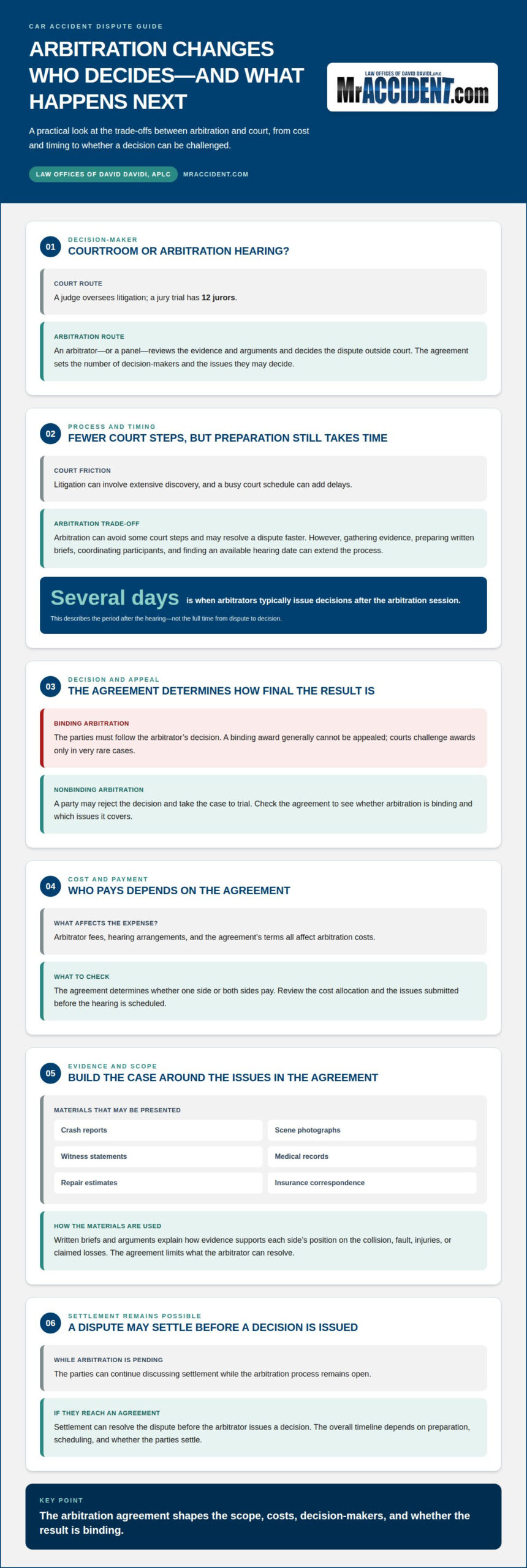
Arbitration replaces a courtroom trial with a decision made outside court by an arbitrator or panel. The agreement specifies which issues they can decide and whether their decision binds the parties.
Arbitration Costs and Payment
Arbitration costs depend on the arbitrator’s fees, hearing arrangements, and the agreement’s terms. The agreement determines whether one or both sides pay those expenses. Review how costs are allocated before the hearing is scheduled, so you understand the financial commitment involved in resolving the dispute outside court.
Costs matter, but so do arbitration’s scope and rules for the outcome. For example, an agreement may specify which issues are submitted and how proceeding expenses are divided. Reviewing those terms helps clarify what participation involves before the parties prepare evidence and arguments.
The Arbitration Process
The parties submit evidence and written briefs to one or three professional decision-makers. The arbitrator or panel reviews those materials, hears arguments, and decides what relief to award. The agreement limits which issues the decision-makers may resolve, so its wording shapes the hearing’s focus.
The parties may select decision-makers with relevant expertise. They present their positions through submitted materials and arguments rather than asking a jury to decide the dispute. Arbitration can still be formal, even though it takes place outside a courtroom. The arbitration agreement determines the number of decision-makers and the issues assigned to them.
Evidence for the Hearing
Evidence may include crash reports, scene photographs, witness statements, medical records, repair estimates, and insurance correspondence. Written briefs can explain how each item supports a party’s position on how the collision happened, the injuries, or the claimed losses.
Organize the materials around the issues covered by the agreement. Photographs and witness accounts, for example, may address the collision, while treatment records document injury-related care. Relevant, well-organized evidence gives the decision-maker a clearer basis for reviewing each side’s arguments.
A binding arbitration award generally cannot be appealed, and courts challenge awards only in very rare cases. If the decision is nonbinding, a party may reject it and take the case to trial. The agreement’s terms on binding effect matter because they determine whether arbitration ends the dispute or leaves another path open.
Arbitration compared with litigation
Arbitration and litigation both resolve disputes, but they involve different decision-makers and procedures. The agreement determines whether an arbitration decision binds the parties.
Binding and Nonbinding Arbitration
In binding arbitration, the parties must follow the arbitrator’s decision. In nonbinding arbitration, they may reject it and proceed to trial. This distinction determines whether the hearing provides a final resolution or another step before court.
A binding decision generally cannot be appealed, and courts challenge arbitration awards only in very rare cases. By contrast, a party may reject a nonbinding decision and take the case to trial. Before arbitration begins, review the agreement: it identifies which issues the arbitrator can decide and whether the result is binding.
Deciding Fault and Damages
The arbitrator reviews the evidence, written briefs, and arguments before deciding the issues covered by the agreement. In a crash dispute, those issues may include who was at fault and what relief to award.
Evidence may address how the collision happened, who was responsible, and what losses are claimed. The parties can present competing accounts of the crash and evidence supporting their positions on damages. Because the arbitrator can decide only the issues included in the agreement, its scope determines what the process can resolve.
In litigation, a judge oversees a court case, and a jury trial has 12 jurors. Court proceedings can involve extensive discovery, while a busy court schedule can add delays. Arbitration can avoid those steps, which may help resolve a dispute faster. It can also prevent an insurer from postponing benefit payments while appealing legal issues in the case.
That speed comes with a tradeoff: a binding arbitration award cannot be appealed, unlike a court judgment that may face an appeal. If you’re weighing arbitration against litigation after a collision, car accident legal representation can help you understand how the dispute process relates to your claim.
Arbitration timelines
The length of car accident arbitration depends on the case and everyone’s schedule. The hearing date is only one part of the timeline. Preparation, the issues in dispute, and the availability of the arbitrator and participants all affect how long it takes to reach the hearing.
Scheduling can extend the process when the parties or decision-maker have limited availability. The work involved matters, too: gathering and reviewing evidence, preparing written briefs, and arranging arguments take time. A dispute with extensive materials may require more preparation than one focused on fewer questions.
Arbitrators typically issue decisions within several days after the arbitration session. That period starts after the hearing, so it doesn’t represent the full time from dispute to decision. The overall timeline also includes preparation and coordination beforehand, which can make the process much longer than the hearing itself.
Settlement can affect the timeline, too. The parties may reach an agreement while arbitration is pending and resolve the dispute before the arbitrator issues a decision. If negotiations continue, the process may remain open while the parties discuss settlement. The actual timeline depends on the hearing schedule, preparation, and whether the parties settle before a decision.
How does car accident arbitration work step by step?
Car accident arbitration takes a dispute through an agreement, evidence review, arguments, and a decision. The process is private, and the case does not appear in the court file.
- Define the dispute. The arbitration agreement sets which issues the arbitrator can decide. That scope matters throughout the process. For example, if the agreement covers a specific insurance conflict, the arbitrator’s decision addresses that conflict rather than unrelated issues.
- Select the decision-maker. The parties use the agreement to determine who will hear the dispute. One arbitrator may decide the case, or a panel of three arbitrators may hear it. Parties may choose decision-makers with expertise in the relevant field.
- Submit written materials. Each side provides evidence and briefs for the decision-maker to review. The materials explain the party’s position and support it with relevant records. Organizing evidence around the issues in the agreement helps keep the presentation focused.
- Present arguments. At the arbitration session, the decision-maker reviews the submitted materials and hears arguments from both sides. Each party explains how the evidence supports its view of the dispute and what relief it seeks.
- Receive a decision or settle. The arbitrator reviews the evidence and arguments, then decides what relief to award within the agreement’s scope. In Georgia, the parties can settle at any point, including while the case is pending with the arbitrator.
These stages help explain why the agreement matters before the hearing: it defines the questions, the decision-maker, and the issues presented. The private process also differs from a court case because the arbitration does not appear in the court file. If you need help understanding how arbitration affects a crash claim, get guidance on your car accident case.
Law Offices of David Davidi, APLC
Law Offices of David Davidi, APLC represents people injured in car accidents and can help them understand how arbitration may affect a claim. If an insurance policy requires arbitration, or you’re weighing a binding decision against continued litigation, legal guidance can help clarify the agreement’s scope, the evidence involved, and the choices ahead.
Arbitration can shape how fault, damages, and settlement are addressed. The firm’s car accident legal representation helps injured people navigate the legal issues tied to their claims, with direct access to experienced attorneys rather than only support staff. That guidance can be useful when you’re unsure what an arbitration clause means for your case or how to approach the process.
Contact Law Offices of David Davidi, APLC to discuss your car accident claim.
Choose your next step with clarity
Understanding what arbitration in a car accident case involves can help you approach the next decision with clearer priorities. Before responding to an arbitration proposal or insurance dispute, focus on the decision at hand and the terms that govern it. Consider what outcome you’re seeking, what information would help you evaluate your options, and which questions you need answered.
If an accident has left you dealing with an insurance dispute, you don’t have to sort through every legal concern alone. A conversation with Law Offices of David Davidi, APLC can help you discuss your claim and understand the legal issues affecting your next step. You can ask for guidance without assuming that arbitration is automatically the right path for every dispute.
Contact Law Offices of David Davidi, APLC about your claim and take the next step with greater confidence.
Frequently Asked Questions
Can You Settle During Arbitration?
Yes, the parties can settle while arbitration is underway. They may reach an agreement before the hearing, during the session, or while the dispute is pending with the arbitrator. If both sides agree on how to resolve the claim before a decision, for example, they can settle rather than wait for the arbitrator’s ruling. Settlement remains possible throughout the process.
How Long Does Arbitration Take for a Car Accident?
The timeline depends on the case and participant schedules. A car accident arbitration hearing may be completed in as little as one day, but the overall process may take several months or longer. Preparation and scheduling add time before the session, and arbitrators typically issue decisions within several days afterward. These stages are separate, so the hearing length is not the full timeline.
What does arbitration mean in a car accident case?
Arbitration means a car accident dispute is decided outside a trial by an arbitrator or panel. The parties submit evidence and arguments, and the decision-maker determines what relief to award within the agreement’s scope. For example, the agreement may limit the arbitrator to resolving a particular insurance dispute. Mediation differs because a mediator helps the parties seek compromise rather than deciding the dispute.
Is arbitration mandatory or voluntary after a car accident?
Whether arbitration is required depends on the agreement and insurance policy. Some uninsured or underinsured motorist policies require arbitration for certain disputes. In other situations, the parties may agree to arbitrate. The policy’s dispute-resolution terms and the parties’ agreement determine whether arbitration is required or chosen voluntarily.
What is the difference between arbitration, mediation, and a car accident lawsuit?
Arbitration puts a dispute before an arbitrator, who decides the issues submitted under the agreement. Mediation involves a mediator helping both sides work toward a settlement through compromise, without deciding the outcome. A lawsuit proceeds in court, where a judge oversees the case and a jury may decide the facts at trial. The processes use different procedures and decision-makers.
How do state laws and insurance policies affect car accident arbitration?
State rules and insurance policy terms can shape whether arbitration is required and which issues it covers. For example, an uninsured or underinsured motorist policy may require arbitration for a benefits dispute. The agreement may also limit what the arbitrator can decide. Together, these terms affect how the claim proceeds and whether unresolved issues can go to court.

Law Offices of David Davidi, APLC is a California – based Personal Injury Law Firm, our Attorney’s provide the representation for your personal injury, accident, product liability, premises liability, and other
negligence resulting in injuries. We treat all clients and cases, large or small, with hands-on care.
Practice Area
© Copyright 2026 Law Offices of David Davidi, APLC. All rights reserved.
Digital Marketing By 