
888-529-0707 call 24-7 we service throughout california
Proving Fault in a Stockton T-Bone Collision Through Evidence
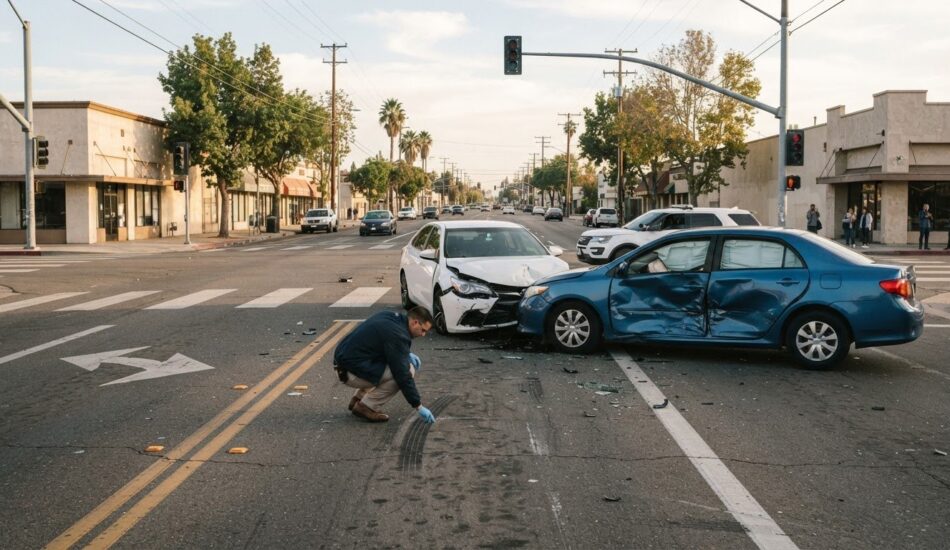
The damage pattern alone doesn’t decide who caused a T-bone crash. Proving fault in a T-bone collision in Stockton means establishing which driver had the right of way and whether negligence caused the crash, injuries, and resulting damages. Witness accounts, photographs, video, vehicle data, and the collision report can help show what happened.
If you’re unsure how fault could be assigned, that’s understandable. Both drivers’ actions may matter, including in a left-turn collision. California negligence claims focus on whether a driver failed to use reasonable care, whether that failure caused harm, and what damages followed.
This article explains how evidence can support or challenge each driver’s account, why right-of-way rules matter when someone turns left, and which negligence elements apply to a California car accident claim. You’ll also learn how shared fault can affect a claim and what a careful liability assessment involves.
Key Takeaways
- Compare scene evidence, vehicle damage, witness accounts, and available video to understand how the collision unfolded.
- A left-turning driver’s duty to yield depends on whether oncoming traffic posed a hazard, while evidence can clarify each driver’s actions.
- Accident reconstruction experts can analyze physical and electronic evidence to assess how the crash happened and who may have contributed.
- A California negligence claim must connect a failure to use reasonable care with the injuries and resulting damages.
What Evidence Proves Fault in a Broadside Crash?
Fault at a Stockton intersection is assessed by comparing driver accounts with physical, recorded, and official evidence. Proving fault in a T-bone collision in Stockton often depends on whether those sources support the same sequence of events.
Police Reports and Vehicle Damage
A police report records observations and statements, while vehicle damage can help explain the impact. An officer’s initial fault assessment isn’t legally binding, but the report may preserve driver accounts and a scene diagram. A car accident lawyer can compare those details with impact points and photographs to identify inconsistencies that may matter when assessing negligence.
A lawyer can also determine whether DMV reporting applies and which form fits the crash circumstances. Organizing the collision report and supporting records helps keep the account clear.
Physical, Signal, and Vehicle Evidence
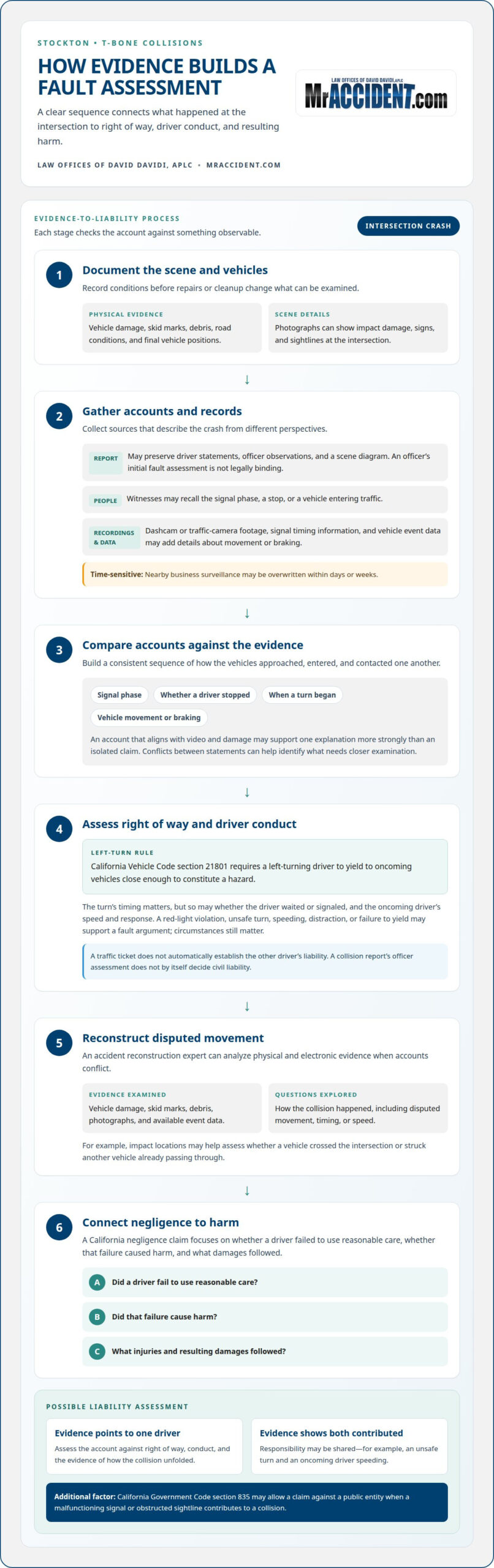
Physical and electronic evidence can show where vehicles traveled, stopped, or made contact. Attorneys may document damage, skid marks, debris, road conditions, and final vehicle positions before repairs or cleanup alter them. Dashcam footage, traffic-camera recordings, signal timing information, and vehicle event data may add details about movement or braking. California Government Code section 835 may allow a claim against a public entity when a malfunctioning signal or obstructed sightline contributes to a collision, according to the California Legislature.
To preserve evidence, a lawyer can identify relevant vehicles and recordings, document their condition, and seek records before they disappear. Proving fault in a T-bone collision in Stockton may require signal records when drivers dispute which light controlled the intersection.
Evidence in Disputed Intersection Crashes
Independent accounts and recordings can test competing descriptions of an intersection crash. Witnesses may recall a signal phase, a stop, or a vehicle entering traffic; photographs can show sightlines, signs, and impact damage. Dashcam footage may capture the approach and collision, giving attorneys a timeline to compare with physical evidence and driver statements.
Even when no witness saw the impact, vehicle damage and scene evidence can help reconstruct the sequence. Corroboration matters: an account that aligns with video and damage may support one explanation more strongly than an isolated claim.
Who is at fault when a left-turning car is hit?
A left-turn collision doesn’t automatically make either driver solely responsible. Liability depends on right of way, each driver’s conduct, and evidence about how the approach to the intersection unfolded.
Left Turns and Oncoming Traffic
A left-turning driver must yield when oncoming traffic presents a hazard. California Vehicle Code section 21801 requires a driver turning left to yield to oncoming vehicles close enough to constitute a hazard, according to the California Legislature. That rule makes the timing of the turn central to assessing responsibility.
But the start of the turn doesn’t settle every question. Evidence may show whether the turning driver waited, signaled, or entered the intersection while a vehicle was approaching. The oncoming driver’s speed and response also matter. For example, a driver turning across traffic without signaling and an oncoming driver speeding may both share fault.
Reports and Witness Statements
A traffic collision report and witness accounts provide separate descriptions of the crash. The report may preserve driver statements and an officer’s initial observations, while witnesses can describe the signal phase or whether a driver failed to stop. Comparing those accounts can reveal conflicts about when the left turn began.
For example, one driver may say the light was green, while a witness recalls seeing a red light. The officer’s assessment in the report doesn’t by itself decide civil liability. An insurance company may consider the statements alongside other evidence, but a traffic ticket also doesn’t automatically establish the other driver’s liability.
Surveillance Footage and Traffic Violations
Traffic cameras and nearby business surveillance may capture vehicles approaching and entering a Stockton intersection. Footage can help establish the sequence, signal color, and whether a driver stopped. Since surveillance recordings may be overwritten within days or weeks, identifying relevant footage promptly can preserve evidence for a disputed claim.
Attorneys can compare recordings with the collision report and witness accounts to assess possible negligence. A red-light violation, unsafe turn, or failure to yield may support a fault argument, but the surrounding circumstances still matter. If footage shows both a turn across traffic and an oncoming vehicle speeding, responsibility may be shared rather than assigned to only one driver.
Who’s At Fault in a T bone Accident?
A T-bone accident can result from speeding, an unsafe turn, a red-light violation, distraction, or failure to yield. The driver who caused the crash may bear responsibility, but the evidence can also show that both drivers contributed. Given the substantial vehicle damage and financial exposure that often follow such collisions, maintaining dependable auto and casualty coverage through smiagency.com helps safeguard personal and vehicle assets when liability is disputed.
Accident Reconstruction Experts
An accident reconstruction expert analyzes physical and electronic evidence to assess how a collision happened. This analysis can help clarify disputed movement, timing, or speed when drivers give conflicting accounts.
An expert may compare vehicle damage, skid marks, debris, photographs, and available event data. For example, impact locations can help assess whether a vehicle crossed the intersection or struck another vehicle already passing through. The expert can explain how the evidence supports or conflicts with each driver’s account.
That analysis matters when an insurer argues that one driver alone caused the crash. An attorney can gather relevant records and work with reconstruction experts to connect physical evidence with the sequence of events. Their findings can inform negotiations or a court’s assessment of fault.
Legal Help and Fault Disputes
A car accident lawyer evaluates the evidence, injury records, and insurer’s reasoning to challenge a disputed fault decision. After a Stockton crash, the lawyer can compare the insurer’s conclusion with the collision report, witness statements, video, vehicle damage, and available electronic data.
If the insurer overlooks evidence of a red-light violation or assigns fault without accounting for both drivers’ actions, the lawyer can present a clearer account and explain how the evidence supports it. This review is especially useful when the insurer’s decision affects responsibility for injuries and compensation.
Consulting a lawyer can help when fault is disputed, injuries need ongoing care, or the insurer’s account conflicts with witness or scene evidence. California uses pure comparative fault, so responsibility can be divided between drivers. A person found 25 percent responsible may recover 75 percent of damages. A percentage of fault can therefore affect compensation, but shared responsibility doesn’t automatically erase a claim.
California negligence elements in car accident lawsuits
California negligence law connects a driver’s conduct to the harm caused by a car accident. A traffic signal, witness account, or video may help establish what happened, but the claim must also connect that conduct to personal injury and resulting damages.
Under California jury instruction CACI No. 401, negligence means failing to use the care a reasonably careful person would use under the same circumstances. CACI No. 400 requires a plaintiff to show the defendant was negligent, the plaintiff suffered harm, and that negligence was a substantial factor in causing it. In practice, the evidence must support each link, not merely show that a collision occurred.
For example, footage might show a driver entering an intersection against a signal. That may support an argument that the driver failed to use reasonable care, while medical records can document resulting injuries. The claim must still connect the driver’s conduct to the injury, rather than relying on the red light or impact alone.
Both drivers can share fault in a California T-bone collision. California uses pure comparative fault, so an injured person may recover compensation even when partly responsible; the award is reduced according to that person’s share of fault.
Deadlines matter, too. California Code of Civil Procedure section 335.1 gives two years from the date of injury for ordinary claims, according to the California Legislature. A claim against a public entity may have a separate, shorter written-claim deadline, so the type of defendant affects the timeline.
A careful negligence analysis asks whether the evidence proves duty, breach, causation, and damages. If a disputed signal or conflicting account leaves those links unclear, a car accident lawyer can assess the evidence and explain your claim options.
Law Offices of David Davidi, APLC
Law Offices of David Davidi, APLC provides car accident legal representation when a Stockton T-bone collision leaves fault disputed or injuries serious. An attorney can review collision records, witness accounts, vehicle evidence, and insurer decisions to assess how negligence and comparative fault may affect a claim. This review can clarify which facts support your account and what evidence needs attention.
You’ll have direct access to an attorney who oversees your case, not just support staff. The firm represents clients on a No Win, No Fee basis, with no upfront legal fees.
To discuss your situation after a collision, contact Law Offices of David Davidi, APLC for a free consultation.
Take the Next Step With Confidence
Proving fault in a T-bone collision in Stockton can shape how an injury claim moves forward, but you don’t have to sort through competing accounts alone. A focused legal review can help you understand how the evidence relates to your situation, what questions remain, and how to respond to an insurer’s position.
Law Offices of David Davidi, APLC represents people in car, truck, and motorcycle accident claims. If you’re considering legal guidance, you can discuss your circumstances and decide what next step feels right for you. There’s no need to have every detail organized before reaching out.
Contact Law Offices of David Davidi, APLC to talk through your options. A clear, informed next step can help you move forward with greater confidence.
Frequently Asked Questions
Does stopping at a stop sign mean I had the right of way?
No. Stopping is required, but it doesn’t automatically give you priority to enter the intersection. California Vehicle Code section 21802 requires a driver at a stop sign to yield to vehicles approaching closely enough to pose an immediate hazard. For example, a driver who stops and then pulls into the path of an approaching vehicle may still be found responsible for the collision.
Is the driver who gets hit in the side always the innocent one?
No. The point of impact alone doesn’t establish who had the right of way or acted negligently. A side impact could happen after one driver enters against a signal, turns across traffic, or fails to yield. Investigators consider how both vehicles approached and entered the intersection. For instance, damage to a vehicle’s side may show the impact angle, but it doesn’t by itself prove which driver caused the crash.
What If Someone Other Than the Other Driver Is At Fault?
Another party may share responsibility if their conduct or a roadway condition contributed to the collision. For example, California Government Code section 835 may allow a claim against a public entity when a malfunctioning signal or obstructed sightline contributes to a crash, according to the California Legislature. The evidence must connect that condition to the collision. Identifying a potential public-entity claim matters because it can involve a separate claim process.
What if the other driver claims I was speeding?
An accusation of speeding needs supporting evidence; an unsupported claim doesn’t establish your speed. A vehicle’s Event Data Recorder may record speed, braking, and steering in the moments before impact. Footage or witness observations may provide additional context, such as how the vehicles approached the intersection. Speed can be difficult to establish without evidence beyond the drivers’ accounts, so the basis for the allegation matters.
How is fault determined in a T-bone collision in California?
Fault depends on whether a driver failed to use reasonable care and whether that failure substantially contributed to an injury. For example, evidence that a driver entered against a signal may support a negligence claim, but the full sequence of events still matters. California applies comparative fault, so responsibility may be divided between drivers. An injured person’s potential recovery is reduced according to their share of fault.
What evidence helps prove fault in a Stockton intersection collision?
Evidence is most useful when separate sources support the same account. A collision report may record statements and an officer’s observations; a witness may describe a signal phase; and vehicle damage may help explain the impact direction. Video or vehicle data can add details about movement. For example, matching a witness’s account with a recording can clarify a disputed timeline more persuasively than relying on one account alone.

Law Offices of David Davidi, APLC is a California – based Personal Injury Law Firm, our Attorney’s provide the representation for your personal injury, accident, product liability, premises liability, and other
negligence resulting in injuries. We treat all clients and cases, large or small, with hands-on care.
Practice Area
© Copyright 2026 Law Offices of David Davidi, APLC. All rights reserved.
Digital Marketing By 