
888-529-0707 call 24-7 we service throughout california
How to Write a Personal Injury Demand Letter for Your Claim

A demand letter is only as persuasive as the evidence behind it. The strongest approach to writing a demand letter for a personal injury claim is to explain how the accident happened, describe your injuries and treatment, itemize your losses, and support each point with relevant records. State the compensation you’re seeking in a clear, professional tone.
It’s understandable to want a straightforward path from documenting your losses to resolving your claim. A well-organized demand can help the insurer assess liability, injuries, and damages, but timing depends on how complete the documentation is and whether the insurer needs more information. This guide explains how to organize evidence, calculate economic and non-economic damages, structure the letter, and prepare for what may happen after it’s sent.
Key Takeaways
- Separate past and future medical costs, lost income, and other financial losses so each damage amount is easy to follow.
- Support the claim with relevant records, bills, photos, reports, and witness statements organized as clear exhibits.
- Use a professional tone to explain liability, describe the injury’s impact, and state a compensation request grounded in documented damages.
- Set a clear response deadline, then account for the possibility that negotiations may take weeks or several months.
Calculating economic and non-economic damages
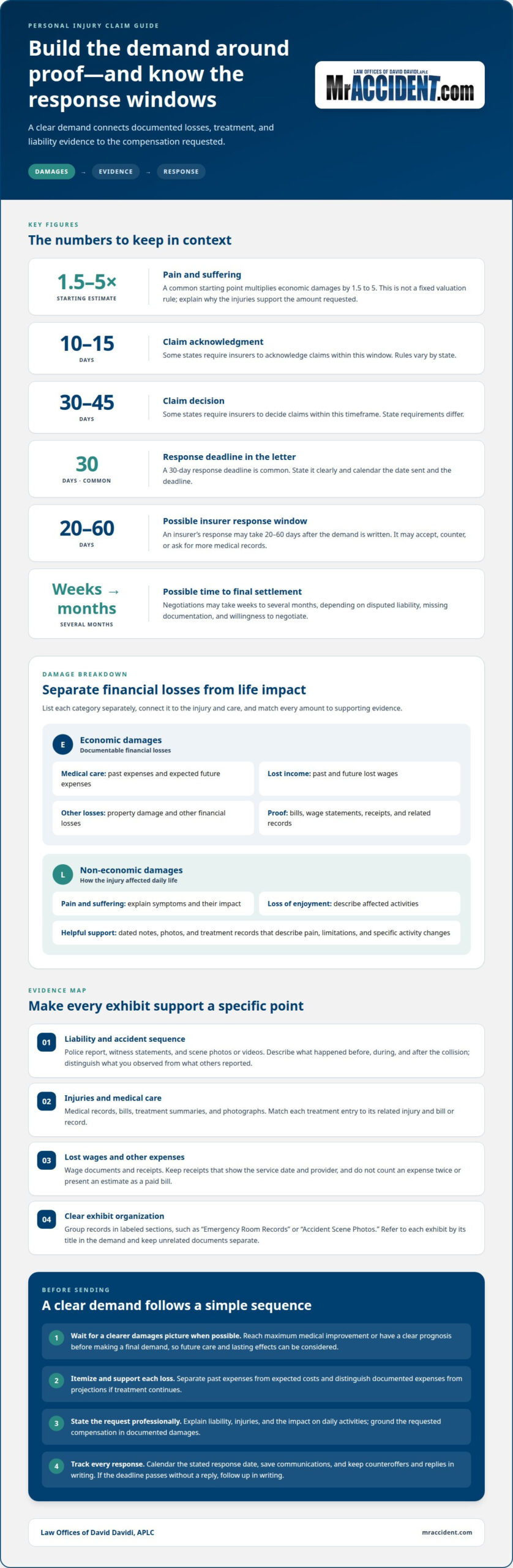
Separate documented financial losses from the effects your injuries have had on your life. It is usually best to wait until you reach maximum medical improvement or have a clear prognosis before demanding settlement, because ongoing treatment can change your future expenses.
-
Document Economic and Non-Economic Damages
Gather records for each loss and connect every amount to supporting evidence. Medical bills and wage statements can document economic damages; dated notes, photos, and treatment records can help explain pain, limitations, and lost enjoyment. Keep receipts that show the service date and provider, for example. Describe how symptoms affect specific activities instead of relying on general statements. Avoid counting an expense twice or presenting an estimate as a paid bill.
-
Itemize Damages and Medical Care
List each category separately and match it to the injury and care it reflects. Include past and expected medical expenses, past and future lost wages, property damage, pain and suffering, and loss of enjoyment when applicable. Use that structure for your own accounting, and explain each treatment entry with its corresponding bill or record.
-
Assess Damages Before Treatment Is Complete
Wait for maximum medical improvement or a clear prognosis before calculating a final demand when possible. That timing helps account for future care and lasting effects, rather than limiting the claim to bills already received. If treatment continues, identify outstanding care and distinguish documented expenses from projections. A common starting point for estimating pain and suffering multiplies economic damages by 1.5 to 5, but it is not a fixed valuation rule. Explain why the injuries support the amount requested.
How Long Does It For A Case To Actually Settle After A Demand Letter Is Sent?
Response rules vary by state: some require insurers to acknowledge claims within 10 to 15 days and decide them within 30 to 45 days. Send your demand after reaching maximum medical improvement or receiving a clear prognosis; settlement timing depends on records, liability disputes, and insurer review.
-
Track Insurer Responses and Timelines
Set a clear response deadline in the letter and calendar it alongside the date sent. A 30-day response deadline is common, while an insurer’s response may take 20-60 days after the demand is written. The insurer may accept, counter, or request more medical records. If the deadline passes without a reply, follow up in writing and save each communication with your claim documents.
-
Proceed With Settlement Negotiations
Before discussing settlement, compare each response to the evidence. If the insurer disputes negligence or questions your ability to recover, address its specific position with relevant records and a concise explanation. A policy-limit demand should identify the limits, request an amount supported by documented damages, and set a clear deadline. A written offer states proposed terms. Accepting it may resolve the claim on those terms, so understand its scope before agreeing.
- If negotiations continue, keep each counteroffer and response in writing. A final settlement may take weeks to several months, depending on disputed liability, missing documentation, and the parties’ willingness to negotiate. Close each letter professionally by restating the requested response date, identifying enclosed documents, and inviting a written reply. If the insurer does not respond or maintains an unreasonably low offer, mediation or a lawsuit may be considered. Filing suit does not necessarily mean the case will go to trial.
Gathering evidence and organizing case details
Build a clear record of the accident, the facts supporting liability, and the resulting losses. Organize each exhibit so the insurance company can connect the evidence to your claim.
-
Gather Factual Evidence of Liability
Collect the police report, witness statements, and photos or videos of the accident scene. Use a timeline to describe what happened before, during, and after the collision, including vehicle positions and visible damage. Separate what you observed from what another witness reported. For a truck accident, note each impact. One sample account, for instance, describes a truck rear-ending a vehicle, followed by two additional impacts. Concrete details can help explain how the crash occurred.
-
Organize Supporting Records and Exhibits
Arrange medical records, bills, treatment summaries, photographs, and wage documents in labeled sections. Give each exhibit a short title, such as “Emergency Room Records” or “Accident Scene Photos,” and refer to it by that title in the demand. Match each medical entry to the related treatment and injury. Keep copies together, avoid mixing unrelated documents, and do not present an estimate as a final bill.
- Connect each piece of evidence to a specific point in the claim. Use the police report and witness accounts to support liability, and medical records to describe injuries and care. Photos can show vehicle damage or visible injuries, while wage records can document lost wages. In the damages section, explain how your injuries affected daily activities and caused pain and suffering. A clear sequence helps the reader follow the claim without sorting through disconnected details.
For a truck collision, organize available photographs, statements, and reports around the sequence of events. Describe where the truck struck the vehicle and what happened next, without presenting assumptions as observed facts. Place records supporting medical care and lost wages in separate exhibit sections. This structure helps the insurance company review liability evidence alongside the damages it may support.
What a personal injury demand letter is
A personal injury demand letter is a formal request for compensation that explains how an incident caused injuries and losses. It is generally sent before a lawsuit as part of a demand package, giving the parties a basis for negotiations.
- Use the letter to move from a general account to a documented position. Explain who you believe caused the incident, how it happened, and what compensation you seek. The letter is often the first substantive document in a claim file when negotiations have not resolved the dispute. Its purpose is to present a clear case, not merely name a dollar amount.
- Identify the responsible party and tailor the claim to the circumstances. For an individual, state the person’s role in the incident; for a business, describe the conduct or condition at issue and identify the business. Claims involving government entities may follow a different notice process or go to a different recipient. Identify the applicable process before sending the letter instead of assuming the same approach fits every defendant.
- Structure the letter around four goals: establish liability, explain the effects of the injuries, anticipate and address defenses, and present damages strategically. Writing a demand letter for a personal injury claim means connecting the incident to the evidence and explaining the harm in a way the insurer can evaluate. For example, link the circumstances of a vehicle collision to the facts supporting fault, then describe how the injuries affected daily life.
- You can prepare a letter yourself, especially when the facts and losses are straightforward. Legal help may be useful if liability is disputed, injuries are complex, several parties may be responsible, or a government entity is involved. A lawyer can assess how the evidence supports the demand and how written offers may affect negotiations. Before sending or accepting settlement terms, understand which claims the proposed resolution covers.
Law Offices of David Davidi, APLC
Law Offices of David Davidi, APLC can assess your evidence, damages, and demand strategy after an accident. If liability is disputed, treatment is ongoing, or the insurer challenges your losses, legal guidance can help you present the claim and respond during negotiations.
The firm represents people in car, truck, motorcycle, and pedestrian accident claims. An attorney oversees each case from start to finish, giving you direct attorney involvement rather than communication only with support staff. The firm works on a No Win, No Fee basis, with no upfront legal fees.
For help with your injury claim, contact Law Offices of David Davidi, APLC.
Move Forward With a Clear Claim Strategy
Writing a demand letter for a personal injury claim is more than requesting payment; it establishes the position you’ll take into negotiations. Before deciding how to proceed, consider whether the proposed resolution accounts for your recovery needs and what accepting it would mean for your claim. Careful review can help you avoid a rushed decision while important issues remain unresolved.
If liability, evidence, or settlement terms are difficult to assess, legal guidance can help clarify your options. Law Offices of David Davidi, APLC provides car accident, truck accident, and motorcycle accident legal representation. Support can be especially useful when the insurer disputes responsibility or the written offer doesn’t reflect the claim you intended to present.
Contact Law Offices of David Davidi, APLC to discuss your injury claim and possible next steps. You can move forward with greater clarity, one considered decision at a time.
Frequently Asked Questions
How Do You Write a Personal Injury Demand Letter?
Write a clear, evidence-based proposal, not an emotional account. Identify the claim and recipient, present the facts in chronological order, and explain how the other party’s conduct caused harm. Use brief paragraphs, label supporting documents, and make the requested resolution easy to find. Before sending, check that names, dates, attachments, and the stated amount are consistent throughout.
What Happens After Sending the Demand Letter?
The insurer may accept the proposal, make a counteroffer, or request more information. Review any response against your claim documents, and answer requests with relevant materials rather than resending an unorganized file. If an offer includes a release, read its terms carefully before signing because the release defines which claims are resolved. Keep copies of correspondence and note each offer’s expiration date.
Can I Request The Full Policy Limit In The Demand Letter?
Yes, a demand may request the full policy limit, but the amount should be realistic in light of documented damages. Identify the policy limit and set a clear response deadline. A request alone does not establish that the claim is worth that amount. Explain how the evidence supports your demand, and consider whether the injuries, losses, and available records justify seeking the full limit.
How Can I Get My Hands on a Sample Demand Letter?
Use a sample as a formatting guide, not as a ready-made claim. A useful example shows how to identify the parties, describe the incident, connect evidence to losses, and state a proposed resolution. Replace every fictional name, date, and figure with accurate case information. Do not copy another claimant’s legal arguments or damages calculations, which may not fit your facts.
Should a Demand Letter Include a Specific Dollar Amount?
Usually, state a specific settlement amount so the insurer knows what resolution you propose. Base it on supported losses and explain how you calculated it, rather than choosing an arbitrary figure. Keep calculations consistent with attached records, and distinguish established expenses from estimates of future losses. If the claim is still developing, account for that uncertainty before presenting a final demand.
What Is a Demand Letter for an Insurance Claim?
A demand letter is a written proposal asking an insurer to resolve an injury claim for stated compensation. It does more than report that an incident occurred: it explains the basis for the claim and presents the requested resolution for consideration. For example, after a vehicle collision, the letter can explain why the insured is responsible and why the claimant seeks compensation for the resulting harm.

Law Offices of David Davidi, APLC is a California – based Personal Injury Law Firm, our Attorney’s provide the representation for your personal injury, accident, product liability, premises liability, and other
negligence resulting in injuries. We treat all clients and cases, large or small, with hands-on care.
Practice Area
© Copyright 2026 Law Offices of David Davidi, APLC. All rights reserved.
Digital Marketing By 