
888-529-0707 call 24-7 we service throughout california
Expert Witness Services in Riverside Personal Injury Cases
A serious injury claim can turn on more than what happened at the scene. An expert witness in a Riverside personal injury case is a professional with specialized knowledge who explains technical issues relevant to a claim. Their analysis may clarify how an accident caused an injury, the extent of the harm, and its effects on future work and care.
When injuries are painful or life-changing, it can be difficult to show how they affect daily life and long-term plans. Expert testimony can make those issues easier to understand by explaining complex evidence in clear terms. An expert’s role depends on the questions the case needs to address, such as how a collision occurred or how an injury may affect someone’s ability to work.
This article explains how medical, vocational, economic, and accident-reconstruction experts may assess causation, damages, future earning capacity, pre-existing injuries, and standards of care in Riverside cases. You’ll also learn how expert analysis can support a claim, what shapes the work involved, and how legal representation can organize the evidence around your experience.
Key Takeaways
- Vocational and economic experts can help explain how an injury affects current work and future earning capacity.
- Medical evidence can distinguish the effects of a new injury from symptoms or limitations that existed before the accident.
- Standard-of-care opinions can help clarify whether conduct fell below the level expected in the circumstances.
- Experts can connect the events of an accident to the injuries and losses claimed, making complex evidence easier to understand.
Expert testimony and future loss of earning capacity
Experts explain technical evidence that may connect an injury to lost income, future care, or another claimed loss. Their opinions can give a Riverside jury a clearer basis for evaluating compensation.
Expert Roles in Injury Cases
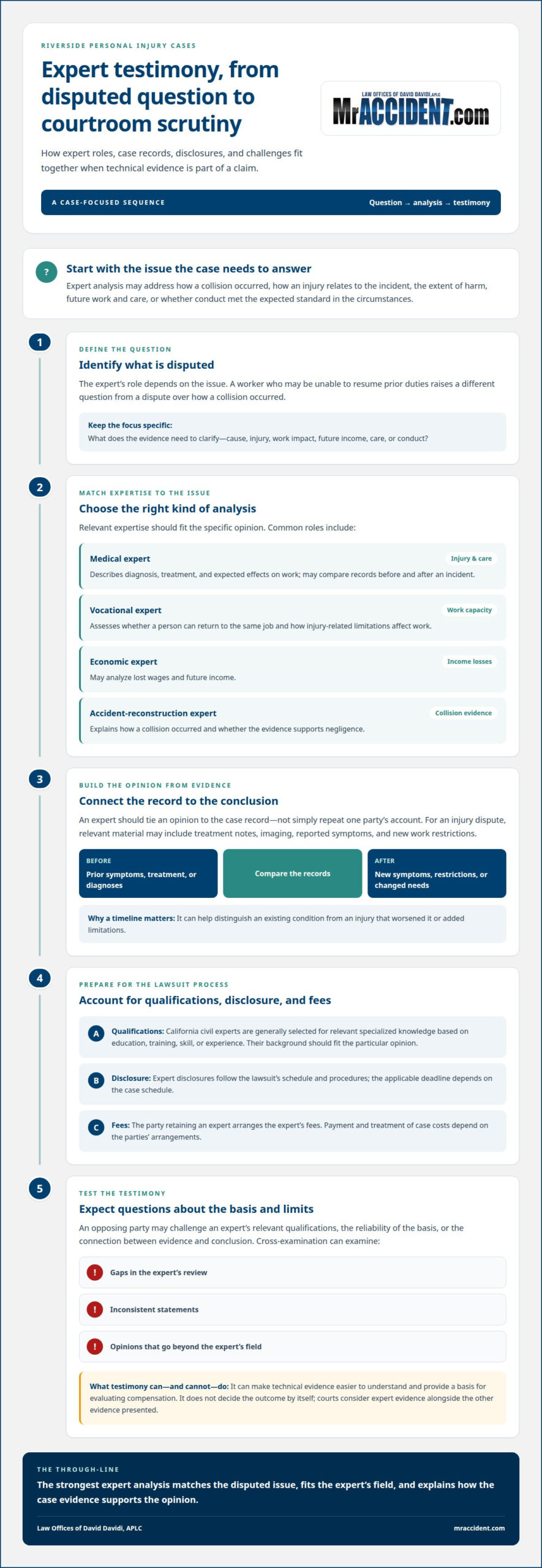
In serious injury cases, medical experts can describe a diagnosis, treatment, and expected effects on work. Vocational experts assess whether a person can return to the same job, while economists may analyze lost wages and future income. Accident-reconstruction experts can explain how a collision occurred and whether the evidence supports negligence. Each expert should tie an opinion to the record, rather than simply repeat a party’s account.
At trial, testimony can make technical evidence easier to understand, but it does not determine the outcome by itself. Riverside County courts consider expert evidence alongside the other evidence presented. Whether an expert testifies remotely or in court depends on the arrangements and requirements for the proceeding.
Expert Qualifications and Disclosure
California civil experts are generally selected for specialized knowledge relevant to the issue, based on education, training, skill, or experience. The key question is whether an expert’s background fits the specific opinion, such as one about future earning capacity or injury-related limitations. Expert disclosures must follow the schedule and procedures for the lawsuit; the applicable deadline depends on the case schedule.
The party retaining an expert arranges the expert’s fees. Payment and treatment of case costs depend on the parties’ arrangements.
Challenges to Expert Witnesses
An opposing party may challenge an expert’s relevant qualifications, the reliability of their basis, or how they connected evidence to a conclusion. Cross-examination can test gaps in the review, inconsistent statements, or opinions that go beyond the expert’s field. These challenges can affect how much weight a judge or jury gives the testimony.
According to the California Department of Motor Vehicles, an accident involving injury, death, or property damage over $1,000 must be reported to the DMV within 10 days. California also requires accident reporting when property damage exceeds $1,000, according to the California Department of Motor Vehicles.
Expert Selection and Fees
Common experts include physicians, vocational specialists, economists, and accident-reconstruction professionals. The choice should match the disputed issue: a worker unable to resume prior duties may need vocational analysis, while a collision dispute may call for reconstruction. Relevant experience, clear explanations, and readiness to defend the opinion under questioning are practical considerations.
Experts may testify about future earning capacity, but their analysis is only one part of a claim’s evidence. A law firm can identify issues that may need expert support, coordinate the evidence, and account for expert expenses as the case proceeds.
Countering defense arguments about pre-existing injuries
The defense may argue that earlier symptoms, treatment, or diagnoses explain an injury. A medical expert can compare records from before and after the incident to assess what changed. Earlier back pain, for example, does not by itself show that a later collision caused no new harm. An expert can examine treatment notes, imaging, reported symptoms, and new work restrictions. A clear timeline helps distinguish an existing condition from an injury that worsened it or added limitations. That distinction can affect how the plaintiff documents recovery, medical needs, and lost wages.
Local context matters in western Riverside County, where medical care, employment, and collision records may involve different communities. Riverside County sees more than 1,700 people injured or killed in crashes every year. The California Superior Court is the trial court of general jurisdiction for Riverside. Attorneys organizing evidence can connect the crash location, treatment timeline, and work impact without treating every prior condition as proof against liability. A consultation can help identify which records and expert opinions address the actual dispute.
Commuting patterns can also matter when an injury affects work across county lines. The largest county-to-county worker flow into Riverside County during the 2016-2020 American Community Survey came from San Bernardino County, with 78,508 workers. The largest flow out of Riverside County went to San Bernardino County, with 113,716 workers. If a person’s commute or job location changed after a serious injury, employment records and expert analysis can help explain the practical impact. The location of a workplace alone, however, doesn’t establish the cause or extent of lost wages.
For an expert witness in a Riverside personal injury case, the key is a grounded comparison, not an assumption based on the medical history alone. Attorneys can organize the evidence around the condition before the incident, the new symptoms, and the resulting limits. If a defective product is involved, product liability legal representation can help address the injury claim and its supporting evidence.
Standard-of-care opinions
A standard-of-care opinion examines whether conduct met the level of care expected in a particular situation. In personal injury litigation, an expert may explain technical practices that jurors cannot assess from photographs or testimony alone. The opinion can connect specific actions to alleged negligence, but jurors decide how much weight to give it. Lawyers use this testimony to clarify disputed conduct, not to replace the jury’s judgment.
After a traffic collision, for example, a qualified expert might analyze vehicle positions, sightlines, and roadway conditions. In a premises case, an expert might examine how a hazard was maintained or whether a warning was visible. The relevant comparison depends on the incident and the expert’s field. A useful opinion identifies the evidence reviewed, explains the applicable practice, and shows how the conduct at issue differs.
Clients should understand what an expert opinion can and cannot establish. An expert can explain technical facts and their relationship to an injury, but testimony alone does not prove every element of a claim. A personal injury case still depends on evidence connecting the conduct, the harm, and the claimed losses. If the expert’s reasoning skips a key step, opposing lawyers may challenge the analysis during litigation.
Before testimony, lawyers can organize an opinion into a clear sequence: identify the disputed act, explain the relevant standard, compare the evidence with that standard, and describe the possible consequence. For example, with a blocked sightline at an intersection, the expert would explain how the obstruction affected visibility and whether the available evidence supports that conclusion. This structure helps jurors follow the reasoning without overstating what it proves.
Trauma can make it difficult for clients to recount an incident in technical terms. Expert testimony can translate engineering, safety, or other specialized evidence into plain language. The strongest explanation stays focused on the record and acknowledges evidence that points the other way. This measured approach gives lawyers a clearer basis to argue negligence and helps jurors distinguish supported conclusions from assumptions.
Causation and damages analysis
In California, a personal injury claim generally requires evidence of duty, breach, causation, and actual damages. Experts can help explain how an accident connects to an injury and resulting losses. For example, an accident-reconstruction expert may analyze vehicle positions, impact points, and roadway evidence to assess how a car accident occurred. A medical expert can then explain whether the collision caused a diagnosed condition or worsened an existing one. Each opinion should address a specific question in the claim.
Damages analysis connects medical evidence to the practical effects of an injury. A healthcare provider may describe treatment, lasting limitations, and the need for future care. An economist can assess lost wages and future income using employment and earnings evidence. These opinions help explain why a claimed loss follows from the injury, rather than simply listing expenses. The plaintiff’s records, treatment history, and work information give experts a factual basis for their conclusions.
A useful review follows a clear sequence: identify the event, evaluate the injury evidence, and connect supported losses to the event. If a vehicle collision caused a fracture, for instance, medical records may document diagnosis and treatment, while a provider explains lasting effects. An expert can clarify the connection but cannot replace missing evidence or decide liability. The opposing side may test the assumptions and reasoning, so precise, well-supported conclusions matter.
Expert analysis can also help lawyers assess the strengths and disputed issues in claims, including during settlement discussions. Most personal injury cases handled by law firms resolve through settlements, while trial testimony may be needed when key facts remain contested. The expert’s role is to explain the evidence, not promise a particular result. Clear analysis can help decision-makers understand how negligence, injury, and damages relate. To discuss how evidence may support your car accident claim, contact the firm.
Law Offices of David Davidi, APLC
Law Offices of David Davidi, APLC represents people injured in accidents and helps them understand how evidence, liability, and damages relate to their claims. If an expert opinion may clarify how an accident caused an injury or affected your future, an attorney can assess how that evidence fits into the broader case.
The firm represents people injured in car, truck, motorcycle, and pedestrian accidents. Its legal representation can help organize a claim and address questions about responsibility and injury-related losses. Expert testimony is one form of evidence, not a substitute for the full record. The right next step depends on the circumstances of your injury and the issues in dispute.
If you need help understanding your personal injury claim, contact Law Offices of David Davidi, APLC to discuss your situation.
Take the Next Step With a Clear Case Strategy
Before deciding what evidence your claim needs, consider which questions remain unanswered and how they affect your next steps. An expert witness in a personal injury case in Riverside may address a disputed issue, but the opinion should fit the facts and your legal strategy. A focused review can help you understand where expert analysis may be relevant and how it relates to your claim.
Law Offices of David Davidi, APLC represents people injured in car, truck, and motorcycle accidents. If your injury followed one of these accidents, legal guidance can help you assess your options and decide how to move forward. The firm can review your case and explain how its representation may support your needs.
Contact Law Offices of David Davidi, APLC to discuss your situation and take a practical next step toward moving forward.
Frequently Asked Questions
What is an Expert Witness?
An expert witness is a person with specialized knowledge or experience who provides an opinion to help explain an issue in a legal case. For example, a medical professional may interpret clinical findings, while an accident reconstruction specialist may explain technical evidence. The expert’s role is to make complex subjects understandable; the judge or jury evaluates the opinion alongside other evidence.
What does an expert witness do in a personal injury case in Riverside, California?
An expert witness in a Riverside personal injury case helps clarify technical questions that could affect how a claim is evaluated. The expert may review relevant materials, explain the basis for an opinion, and answer questions in testimony. For instance, an expert could explain whether a medical finding is consistent with the account of an incident. The opinion informs the case but does not decide it.

Law Offices of David Davidi, APLC is a California – based Personal Injury Law Firm, our Attorney’s provide the representation for your personal injury, accident, product liability, premises liability, and other
negligence resulting in injuries. We treat all clients and cases, large or small, with hands-on care.
Practice Area
© Copyright 2026 Law Offices of David Davidi, APLC. All rights reserved.
Digital Marketing By 