
888-529-0707 call 24-7 we service throughout california
Contingency Fee Agreements: How Fees Are Calculated and Paid

The attorney’s fee depends on a successful recovery, not an hourly bill. If you’re asking what a contingency fee agreement is, it’s a written arrangement that sets how the lawyer will be paid from money recovered for you. If there’s no recovery, you generally don’t owe an attorney fee, though the agreement may address case expenses separately.
It’s reasonable to want clear terms before moving forward, especially when an injury has already brought stress and unexpected demands. The fee calculation and any case expenses can affect the amount you receive. The written agreement should explain these terms before you sign, rather than leaving you with surprises later.
This article explains how contingency fees are calculated, how case expenses may affect a settlement or award, and what the No Win, No Fee arrangement means if a case does not succeed. You’ll also learn which terms to understand before signing, so you can make a more informed decision about legal representation.
Key Takeaways
- A contingency fee is tied to a successful recovery, but the agreement determines how the percentage is applied.
- The fee may change as a case moves through negotiation, filing, or trial, so timing can affect the final calculation.
- Case expenses can affect the amount you receive; understand how they’re handled alongside the attorney’s fee.
- Before signing, focus on the written terms for payment, expenses, and your role in deciding whether to accept a settlement.
How contingency fees are calculated
A contingency fee is a percentage of the compensation recovered for a client. The contract determines how that percentage is calculated and whether case expenses affect the final amount.
Fee Calculation and Payment Structure
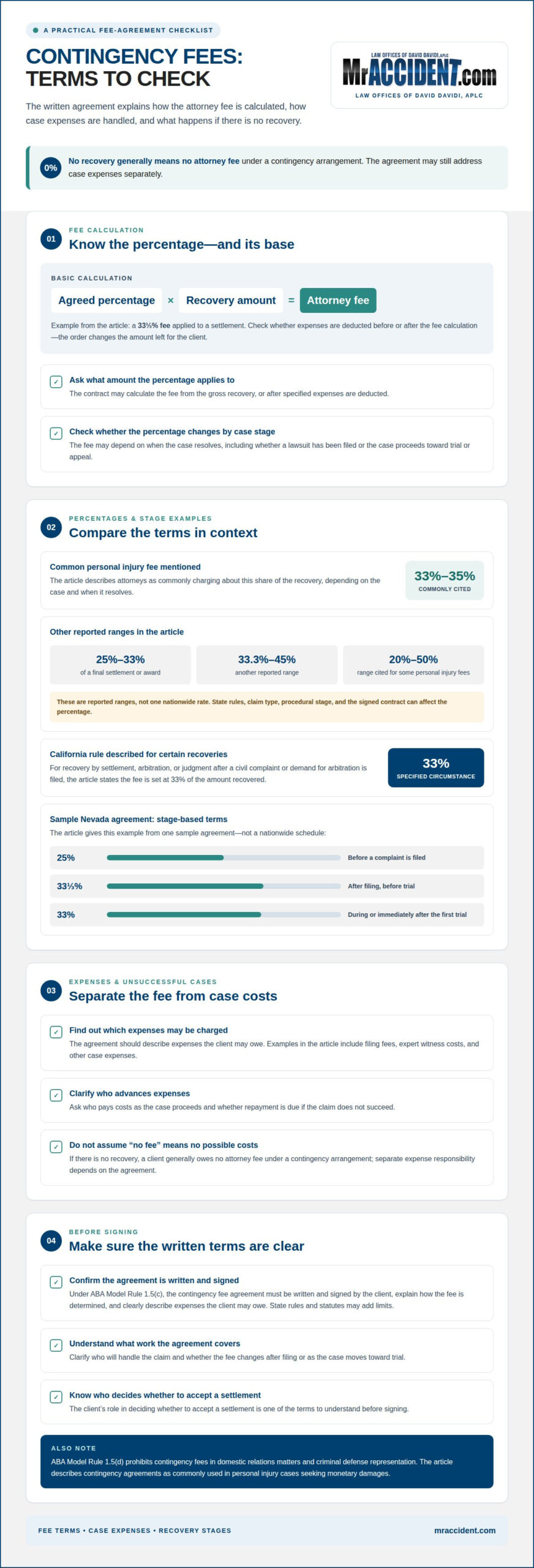
The lawyer’s fee is calculated by multiplying the agreed percentage by the recovery amount. For example, a 33⅓% fee applied to a settlement means that percentage goes toward the attorney fee; the agreement explains whether costs are deducted before or after that calculation. This order matters because it changes the amount left for the client. A fee may also depend on when a case resolves, such as before or after a lawsuit is filed.
Unlike hourly billing, where a client pays for the lawyer’s time, a contingency fee depends on a successful recovery. A flat fee is a set amount for defined legal work, while a contingency fee is linked to the outcome. For someone seeking personal injury representation, this arrangement avoids paying attorney fees upfront.
State rules shape written fee contracts. Under ABA Model Rule 1.5(c), a contingency fee agreement must be written and signed by the client, explain how the fee is determined, and clearly describe expenses the client may owe. State rules and statutes can add limits. Model Rule 1.5(d) prohibits contingency fees in domestic relations matters and criminal defense representation.
Contingency agreements are commonly used for personal injury cases seeking monetary damages, including claims arising from accidents. They are generally not used for criminal defense or domestic relations matters under Model Rule 1.5(d). The type of claim and the damages sought help determine whether this payment structure fits. For individuals dealing with service-connected conditions or seeking military benefits rather than standard civil litigation, working with specialized advocates such as Military Veteran Solutions, LLC can provide essential guidance on securing the support they are entitled to.
Fees When a Case Is Unsuccessful
If a case ends without a recovery, the client generally owes no attorney fee under a contingency arrangement. That does not automatically eliminate every possible charge: the contract may make the client responsible for filing fees, expert witness costs, or other case expenses. Before signing, identify who advances those expenses and whether repayment is due if the claim fails. This distinction helps prevent an unexpected bill after an unsuccessful case.
The incentive for attorneys to pursue successful outcomes
A contingency fee gives an attorney a financial interest in recovering compensation. The structure can make representation accessible, while the agreement and state rules shape the fee.
Typical Fee Percentages
In personal injury cases, attorneys commonly charge about 33% to 35% of the recovery, depending on the case and when it resolves. That range helps clients understand how the fee may affect a settlement, but it isn’t a fixed rate for every claim. California rules also set a specific rate for certain recoveries after a case is formally filed.
Negotiating the Fee Percentage
The percentage is a contract term to discuss before signing, subject to state limits and rules requiring reasonable fees. Ask how the percentage changes if the attorney files a lawsuit or the case proceeds toward trial. Also clarify whether the fee applies to the gross recovery or an amount calculated after expenses. These details affect the client’s share.
For recoveries pursuant to settlement, arbitration, or judgment after a civil complaint or demand for arbitration is filed, the California Legislature sets the attorney fee at 33% of the dollar amount recovered. The rule gives clients a concrete reference point for that circumstance. Other case stages or claim types may involve different terms, so the signed agreement matters. In property insurance claims, for instance, policyholders frequently encounter similar percentage-of-recovery fee arrangements when hiring licensed public adjusters such as Apex Adjusting Group to document and negotiate their settlement.
A contingency fee links the attorney’s payment to a successful recovery, but it does not guarantee a particular result. An injury case may require time for gathering evidence, reviewing medical records, negotiating, or pursuing litigation. The strength of the claim and potential damages can affect whether a lawyer takes a case, since a weak claim may involve substantial work without a recovery.
Before hiring an attorney, ask who will handle the claim, what work the agreement covers, and how case expenses are treated. Ask whether the percentage changes after filing and whether it applies before expense deductions. These questions help reveal financial terms and risks early. For accident claims, explore personal injury representation as you consider your next step.
The percentage charged for a successful case
In the United States, contingency percentages vary by case, agreement, and procedural stage. The percentage determines how much of a recovery goes toward the attorney’s fee.
Reported ranges differ: common figures include 25% to 33% of a final settlement or award, while another typical range is 33.3% to 45%. Some descriptions place personal injury contingency fees between 20% and 50%. These figures aren’t one nationwide rate. State rules, claim type, and the contract’s terms can all affect the percentage.
A useful way to compare percentages is to identify the exact recovery base. The agreement may apply the rate to the gross settlement or award, or calculate the fee after specified expenses are deducted. That distinction changes the remaining compensation. Ask which calculation applies, and whether the percentage shifts if a claim proceeds from settlement negotiations to trial or appeal.
Stage-based terms can make the rate rise as litigation advances. For example, a sample Nevada agreement uses 25% before a complaint is filed, 33⅓% after filing but before trial, and 33% during or immediately after the first trial. These are terms from that sample agreement, not a nationwide schedule. They show why the contract should spell out each triggering event.
Hourly billing charges for attorney time, regardless of the result; a contingency fee ties payment to recovery. A percentage can therefore make a substantial difference in the client’s share, especially when compensation is high. The client remains responsible for understanding any separate costs the agreement assigns to them.
Before signing, ask how the fee is calculated, how expenses are handled, and what legal work the agreement covers. The percentage alone does not explain the full arrangement. Understanding the fee and expense terms together helps you see how they affect the amount you may receive after the case is resolved.
How contingency fee agreements work
A contingency agreement sets the terms for legal representation before work begins. It should clearly explain how the attorney is paid and how case expenses are handled.
Written Agreement Terms
A U.S. contingency fee agreement must be written and signed by the client, and explain how the fee will be determined. Under Model Rule 1.5(c), it must also clearly identify expenses the client may owe. These terms matter because a percentage alone doesn’t explain the full payment arrangement. The written contract should make clear whether expenses are advanced and when reimbursement is due.
The agreement can also define the work covered, such as investigation, negotiation, filing a lawsuit, or trial preparation. It should clarify whether appeals or unrelated claims fall outside the representation. At the matter’s conclusion, the lawyer must provide a written statement showing the outcome and how the fee and expenses were calculated.
Contingency Fees in Personal Injury Cases
In a personal injury case, the lawyer handles the claim in exchange for an agreed share of compensation if the case succeeds. This arrangement can let an injured person pursue a claim without paying hourly attorney fees upfront. The agreement establishes how the fee is calculated and how case expenses affect any settlement or judgment.
The process may move from gathering medical records and investigating the injury to negotiating a settlement or filing a lawsuit. The client retains authority to decide whether to accept a settlement. That choice is important: a successful recovery still requires the client’s decision about resolving the claim, while the contract governs the fee and expense deductions.
Before signing, understand which legal work the agreement covers, how costs are handled, and what happens if the case ends without recovery. For help understanding representation for an injury claim, discuss your legal options.
Law Offices of David Davidi, APLC
Law Offices of David Davidi, APLC represents injured people in car, truck, motorcycle, and pedestrian accident cases across our local coverage areas. Its No Win, No Fee policy means clients pay no upfront attorney fees, with payment tied to a successful recovery.
The firm’s No Win, No Fee policy means you pay no upfront attorney fees. The written agreement explains how the fee is calculated and how expenses are handled. A direct conversation with an attorney can help you understand these terms in relation to your injury claim and legal options.
For help discussing an accident claim and the fee arrangement, contact Law Offices of David Davidi, APLC.
Take the next step with clear expectations
Understanding what a contingency fee agreement means can help you prepare for a focused conversation about your legal options. Bring questions about the case, the work involved, and how decisions will be communicated. A clear discussion helps you understand the arrangement before moving forward.
Law Offices of David Davidi, APLC represents people in car, truck, and motorcycle accident matters. If an accident has left you weighing what to do next, a conversation can help you discuss your circumstances and concerns without pressure. You deserve to feel informed as you consider your options.
Contact Law Offices of David Davidi, APLC to talk about your situation and take your next step with greater confidence.
Frequently Asked Questions
Contingency Fee Agreements, How Do They Work?
The lawyer’s compensation is tied to money recovered for the client, with the signed agreement setting how the fee is calculated. In a California injury claim, the matter may resolve through negotiation or proceed to a lawsuit. The agreement’s scope helps clarify which stages the lawyer handles. At resolution, ask for a written breakdown showing the recovery, attorney fee, expenses, and amount distributed to you.
What is a contingency fee agreement in the United States?
If you’re asking what a contingency fee agreement is, it’s a written contract that sets how a lawyer is paid from a recovery rather than through ordinary hourly billing. The contract should explain the fee calculation and expenses the client may owe. State rules can affect terms, so a personal injury agreement used in California may not match one used elsewhere in the United States.
What costs and expenses are charged separately from a contingency fee?
Case expenses can include court filing fees, expert witness fees, deposition expenses, court reporter charges, and medical-record retrieval or investigation costs. These are separate from the attorney’s fee, and the agreement explains how expenses are handled. Make sure you understand what happens to those expenses if the claim ends without a recovery.
What happens if a client loses a contingency fee case?
If there’s no recovery, the client generally doesn’t owe an attorney fee, but the agreement may assign responsibility for case expenses. A separate concern can arise if litigation exposes the client to an opposing party’s fees or costs under applicable rules. Review both provisions before signing, especially the language covering an unsuccessful lawsuit, rather than assuming “contingency” removes every possible financial obligation.
What questions should clients ask before signing a contingency fee agreement?
Ask what recovery amount the percentage applies to, whether the rate changes as the case advances, and which expenses may be deducted or owed separately. Clarify whether the representation covers investigation, negotiation, filing a lawsuit, trial preparation, and any appeal. Also ask who makes the final settlement decision and how you’ll receive an accounting when the matter ends. Clear answers help you understand the agreement’s practical effect.

Law Offices of David Davidi, APLC is a California – based Personal Injury Law Firm, our Attorney’s provide the representation for your personal injury, accident, product liability, premises liability, and other
negligence resulting in injuries. We treat all clients and cases, large or small, with hands-on care.
Practice Area
© Copyright 2026 Law Offices of David Davidi, APLC. All rights reserved.
Digital Marketing By 