
888-529-0707 call 24-7 we service throughout california
Suing a City for a Pothole Accident in Los Angeles: Who May Be Liable
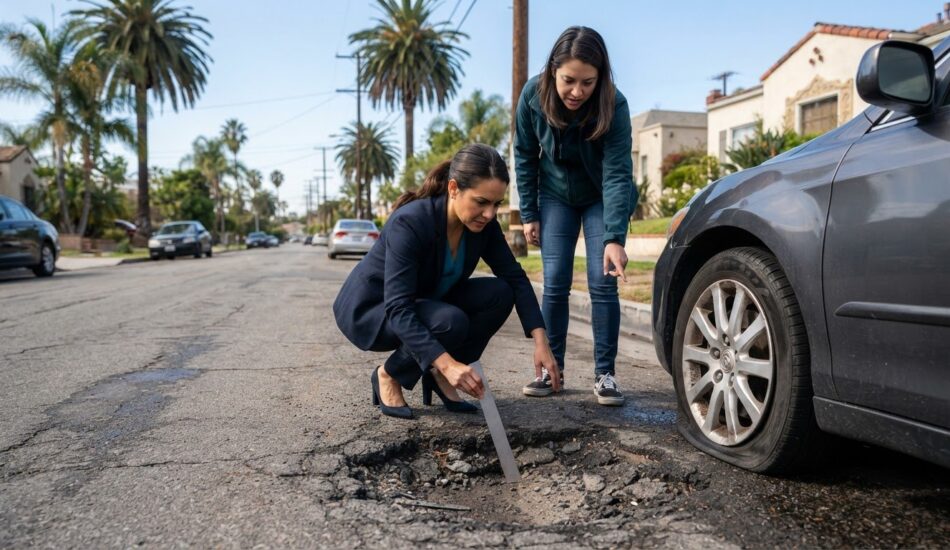
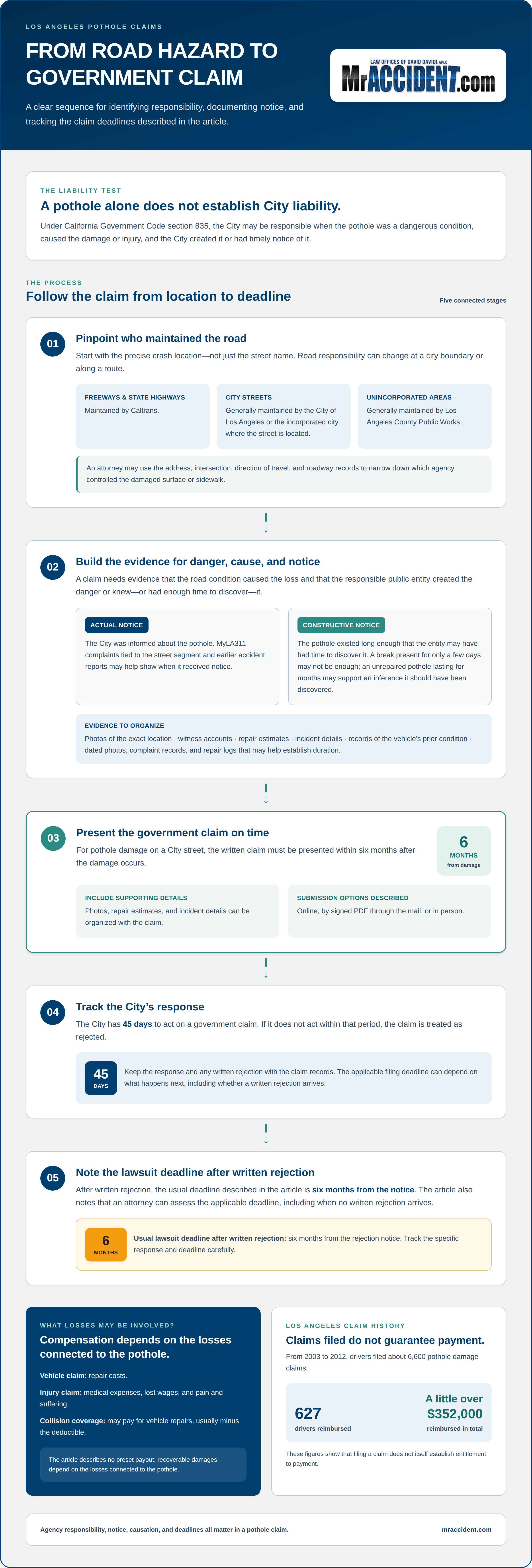
A pothole alone doesn’t make the City of Los Angeles liable. Under California Government Code section 835, the City may be responsible if the pothole was a dangerous condition, caused the damage, and the City created it or had timely notice of it. For car damage on a City street, a claim must be presented within six months after the damage occurs. That deadline matters if you’re considering suing a city for a pothole accident in Los Angeles.
It’s understandable to look to the City when a road hazard damages your vehicle or injures you. But responsibility depends on who maintained the road, how the pothole developed, and whether the responsible public entity knew about it in time to act.
This article explains when a public entity may be liable, how to identify the agency responsible for the road, and why evidence of prior notice matters. It also covers the government claim process and deadlines that can affect your next steps.
Key Takeaways
- Pinpoint who controls the road before pursuing a claim, since responsibility can depend on whether the route is a city street, state highway, or county road.
- Prior complaints and records tied to the pothole’s location may help show what the responsible agency knew and when.
- Track the claim process closely: the City has 45 days to act on a government claim, according to California Legislative Information.
- A lawyer can assess the roadway evidence and, if you were injured in a vehicle crash, help evaluate a potential accident claim.
Can I sue the City of Los Angeles for pothole damage?
A city may be liable if the pothole was a dangerous condition, caused your loss, and the City created it or had timely notice of it. You must also meet the government claim deadline and show that the roadway condition caused the damage or injury.
How a lawyer handles claim filing requirements and submits a claim to the Los Angeles City Clerk
A government claim is written notice asking a public agency to address loss caused by its action or inaction. For pothole damage on a City street, the claim must be presented within six months after the damage occurs. A lawyer can prepare the claim and organize supporting photos, repair estimates, and incident details for submission online, by signed PDF through the mail, or in person. California Legislative Information states the City has 45 days to act on a government claim; if it does not act, the claim is treated as rejected. After written rejection, California Legislative Information says the usual lawsuit deadline is six months from the notice.
If the City rejects your claim in writing, you generally have six months from the rejection date to file a lawsuit. An attorney can track the response and assess the applicable filing deadline, including if no written rejection arrives.
Potential Compensation
Recoverable damages depend on the losses connected to the pothole, not a preset payout. A vehicle claim may include repair costs; an injury claim may involve medical expenses, lost wages, and pain and suffering. Collision coverage may pay for vehicle repairs, usually minus your deductible. An attorney can review the evidence and identify which losses your claim may support.
A private contractor’s road-repair work does not automatically shield a public entity from responsibility. Depending on who controlled the road and who caused or knew about the danger, a claim may involve both the government entity and a repair contractor.
Los Angeles claim outcomes vary. From 2003 to 2012, drivers filed about 6,600 pothole damage claims; the City reimbursed 627 drivers a little over $352,000 in total. The figures show that filing a claim does not itself establish entitlement to payment.
For an injury claim, legal representation can help assess notice, causation, and damages while managing the government claim process. There is no single typical fee; terms depend on the agreement, so understand the arrangement before retaining a lawyer.
How a lawyer identifies the agency responsible for the road or sidewalk
An attorney starts by pinpointing the crash location, since road ownership can change at a city boundary or along a route. The street name alone may not identify the responsible agency. The investigation determines whether the road is a city street, state highway, freeway, or road in an unincorporated area, then identifies the public entity that maintains it.
Caltrans maintains California freeways and state highways. The City of Los Angeles generally maintains its city streets, while other incorporated cities maintain their own streets. Roads in unincorporated areas, including East Los Angeles and Altadena, are generally maintained by Los Angeles County Public Works. These distinctions matter: a pothole on a state highway may involve a different agency from one on a nearby Los Angeles street.
Within the City, StreetsLA maintains about 7,300 centerline miles of streets and alleys. The City has 23,000 lane miles of streets. Those figures describe different measurements, but they show why identifying the precise block or roadway segment matters. A lawyer can use the address, intersection, direction of travel, and available roadway records to narrow down which agency controlled the damaged surface or sidewalk.
Responsibility also depends on the condition and the agency’s connection to it. A California public entity may face liability if a dangerous road condition caused a foreseeable injury and the entity created it or had timely actual or constructive notice. For example, after a bicycle crash on a poorly maintained road, the investigation should identify who controlled that section and what they knew about the hazard.
A private contractor’s repair work does not, by itself, make the government immune from responsibility. Depending on who controlled the road and who caused or knew about the danger, a claim may involve both the public agency and the contractor. Identifying potentially responsible parties helps an attorney assess where to direct a compensation claim and what evidence supports it.
Actual or constructive notice of potholes
To establish notice, an attorney looks for evidence showing the City knew about the pothole before the crash or had enough time to discover it. Useful evidence may include photos of the specific location, witness accounts, repair estimates, incident details, and records of the vehicle’s prior condition.
How a lawyer establishes City notice
Actual notice means the City was informed about the pothole. Constructive notice asks whether it existed long enough to be discovered. This distinction matters because a dangerous condition alone doesn’t establish government knowledge. In Los Angeles, a lawyer can locate MyLA311 complaints tied to the street segment and compare dates with the crash. Those records can show when the City received notice; earlier accident reports may support that timeline.
Pothole Duration and Notice
How long the pothole existed can help show constructive notice, but the timeline must fit the facts. A surface break present for only a few days may not give a public entity enough time to repair it or warn road users. An unrepaired pothole that remains for months may support an inference that the entity should have discovered it. An attorney can compare dated photos, complaint records, and repair logs to estimate how long the condition existed before the injury.
Prior Complaints
Earlier complaints can show actual notice if they describe the same location and hazard. MyLA311 records can help establish when Los Angeles was notified, while earlier car or bicycle crashes at the same pothole may support actual or constructive notice. A lawyer compares reported locations, descriptions, and dates with the crash evidence. A report for a nearby but different road segment may carry less weight.
Repairs after a crash don’t erase a possible injury claim. If crews patch the pothole within days, photos and earlier MyLA311 reports may become especially important. A lawyer can organize witness statements, vehicle damage records, and repair estimates during the six-month claim window, then assess what evidence supports a claim or lawsuit.
When a California public entity may be liable for a pothole accident
In California, a government entity can be liable when a dangerous road condition causes injury and creates a reasonably foreseeable risk of that kind of harm. Under California Government Code § 835, responsibility also requires evidence the entity created the condition or had timely actual or constructive notice.
Each element matters. You must connect the pothole to the crash and resulting injury, not merely show that a pothole existed. For example, evidence that a wheel struck a deep road break and caused the driver to lose control may help establish causation. The condition must also be dangerous in context, taking into account how the road was used and the foreseeable risk to drivers. If you are considering suing a city for a pothole accident in Los Angeles, evidence must support these legal elements.
The public entity’s connection to the hazard is another key question. If the responsible department’s work created the pothole, the claim may focus on that work. If someone else caused it, prior reports or evidence of how long it remained unrepaired may help establish notice. Identify the agency responsible for the road before filing a claim.
Road repairs can create a separate danger. In California, hazardous work areas generally should have adequate warnings, such as nearby cones or a blocked-off street. If you encounter an unmarked excavation or road break, the investigation should consider whether warnings were present and whether the repair work contributed to the crash. These facts may also matter when suing a city for a pothole accident in Los Angeles.
Liability is not automatic just because a pothole is on a public road. A claim needs evidence supporting each required element: a dangerous condition, causation, foreseeable risk, and the entity’s creation of the condition or timely notice. An attorney can assess how photos, witness accounts, incident details, and roadway records fit those requirements before a claim is filed.
If a pothole caused an injury, discuss your pothole accident claim with a legal professional who can evaluate the applicable liability issues.
Law Offices of David Davidi, APLC
Law Offices of David Davidi, APLC can assess whether a pothole-related crash supports an injury claim and which parties may be responsible. If you were injured in a car, truck, or motorcycle accident, the firm can evaluate roadway evidence, notice issues, and government claim deadlines. An attorney oversees each case from start to finish.
The review can examine how the pothole caused the crash, what records may show the agency knew about the condition, and whether repair work by another party contributed. This evidence can clarify the potential claim and next steps, without treating every pothole as proof of liability.
If you’d like to discuss your situation, contact Law Offices of David Davidi, APLC.
Take the Next Step With a Clear Plan
Deciding whether suing a city for a pothole accident in Los Angeles is the right path involves more than identifying a road hazard. It means understanding how the crash affected you, which legal process may apply, and what you hope to achieve. A focused legal review can organize the incident details and clarify whether pursuing a claim makes sense in your circumstances.
Law Offices of David Davidi, APLC represents people in car, truck, and motorcycle accident cases. If you’re ready to discuss your situation and the available next steps, contact Law Offices of David Davidi, APLC. You deserve clear guidance as you decide how to move ahead.
Frequently Asked Questions
Can I take a pothole claim to small claims court?
Yes, an individual may sue for up to $12,500 in California small claims court. A claim against a public entity still generally requires presenting a written government claim before filing suit. Small claims court may fit a vehicle repair dispute with a straightforward amount and evidence, but it may be less suitable when injuries, disputed liability, or complex roadway records are involved.
How long does the city have to respond to my claim?
The City of Los Angeles has 45 days to act on a government claim, according to California Legislative Information. If the City takes no action during that period, the claim is treated as rejected. Keep the claim number and any written response together, since the response or deemed rejection can affect the deadline for a later lawsuit.
When should a lawyer submit a Claim for Damage?
A claim for property damage to a vehicle on a City street must generally be filed within six months of the damage. Starting promptly leaves time to identify the right agency, describe the incident accurately, and gather supporting records. Vehicle repair estimates and clear incident details, for example, can help document the loss.
Who do I file with if the pothole was on Lincoln Boulevard or a freeway?
For a freeway or state highway, Caltrans maintains the roadway, so the exact location helps identify the appropriate claim route. The name Lincoln Boulevard alone does not establish which agency controls a particular segment. An attorney can pinpoint the crash location and determine whether the stretch is maintained by the City or another agency before directing the claim.
Can you sue a town for potholes?
Yes, a town or city may be sued when the legal requirements for public-entity liability are met. Under California Government Code section 835, the claim must connect a dangerous condition to the injury and show the entity created the condition or had timely notice. The town’s control of the road and evidence about the hazard are central to assessing liability.
Does my own fault stop my claim?
No. California follows pure comparative negligence, so your share of fault reduces your damages rather than automatically barring recovery. Evidence that you were partly responsible may affect the amount recoverable, while evidence about the pothole and the public entity’s notice remains relevant. The fault assessment depends on how each party’s conduct contributed to the crash.

Law Offices of David Davidi, APLC is a California – based Personal Injury Law Firm, our Attorney’s provide the representation for your personal injury, accident, product liability, premises liability, and other
negligence resulting in injuries. We treat all clients and cases, large or small, with hands-on care.
Practice Area
© Copyright 2026 Law Offices of David Davidi, APLC. All rights reserved.
Digital Marketing By 