
888-529-0707 call 24-7 we service throughout california
Punitive Damages in California Personal Injury Claims and Caps

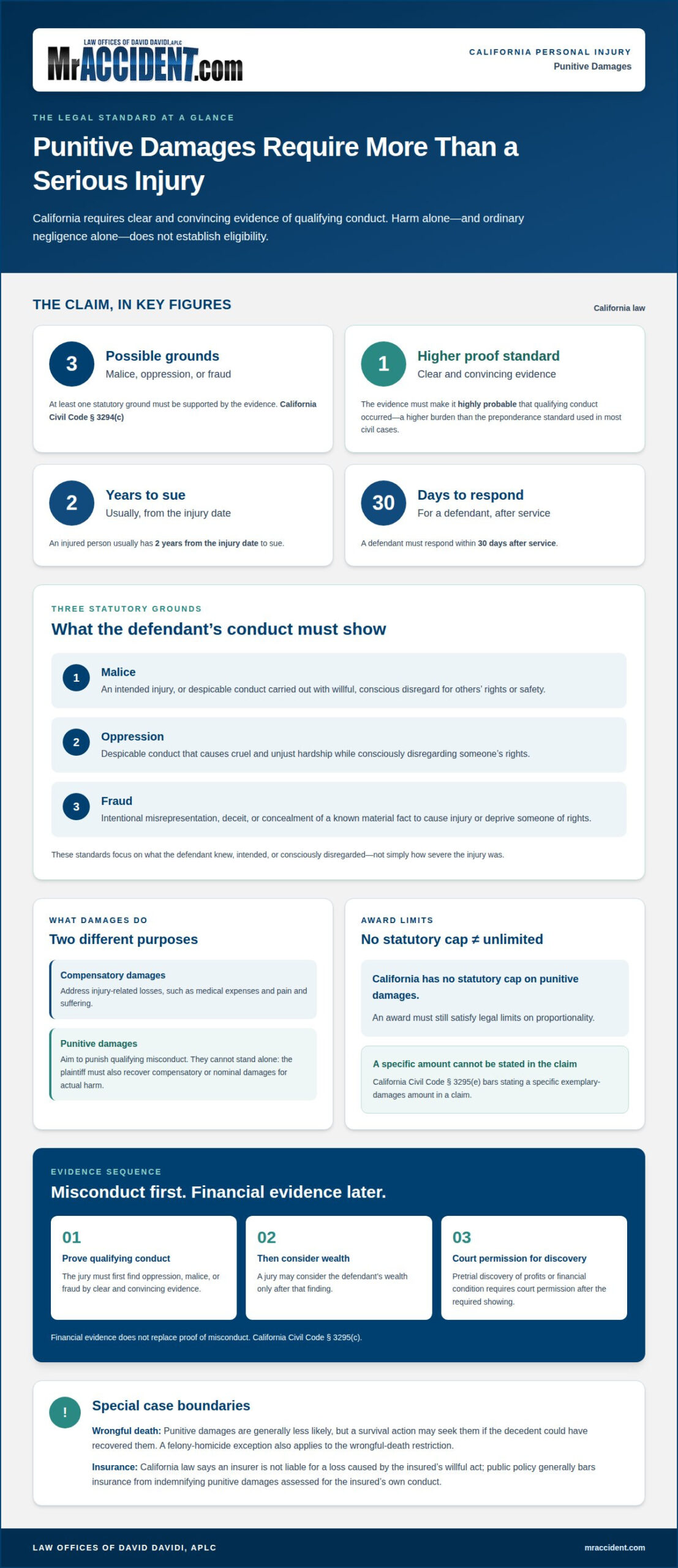
A serious injury alone doesn’t qualify a claim for punitive damages. Punitive damages in California personal injury cases may be awarded when clear and convincing evidence proves malice, oppression, or fraud, according to the California Legislature. California has no statutory cap on punitive damages, but an award must still satisfy legal limits on proportionality.
It’s understandable to expect especially harmful conduct to lead to additional accountability. But punitive damages aren’t automatic, and ordinary negligence alone isn’t enough. The key question is whether the evidence meets California’s demanding legal standard.
This article explains what malice, oppression, and fraud mean, when punitive damages may be available, and how the absence of a statutory cap differs from the limits courts apply to an award. It also explains how punitive damages relate to compensation for injury-related losses.
Key Takeaways
- Learn why an especially serious injury does not, by itself, establish eligibility for punitive damages.
- See how intent, conscious disregard, or deceptive conduct can affect whether a claim meets the required standard.
- Understand how the underlying personal injury claim and the defendant’s conduct shape the damages a plaintiff may pursue.
- Distinguish California’s statutory limits on certain damages from the constitutional review that can affect a punitive award.
Are Punitive Damages Ever Awarded in California Personal Injury Cases?
Yes. A court may award exemplary damages in a personal injury case when the legal standard is met, in addition to actual damages. According to the California Legislature, an injured person usually has 2 years from the injury date to sue, and a defendant must respond within 30 days after service.
The Clear and Convincing Evidence Standard
Clear and convincing evidence must make it highly probable that the defendant engaged in conduct meeting California’s punitive-damages standard. This is a higher burden than the preponderance standard used in most civil cases. California law requires plaintiffs to prove oppression, fraud, or malice by clear and convincing evidence. A jury considers the evidence before deciding whether punitive damages may be awarded.
Punitive damages cannot stand alone; the plaintiff must also recover compensatory or nominal damages for actual harm. California Civil Code section 3295(e) also bars stating a specific exemplary-damages amount in a claim.
Malice, Oppression, and Fraud Standards
California Civil Code section 3294(c) defines malice as intended injury or despicable conduct showing willful, conscious disregard for others’ rights or safety. Oppression involves despicable conduct causing cruel, unjust hardship with conscious disregard for someone’s rights. Fraud involves intentional misrepresentation, deceit, or concealment of a known material fact to cause injury or deprive someone of rights.
Can an employer be held liable for an employee’s conduct? Yes, but section 3294(b) restricts employer liability for punitive damages based on employee conduct. The evidence must satisfy the statute’s requirements.
Evidence of a Defendant’s Financial Condition
Financial-condition evidence concerns the defendant’s resources and may inform the amount of punitive damages after liability is established. California Civil Code section 3295(c) allows pretrial discovery of profits or financial condition only when the court permits it after the required showing. A jury may consider wealth only after first finding, by clear and convincing evidence, that oppression, malice, or fraud occurred. This sequence keeps financial evidence from replacing proof of misconduct.
Punitive Damages in Wrongful Death Cases
Can punitive damages be recovered in a California wrongful death case? They are generally less likely in wrongful death claims, but a survival action may seek them if the decedent could have recovered them. California Code of Civil Procedure section 377.34(a) permits that recovery, while Civil Code section 3294(d) provides a felony-homicide exception to the wrongful-death restriction.
Are punitive damages covered by insurance? California Insurance Code section 533 says an insurer isn’t liable for a loss caused by the insured’s willful act. California public policy generally bars insurance from indemnifying punitive damages assessed for the insured’s own conduct.
Malice, oppression, and fraud
California Civil Code section 3294(c) sets three grounds for punitive damages: malice, oppression, or fraud. These terms describe the defendant’s conduct, not simply the severity of an accident or the plaintiff’s pain and suffering. A serious injury may support compensatory damages, but punitive damages require proof of a more blameworthy state of mind or behavior. The distinction helps explain why harmful consequences alone do not establish eligibility.
Malice includes conduct intended to injure someone, or despicable conduct carried out with willful and conscious disregard for others’ rights or safety. “Despicable” points to conduct that is base or contemptible, not merely careless. For example, California’s Supreme Court held that driving while intoxicated may constitute malice under section 3294 in Taylor v. Superior Court, 24 Cal.3d 890. The circumstances and evidence still matter: an accident does not become malicious solely because it caused grave harm.
Oppression means despicable conduct that subjects someone to cruel and unjust hardship while consciously disregarding that person’s rights. Fraud involves intentional misrepresentation, deceit, or concealment of a material fact known to the defendant, with the intent to cause injury or deprive someone of property or legal rights. For instance, knowingly hiding a dangerous defect could raise a fraud issue if the concealment was intended to cause harm or deprive someone of rights. Each definition focuses on what the defendant knew, intended, or consciously disregarded.
To support punitive damages, evidence must connect the defendant’s acts to at least one statutory ground. A lawyer may examine statements, records, and the sequence of events to distinguish intentional or despicable conduct from ordinary carelessness. That distinction matters: punitive damages aim to punish qualifying misconduct, while compensatory damages address losses such as medical expenses and pain and suffering. If an accident raises questions about a defendant’s conscious disregard, accident-related legal guidance can help clarify which facts bear on the claim.
Causes of action, including negligence and battery
A personal injury plaintiff may bring a negligence claim when another person’s lack of ordinary care causes harm. California Civil Code section 1714 addresses responsibility for harm caused by that failure. In a car accident, for example, evidence that a driver failed to use reasonable care can support a negligence action. That proof addresses liability for losses, but ordinary negligence alone does not meet the separate standard for punitive damages.
Willful misconduct differs from a simple mistake. Punitive damages require clear and convincing evidence of oppression, fraud, or malice, not merely proof that the defendant caused an injury. The distinction turns on the defendant’s conduct and state of mind. A deliberate harmful act, or conduct showing conscious disregard for others’ safety, presents a different issue from an inadvertent driving error.
Battery is an intentional tort involving harmful or offensive contact. Because the conduct is intentional, evidence supporting a battery claim can also be relevant to punitive damages. But the claim’s name does not decide the outcome. The plaintiff still must establish the required ground for punitive damages with clear and convincing evidence. By contrast, a negligence claim based only on ordinary carelessness does not establish that heightened level of misconduct.
California follows pure comparative negligence. A plaintiff’s share of fault reduces the damages recovered, but does not automatically bar recovery. For example, if a personal injury award is $100,000 and the plaintiff is found 20 percent at fault, the recovery is $80,000. That calculation concerns compensatory damages. It does not replace the separate proof required for punitive damages, and the defendant’s actions must still meet the applicable standard.
In Li v. Yellow Cab Co., the California Supreme Court adopted the pure comparative fault rule. A plaintiff can therefore pursue compensation even when partly responsible, while the nature of the defendant’s conduct remains central to any punitive claim.
California personal injury damage caps
California has no statutory cap on punitive damages in a personal injury case. Nor does it cap compensatory damages in ordinary personal injury lawsuits. The absence of a statutory ceiling is central to punitive damages in california personal injury cases, but it doesn’t make an exemplary award unlimited. Courts can still review whether an award is excessive in relation to the defendant’s misconduct and the harm caused.
There’s no statutory cap, but courts review punitive awards for due process and reasonable proportionality. The U.S. Supreme Court identified guideposts in BMW of North America, Inc. v. Gore, 517 U.S. 559. It has also cautioned that an award exceeding four times compensatory damages might approach the constitutional line. That guidance isn’t a fixed formula for calculating every injury case.
Ratios are one consideration, not a guaranteed ceiling. The harm caused, the reprehensibility of the defendant’s intentional conduct, and the relationship between compensation and punishment can all matter in judicial review. Awards significantly greater than a single-digit ratio to compensatory damages are generally treated as suspect without special justification. A court may assess the facts and the award’s purpose rather than apply an automatic multiplier. Clear and convincing evidence of malice, oppression, or fraud remains necessary before punitive damages may be awarded.
Medical malpractice is a separate context. Medical malpractice claims may be subject to distinct limits on non-economic damages, unlike ordinary injury claims. This limit concerns non-economic compensation, such as pain and suffering, rather than creating a general cap on punitive damages or economic losses. For anyone assessing punitive damages in california personal injury cases, distinguishing malpractice limits from ordinary injury claims helps identify which cap applies.
Separating economic losses, non-economic harm, and exemplary damages helps clarify which rules apply. If you’re evaluating how a damages limit may affect an injury claim, discuss California damage limits.
Law Offices of David Davidi, APLC
Law Offices of David Davidi, APLC helps injured people understand how punitive-damages rules relate to their personal injury claims. If a car, truck, motorcycle, or pedestrian accident caused harm, an attorney can assess the available evidence, the defendant’s conduct, and the losses involved. This analysis helps distinguish a claim for compensation from the separate question of whether punitive damages may be pursued.
These cases require careful attention to facts, including what the defendant knew and how the conduct affected the injured person. The firm represents people in accident claims and can explain how these issues fit into the broader case. An attorney can also help address applicable filing deadlines and the legal process.
If you have questions about an injury claim, contact Law Offices of David Davidi, APLC to discuss your situation.
Take the Next Step With a Clear Case Strategy
The next step is to connect the legal standard to the evidence in your own claim. Keep records showing how the injury affected you, and note communications or conduct that may help explain what happened. A focused review can clarify which issues deserve attention and how a request for punitive damages in California personal injury cases fits alongside your claim for compensation.
Law Offices of David Davidi, APLC represents people in car, truck, and motorcycle accident claims. If you’re weighing your options after an injury, a conversation can help you understand how the facts may shape your case and what steps could follow. You don’t have to sort through the legal questions alone.
Contact Law Offices of David Davidi, APLC to discuss your situation and move forward with greater clarity.
Frequently Asked Questions
Can I get punitive damages in a car accident case?
Yes, if clear and convincing evidence shows the other driver’s conduct involved malice, oppression, or fraud. California courts have recognized that intoxicated driving may constitute malice, but intoxication alone doesn’t guarantee an award. Evidence about the driver’s choices, knowledge, and actions before the collision can help distinguish a qualifying claim from one involving careless driving alone.
How Can Punitive Damages Increase the Value of My Claim?
Punitive damages may add an award intended to punish qualifying misconduct, rather than compensate you for another category of personal loss. They’re considered separately from amounts for medical care, lost income, or pain and suffering. For example, evidence that a defendant knowingly concealed a dangerous product defect could raise a punitive-damages issue alongside compensation for injuries caused by that product.
How Can an Attorney Help Me Pursue Punitive Damages?
An attorney can evaluate whether the available evidence supports a punitive-damages claim, then connect relevant records, witness accounts, and the defendant’s conduct to the legal requirements. In a crash claim, for example, the attorney may examine evidence about the driver’s decisions before the collision, not just the damage afterward. That distinction helps frame the claim without treating every serious injury as proof of misconduct.
How Large Can an Award Be?
California law sets no statutory maximum for punitive damages, but that doesn’t mean an award can be unlimited. Courts review whether the amount is constitutionally reasonable in light of the defendant’s misconduct and the harm. There’s no guaranteed formula for predicting an award. The evidence, the injury, and the relationship between punitive and compensatory damages all matter to that review.
Punitive Damages Examples – When Do They Apply?
Possible examples include an intoxicated driver causing a serious crash, an intentional battery, or a manufacturer concealing a known product defect. These circumstances can raise questions about punitive damages, but they don’t automatically establish entitlement. The evidence must show conduct meeting California’s legal standard. A claim based only on an accidental mistake or ordinary carelessness generally presents a different issue.
What Are The Three Types Of Monetary Damages In California Accident Cases?
The three commonly discussed categories are economic, non-economic, and punitive damages. Economic damages address financial losses, such as medical expenses and lost wages. Non-economic damages concern personal effects, including emotional distress or reduced quality of life. Punitive damages serve a different purpose: they punish and deter qualifying misconduct. A case may involve compensatory damages without meeting the separate requirements for punitive damages.

Law Offices of David Davidi, APLC is a California – based Personal Injury Law Firm, our Attorney’s provide the representation for your personal injury, accident, product liability, premises liability, and other
negligence resulting in injuries. We treat all clients and cases, large or small, with hands-on care.
Practice Area
© Copyright 2026 Law Offices of David Davidi, APLC. All rights reserved.
Digital Marketing By 