
888-529-0707 call 24-7 we service throughout california
Tax Implications of a Personal Injury Settlement in California

A personal injury settlement isn’t automatically taxable. Under federal rules, compensation for physical injuries or physical sickness is generally excluded from gross income, and California generally follows the same treatment for qualifying damages. To understand the tax implications of a personal injury settlement in California, look at what each part of the recovery is intended to compensate.
It’s reasonable to ask whether money for lost wages or medical bills is treated differently from compensation for your injuries. The answer may depend on how the settlement is characterized, whether you previously claimed a deduction for medical expenses, and whether the award includes interest or punitive damages.
This article explains when settlement proceeds may be taxable under federal and California rules, including how lost wages, medical expenses, and other payment categories can affect the outcome. You’ll learn which distinctions matter and what records can help explain what your settlement covers.
Key Takeaways
- Separate compensation for physical injuries from other parts of a settlement to understand which amounts may be taxable.
- Look at how lost wages are characterized: the connection to a physical injury can affect their tax treatment.
- Review whether you previously deducted medical expenses, since repaid costs may have different tax consequences.
- Keep settlement documents that explain what each payment covers, and distinguish a tax reporting form from the taxability of the proceeds.
Are Personal Injury Settlements Taxable?
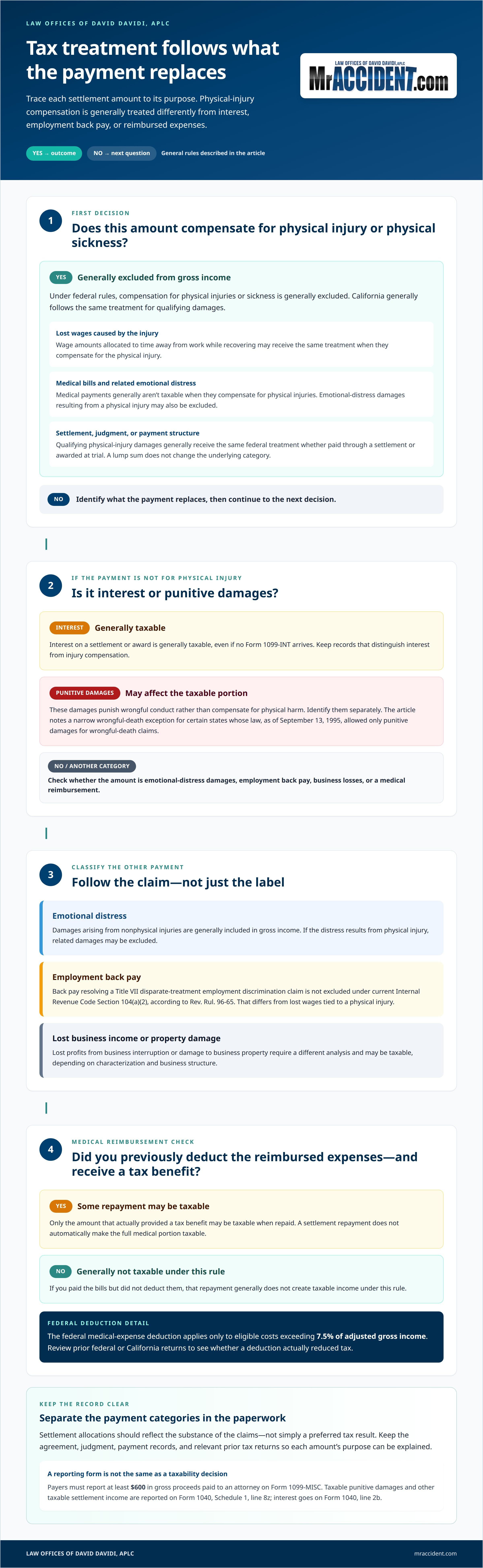
Under federal law, compensation for physical injuries or sickness is generally excluded from gross income, but some settlement components are treated differently.
Punitive Damage Tax Treatment
Punitive damages punish wrongful conduct rather than compensate someone for physical harm. Punitive damages may affect the tax treatment of a recovery, so identifying them separately can help clarify its taxable portion. A narrow exception applies to certain wrongful-death awards under state law. The exception concerns states whose law, as of September 13, 1995, allowed only punitive damages for wrongful-death claims.
Emotional Distress Damage Tax Treatment
Emotional distress damages compensate for mental suffering, and their tax treatment depends on whether they stem from physical injury or sickness. Damages arising from nonphysical injuries are generally included in gross income. If emotional distress results from a physical injury, related damages may be excluded. Reimbursement for medical expenses may also qualify for exclusion if you didn’t previously deduct those expenses.
Separating Damage Categories in Settlement Agreements
A settlement agreement may allocate payment among physical injuries, emotional distress, punitive damages, and medical expenses. That allocation matters because each category can receive different tax treatment. The stated categories should reflect the substance of the claims, not just a preferred tax result. If taxable recovery includes attorney fees, the fee portion is generally treated as the claimant’s income. Payers must report at least $600 in gross proceeds paid to an attorney on Form 1099-MISC, according to the Internal Revenue Service. Taxable punitive damages and other taxable settlement income are reported on Form 1040, Schedule 1, line 8z; interest goes on Form 1040, line 2b.
Settlements Compared With Court Judgments
Qualifying damages for physical injuries generally receive the same federal tax treatment whether awarded at trial or paid through a settlement. The key distinction is what the payment compensates for, not whether a judge ordered it. Structured payments also may remain excluded when they qualify under IRC § 104 and are received under IRC § 130; a lump sum doesn’t change the underlying category. Interest on a settlement or award is generally taxable, even if no Form 1099-INT arrives. Keep the agreement, judgment, and payment records to distinguish interest from injury compensation.
Lost wages from injury versus employment claims
Lost wages can be part of an injury settlement or an employment claim, but the reason for the payment matters. If an accident causes physical injuries that prevent someone from working, damages allocated to replace those wages may still be compensation for the physical injury. Under federal law, compensatory damages received on account of personal physical injury, including amounts allocated to lost wages, are generally excluded from gross income.
Consider a worker who misses work while recovering from an injury caused by a collision. A settlement may cover medical expenses, pain and suffering, and income lost during recovery. If the payment compensates for the physical injury, the wage-related portion may receive the same tax treatment. The label “lost wages” alone doesn’t determine whether the amount is taxable. Its connection to the injury matters.
Employment claims work differently. Back pay received to resolve a Title VII disparate-treatment employment discrimination claim is not excluded under current Internal Revenue Code Section 104(a)(2), according to Rev. Rul. 96-65. That treatment contrasts with wage damages tied to physical injuries. A payment resolving a workplace discrimination claim compensates for an employment-related wrong, not for physical injury or sickness.
Read the settlement language alongside the underlying claim. A separate allocation to replace income may clarify the payment’s purpose, while an injury claim may describe lost wages as one part of compensation for physical harm. The agreement should reflect the claims and evidence, not rely on a label alone. This distinction helps separate potentially taxable employment back pay from injury-related damages.
Lost profits are different from an injured person’s missed pay. A recovery for business interruption or damage to business property may be taxable, depending on its characterization and the business structure. For example, a settlement for business income lost after property damage requires a different analysis from wages missed while recovering from an accident. Identify what the payment replaces before assessing its tax treatment.
Are medical bills from a settlement taxable?
Medical bill payments generally aren’t taxable when they compensate for physical injuries. A different issue arises if a settlement repays expenses deducted on an earlier federal or California tax return.
Reimbursed Medical Expenses With Prior Deductions
Reimbursed medical expenses may create taxable income if you previously deducted them and received a tax benefit. The Internal Revenue Service says the federal medical-expense deduction applies only to eligible costs exceeding 7.5% of adjusted gross income. A settlement repayment therefore doesn’t automatically make the full medical portion taxable.
For example, if you claimed eligible medical costs on a prior return, determine whether that deduction actually reduced your tax. Only the amount that provided a tax benefit may be taxable when repaid. If you paid the bills but didn’t deduct them, that repayment generally doesn’t create taxable income under this rule.
Separate medical reimbursements from other settlement categories. Payments for emotional distress, lost wages, or physical injury may follow different tax rules. The settlement allocation and prior-year returns can show what the reimbursement replaces and whether an earlier deduction affected your taxes.
Medical Expenses and the Tax Benefit Rule
The tax benefit rule limits taxable income to the portion of a recovered expense that previously lowered your tax. In practice, a deduction that provided no tax benefit doesn’t create taxable income when a settlement later repays that cost. This prevents taxing the full reimbursement simply because the medical expense appeared on an earlier return.
Compare the medical costs listed in the settlement with expenses claimed on the relevant federal and California returns. Then determine whether the deduction reduced taxable income or tax owed. If only part of a deduction provided a benefit, only that portion may be included as income when repaid. Keep the settlement allocation and prior returns together to support your calculation.
The distinction concerns the earlier deduction, not simply whether the settlement includes medical bills. A payment for current injury-related expenses differs from reimbursement for costs that already provided a tax benefit. Review each expense and its tax history separately before treating the medical portion as taxable income.
Taxability of personal injury settlements in California
California generally follows federal treatment for qualifying physical-injury damages. The state generally conforms to Internal Revenue Code section 104 as of January 1, 2015, so qualifying compensation excluded federally is generally excluded from California income. Understanding the tax implications of a personal injury settlement in California starts with identifying what each payment is meant to compensate.
Separate categories in the settlement agreement help explain what the recovery replaces. Physical-injury compensation and taxable items such as interest can receive different treatment. Interest on a personal injury settlement or award is generally taxable, even if you don’t receive Form 1099-INT. Keep the agreement and payment records together so the interest is distinguishable from injury damages.
California also excludes workers’ compensation settlements from income under Revenue and Taxation Code section 17131.2. That is a separate rule from the treatment of a third-party personal injury settlement. If a settlement includes taxable income, that portion may affect both federal and California reporting. An attorney’s payment on your behalf can still be treated as a distribution to you for federal information-reporting purposes.
Tax-free treatment and eligibility for public benefits are separate issues. Medi-Cal, SSI, and other programs have their own eligibility rules, so the settlement’s form and how the funds are held may matter. These benefit considerations are distinct from the tax implications of a personal injury settlement in California, especially if you receive needs-based benefits.
For California claims, preserve the signed settlement agreement, payment records, and any tax forms received. Those records help explain the source and allocation of funds when preparing returns. A qualified structured settlement may also receive federal exclusion as payments are received under IRC section 130, provided the injury recovery qualifies under IRC section 104.
If an accident settlement includes several payment categories, get help understanding your injury claim and the documents that describe its recovery.
Law Offices of David Davidi, APLC
Law Offices of David Davidi, APLC represents people injured in accidents, including car, truck, motorcycle, and pedestrian accident claims. If you’re reviewing a settlement or still resolving an injury claim, an attorney can explain how the damages and settlement terms relate to your recovery. Clear documentation of what the agreement covers can help distinguish injury compensation from the other payment categories discussed above.
An attorney oversees each case at the firm, giving you direct access to legal guidance about your accident and the issues affecting your claim. Tax questions about reporting or deductions may require advice from a tax professional, while your injury attorney can address the legal claim and settlement documents.
Contact Law Offices of David Davidi, APLC to discuss your injury claim and settlement questions.
Move Forward With a Clear Plan
Before finalizing an injury claim, take time to understand what the agreement means for your next steps. Consider how the timing and terms fit your financial needs, any public benefits you rely on, and the records you’ll need to keep. Understanding the tax implications of a personal injury settlement in California can help you ask focused questions and make informed decisions about your recovery.
Legal guidance can help you understand your injury claim and settlement documents, while a tax professional can explain how your circumstances affect filing. Start by identifying what remains unclear, then seek advice suited to that question.
Discuss your injury claim with Law Offices of David Davidi, APLC. Take the next step at a pace that feels right for you.
Frequently Asked Questions
What About Emotional Distress?
Emotional distress damages may be taxable if they arise from a nonphysical injury, such as defamation or humiliation. If distress follows a physical injury, its connection to that injury can affect the tax treatment. For example, distinguish distress tied to accident-related bodily harm from distress claimed independently. Also identify whether any payment reimburses qualifying medical care and whether you previously deducted those expenses.
What About Lost Wages?
Lost wages may be excluded when they compensate for income lost because of a physical injury. The same label can receive different treatment in an employment claim. For example, back pay resolving a discrimination claim is treated differently from wages missed while recovering from an accident. Review what the claim sought to compensate for rather than assuming every wage-related payment is taxable or tax-free.
Are Punitive Damages Taxable in California?
Generally, punitive damages are taxable under federal rules, and California generally follows federal treatment for qualifying income categories. A narrow federal exception applies to certain wrongful-death awards in states whose law, as of September 13, 1995, allowed only punitive damages. If an award includes punitive damages, keep the verdict or settlement allocation so the payment’s stated purpose is clear.
Are pain and suffering damages taxable?
Pain and suffering damages resulting from physical injury are generally excluded from income. The key distinction is whether the compensation relates to bodily harm or instead addresses a nonphysical claim. For example, pain and suffering from an injury sustained in a collision differs from emotional distress damages arising independently. The settlement’s factual basis and allocation can help show which situation applies.
Exceptions: When Is Your Settlement Money Taxable?
Some settlement components may be taxable even when the underlying claim involves an injury. Common examples include punitive damages, interest, and damages for emotional distress arising from a nonphysical injury. Repayment of medical expenses may also be taxable to the extent an earlier deduction provided a tax benefit. Identify the purpose of each payment and review prior returns before determining what belongs in taxable income.
How does California tax lawsuit settlements differently from the IRS?
For qualifying physical-injury damages, California generally follows the federal exclusion under Internal Revenue Code section 104. That means the state and federal treatment is generally similar for that category, rather than automatically different because a claim was filed in California. Taxable portions, such as interest, may still need to be considered on both returns. Keep the settlement allocation available when preparing each filing.

Law Offices of David Davidi, APLC is a California – based Personal Injury Law Firm, our Attorney’s provide the representation for your personal injury, accident, product liability, premises liability, and other
negligence resulting in injuries. We treat all clients and cases, large or small, with hands-on care.
Practice Area
© Copyright 2026 Law Offices of David Davidi, APLC. All rights reserved.
Digital Marketing By 