
888-529-0707 call 24-7 we service throughout california
Bakersfield Truck Accident Settlement Calculator: Estimate Your Damages
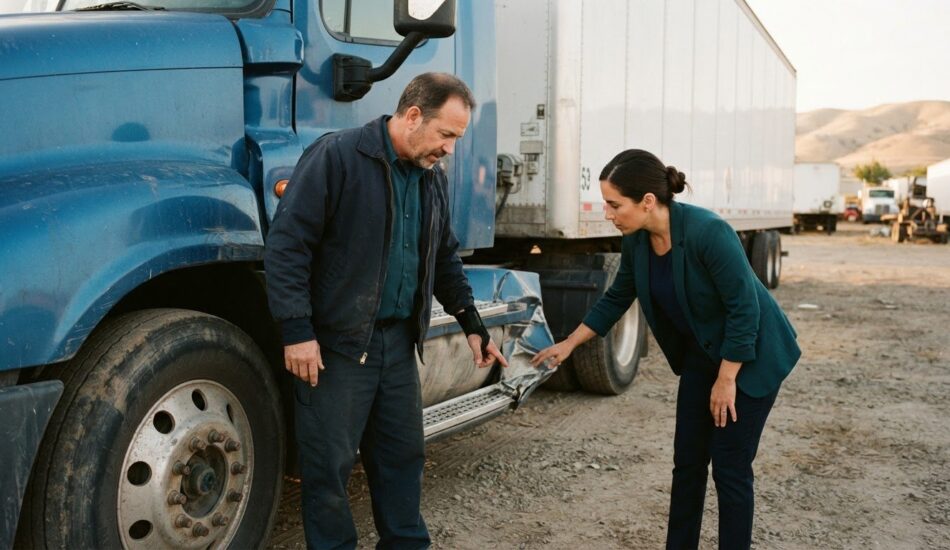
A settlement calculator can offer only a preliminary estimate, and the value of a truck accident claim depends on the circumstances of the case. A Bakersfield truck accident settlement calculator can help organize a preliminary estimate, but its result depends on the information entered and the losses those figures represent. The goal is to account for the collision’s full impact, not just the first bills.
It’s understandable to want a clear figure while facing medical care, missed work, and uncertainty about what comes next. This guide explains how economic and non-economic damages, possible punitive damages, and California’s comparative-fault rule can affect an estimate. It also compares multiplier and daily-rate approaches to pain and suffering, explains how legal representation can help evaluate a claim, and clarifies why settlement averages may not predict the value of a particular Bakersfield case.
Key Takeaways
- Separate financial losses from the personal impact of an injury to see what a settlement estimate needs to account for.
- Fault allocation and the strength of evidence can change how much compensation may be recoverable.
- Compare daily-rate and multiplier approaches to understand how pain and suffering can be valued.
- Treat settlement ranges as context, not a prediction; injury severity, future needs, and claim details all matter.
Calculating economic, non-economic, and punitive damages
Build an estimate by separating documented financial losses from personal harm.
Economic Losses and Medical Expenses
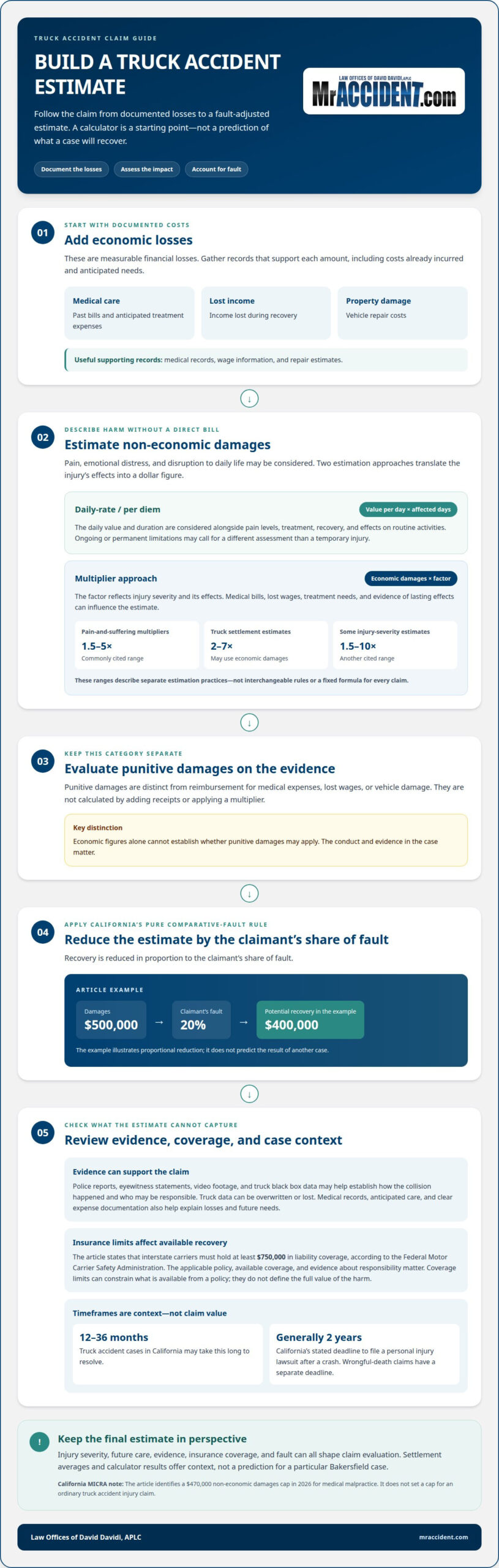
Economic damages are measurable financial losses, including medical bills, missed income, and vehicle repair costs. Add past and anticipated treatment expenses, income lost during recovery, and property damage to show the claim’s financial impact. Medical records, wage information, and repair estimates can help support each amount.
Non-Economic Damages and Multiplier Estimates
Non-economic damages address harm without a direct bill, such as pain, emotional distress, and disruption to daily life. A multiplier estimate applies a factor to economic damages, with injury severity and its effects informing the factor. This is an illustration, not a fixed formula for every claim.
Some estimates use injury-severity multipliers ranging from 1.5× to 10×. A serious injury with lasting treatment needs may support a different estimate than a shorter recovery. Medical evidence and anticipated care help explain future expenses. Insurance coverage and proof of losses also shape how a claim is evaluated.
Punitive damages are distinct from reimbursement for medical expenses, lost wages, or vehicle damage. They aren’t calculated by adding receipts or applying a multiplier. Economic figures alone therefore can’t establish whether punitive damages may apply. The conduct and evidence in the case matter.
California’s pure comparative-fault approach reduces recovery in proportion to the claimant’s share of fault. For example, a claimant assigned 20% fault could recover $400,000 from $500,000 in damages. California’s MICRA non-economic damages cap is $470,000 in 2026, but applies only to medical malpractice. It doesn’t set a cap for an ordinary truck accident injury claim.
How does hiring a lawyer affect my settlement amount?
A lawyer can assess evidence, document losses, and identify factors that may affect compensation. The goal is to build a supported picture of the accident claim, not simply enter figures into a calculator.
California generally allows two years from a crash to file a personal injury lawsuit. That rule applies to injury claims; a wrongful-death claim has a separate filing deadline that must be assessed on its own.
Injury severity and medical costs affect settlement value because they help show the harm and financial impact. Treatment records, anticipated care, and recovery limitations can support claims for economic damages and pain and suffering. Severe or lasting injuries may require more care and have broader effects on daily life. Missing treatment records or unclear expense documentation can make those losses harder to establish.
Insurance limits can constrain the compensation available from a policy, though they don’t determine the full value of the harm. According to the Federal Motor Carrier Safety Administration, interstate carriers must hold at least $750,000 in liability coverage. The applicable policy, available coverage, and evidence about responsibility all matter when assessing potential recovery.
Truck accident cases in California may take 12 to 36 months to resolve. Investigation, medical treatment, disputed fault, and negotiations can affect the timeline. A claim involving ongoing care may require a clearer view of future needs before its value can be assessed.
A lawyer can review police reports, eyewitness statements, video footage, and truck black box data. This evidence may help establish how the collision happened and which parties may be responsible. Preserving electronic records matters because truck data can be overwritten or lost. A thorough review can also identify issues a basic calculator cannot evaluate, including disputes about fault or the cause of particular injuries.
It illustrates how case evidence and negotiation can affect the result, not a standard outcome or universal calculation method.
Daily-rate and multiplier methods for pain and suffering
Calculators estimate pain and suffering by translating injury effects into a dollar figure. The daily-rate method assigns a value per day and applies it across the period affected by the injury. A multiplier method instead applies a factor to economic damages. Both are estimates, and neither captures every detail of an accident claim.
The per diem approach selects a daily value and counts the days the person’s injuries affect them. The length of recovery, pain levels, treatment, and effects on routine activities can inform that period. Ongoing or permanent limitations may require a different assessment than a temporary injury.
A multiplier approach uses injury severity to choose a factor. Pain-and-suffering multipliers commonly range from 1.5 to 5, while truck settlement estimates may use 2x to 7x economic damages. These are separate estimation ranges, not interchangeable rules. Medical bills, lost wages, treatment needs, and evidence of lasting effects can influence the chosen method and estimate.
Federal trucking rules can also matter to liability. According to the Federal Motor Carrier Safety Administration, hours-of-service rules limit truck drivers to 11 hours of driving within a 14-hour window. Evidence of a relevant driver or carrier violation may help explain how a crash occurred, but the connection between the violation and the collision matters.
When multiple parties may share responsibility, evidence is needed to assess each party’s role. An attorney can review records, witness accounts, and available truck data to evaluate how liability may be allocated. The resulting fault assessment can affect the compensation sought, even when injury evidence supports substantial damages.
Calculator inputs should reflect medical bills, lost wages, injury severity, and the duration of pain. Keep these inputs distinct, then note how the selected method converts them into non-economic damages. Comparing both approaches can show how assumptions change the result, rather than suggesting one figure is definitive.
Average trucking accident settlement estimate
California has no official car accident settlement calculator and no average settlement amount. There’s no official figure for a Bakersfield or Kern County truck accident average, either. A useful estimate starts with the injuries, financial losses, negligence evidence, and responsible parties involved in the claim.
That broad range reflects different outcomes, not a prediction for an individual driver.
National truck settlement estimates range from $73,000 to $552,000, but those figures reflect cases with different circumstances. A California bodily-injury liability statistic offers another comparison, but not a truck-specific average: the average paid claim was $28,393 across 2020-2022. Don’t treat that figure as a Bakersfield truck settlement benchmark.
A Bakersfield truck accident settlement calculator can organize inputs such as medical losses, missed income, and vehicle damage. Use it to see how different assumptions affect an estimate, then consider whether the figures reflect the available records. A second estimate from a Bakersfield truck accident settlement calculator may help compare scenarios, but entering the same incomplete information won’t make the result more precise.
Settlement ranges describe past or estimated outcomes, not guaranteed recovery. They don’t show whether the evidence supports a particular claim’s losses or whether insurance limits affect payment. Injury severity, expected recovery, and lasting limitations can change the damages analysis. If several parties share responsibility, their roles can also affect how liability is assessed.
A calculator can help organize a claim, but assessing a case requires considering its treatment records, collision details, and evidence connecting negligence to the crash. Those details give an estimate context beyond a broad range.
There is no established average truck accident settlement for Bakersfield or Kern County. The cited ranges are estimates across cases with different circumstances, not a local average.
Law Offices of David Davidi, APLC: Truck Accident Legal Representation
Law Offices of David Davidi, APLC represents people injured in truck accidents and helps assess the legal issues behind their claims. Consider legal guidance when fault is disputed, injuries require ongoing treatment, or an estimate doesn’t account for your losses. An attorney can review the available evidence and explain how it relates to your case.
The firm also represents people injured in car, motorcycle, and pedestrian accidents. Its No Win, No Fee policy means clients pay no upfront legal fees and the firm is paid only if it recovers compensation. Direct attorney involvement gives you the opportunity to discuss your situation with legal counsel throughout your case.
If you were injured in a truck accident, contact Law Offices of David Davidi, APLC to discuss your claim.
Turn Your Estimate Into a Clear Next Step
A Bakersfield truck accident settlement calculator can help frame your next decisions, but the most useful figure is one you can connect to your circumstances. Treat the estimate as a starting point for identifying what remains unresolved, such as how recovery may affect daily responsibilities or what questions you want answered about the claim. Preparing this information can make a legal discussion more focused and help you feel more in control of the process.
You don’t need to have every answer before seeking guidance. Share the concerns that matter most to you and ask how they relate to your potential claim. For a conversation about your situation, contact Law Offices of David Davidi, APLC. Taking a thoughtful next step can help you move forward with greater clarity.
Frequently Asked Questions
How Does a California Semi Truck Accident Settlement Calculator Work?
A California semi-truck calculator uses the details entered to produce a rough estimate. Typical inputs include current and anticipated medical bills, lost income, vehicle repair or replacement costs, and information about physical or emotional harm. Some tools also draw on historical insurance claim awards. The result can help organize information for a claim discussion, but it cannot assess every piece of evidence or resolve disputed liability.
How Do Insurance Companies Calculate Truck Accident Settlement Offers?
Insurers assess the claimed losses, evidence connecting those losses to the crash, and arguments about responsibility. They may compare medical documentation, income records, repair estimates, and details about recovery. Available policy coverage can also affect what an insurer can offer under that policy. An initial offer reflects the insurer’s position, not a neutral calculation. Compare its assumptions with the records and losses supporting your claim.
What Is Your Truck Accident Case Actually Worth?
Your case’s value depends on the injuries, financial losses, evidence of fault, and available coverage. No single figure applies to every Bakersfield truck collision. For example, two people with similar medical bills may have different claims if one faces lasting limitations or missed income. An estimate is more useful when it reflects documented losses and the likely effect of injuries on future work and daily activities.
What information strengthens my personal injury claim?
Consistent records help connect the crash to your losses. Keep medical visit summaries, treatment recommendations, bills, proof of missed work, and repair documentation together. Photos of injuries and vehicle damage can show conditions close to the collision. Witness names and contact details, along with a copy of the police report, may help establish what happened. A dated record of symptoms and affected activities can also clarify changes during recovery.
Does California place limits on personal injury compensation?
California’s $470,000 non-economic damages cap for 2026 applies to medical malpractice cases, not ordinary truck accident injury claims. That distinction matters: a cap tied specifically to medical malpractice shouldn’t be assumed to limit damages from a commercial vehicle crash. The losses supported by the evidence, responsibility for the collision, and applicable insurance coverage remain important considerations in evaluating a truck injury claim.
How Does Comparative Negligence Affect My Settlement?
California follows pure comparative fault, so a claimant’s recovery is reduced according to their share of responsibility for the crash. If evidence shows that an injured person contributed to the collision, the assessed fault percentage affects the damages they can recover. Parties may disagree about that allocation, making scene evidence, witness accounts, and vehicle records relevant to deciding how responsibility should be divided.

Law Offices of David Davidi, APLC is a California – based Personal Injury Law Firm, our Attorney’s provide the representation for your personal injury, accident, product liability, premises liability, and other
negligence resulting in injuries. We treat all clients and cases, large or small, with hands-on care.
Practice Area
© Copyright 2026 Law Offices of David Davidi, APLC. All rights reserved.
Digital Marketing By 