
888-529-0707 call 24-7 we service throughout california
California Wrongful Death Settlements: 2026 Guide

What if the “average wrongful death settlement california” tells you very little about what your family’s claim may be worth? A statewide figure can’t account for the losses, evidence, and circumstances that make each case different.
It’s understandable to want a clear number, especially when bills are arriving and an insurer may make an offer before you know the full financial impact of your loss. Accepting an early offer without understanding the claim can leave important questions unanswered.
This guide explains why wrongful death settlement values vary, which losses and evidence may affect a California claim, and how liability, available insurance, and the deceased person’s circumstances can shape negotiations. You’ll also learn what to consider before responding to an offer and why deadlines matter. The Law Offices of David Davidi, APLC represents families in wrongful death matters throughout California, including Los Angeles, Fresno, Modesto, Bakersfield, Stockton, Tulare, Visalia, Merced, and Riverside. The firm provides direct attorney access and individualized guidance. The goal is to help you understand your options, not promise a particular recovery.
Key Takeaways
- The average wrongful death settlement california figure can’t predict an individual family’s recovery. Case value depends on the evidence, losses, liability, and available coverage.
- Organize records of income, household contributions, accident details, and insurance to help document the losses connected to your claim.
- Before assessing an offer, compare its terms with documented losses, unresolved evidence, and known coverage. Review the release language and who must sign.
- Preserve important documents and avoid rushed statements or decisions while key facts and the impact of the loss are still being assessed.
- An attorney can investigate liability, organize evidence, and review an offer, but no ethical case review can promise an exact settlement in advance.
Is There an Average Wrongful Death Settlement in California?
If you’re searching for a number after losing someone, it’s understandable to want a clear point of reference. But the average wrongful death settlement california figure, even when presented as a statewide benchmark, can’t reliably predict what an individual family may recover. Each claim depends on its own facts. No single number can reflect your family’s evidence, losses, and circumstances.
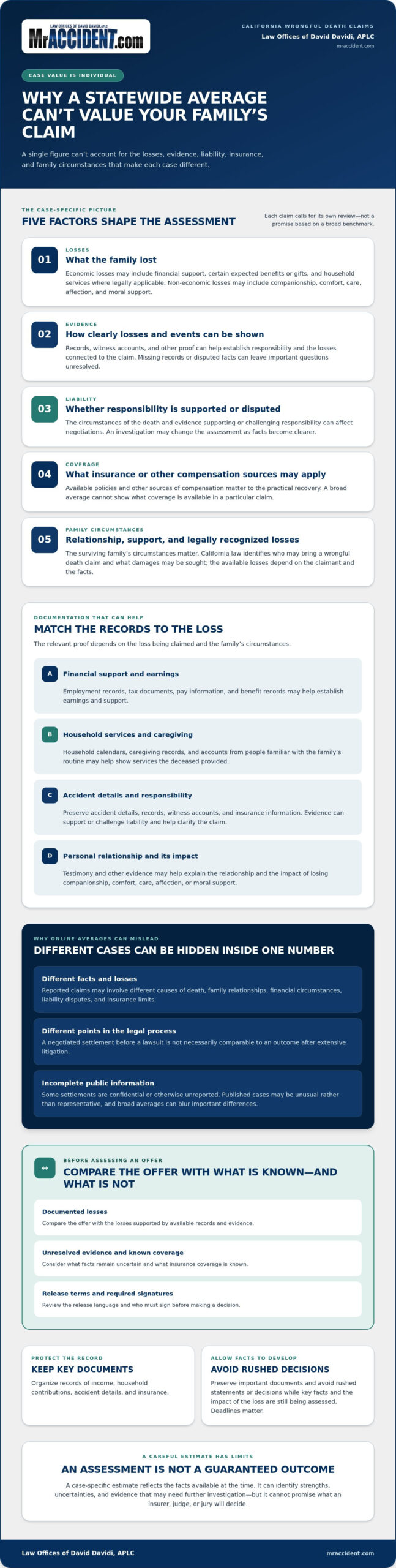
A statistical average summarizes a group of reported outcomes; an individual case valuation assesses the evidence, legally recognized losses, liability, and available coverage in one family’s claim. A figure drawn from dissimilar cases can sound precise while saying little about the value of yours.
Why online settlement averages can mislead
Reported results may combine claims involving different causes of death, family relationships, financial circumstances, liability disputes, and insurance limits. They may also reflect different stages of the legal process. A negotiated settlement reached before a lawsuit, for example, is not necessarily comparable to an outcome after extensive litigation. Unless the underlying cases are described and grouped consistently, an average can blur important differences.
Publicly available outcomes are only part of the picture. Some settlements are confidential or otherwise not reported, and published cases may be unusual rather than representative of typical claims. A general overview of wrongful death claims can explain the broad concept, but it doesn’t establish what California law allows in a particular case or how a specific claim may be valued.
An average also can’t measure your family’s evidence. Records, witness accounts, and other proof may affect how clearly responsibility and losses can be established. The surviving family’s circumstances matter, too. Two cases with similar accident descriptions may involve different financial support, relationships, disputed facts, or available insurance. A broad statistic can’t account for those details.
What a case-specific estimate can and cannot tell you
A case-specific estimate is an informed assessment based on the facts available at the time, not a guaranteed settlement or prediction of what an insurer, judge, or jury will decide. It can help a family understand the strengths, uncertainties, and evidence that may need further investigation. It should not be treated as a firm dollar figure before key facts are known.
A meaningful evaluation may require examining how the death occurred, what evidence supports or challenges liability, which losses can be documented, and what insurance coverage may apply. If responsibility is disputed or important records are missing, the assessment may change as an investigation clarifies the facts. Coverage also matters because the practical recovery may depend on available policies and other sources of compensation.
Families don’t need every answer before asking about their options. Be cautious of anyone who offers certainty based only on a statewide average or a brief description of the incident. A careful review should explain what is known, what remains uncertain, and what information could make the assessment more reliable, without promising a particular result.
What Determines Wrongful Death Settlement Value in California?
Families may share the same grief, but their claims can involve very different losses and evidence. Case value depends on provable losses and case-specific liability. California wrongful death damages generally include eligible family members’ economic losses and legally recognized non-economic losses, subject to the facts and applicable law.
Economic losses may include financial support the deceased would have contributed, certain benefits or gifts the family reasonably expected, and the value of household services where legally applicable. Non-economic damages address losses such as companionship, comfort, care, affection, and moral support. These categories call for different evidence: financial records may help show support, while testimony and other evidence may help explain the personal relationship and its impact.
Financial losses and evidence of support
Documentation helps make a claimed loss easier to evaluate. Employment records, tax documents, pay information, and benefit records may help establish earnings and support. Household calendars, caregiving records, and accounts from people familiar with the family’s routine may help show services the deceased provided. The relevant evidence depends on the loss being claimed and the family’s circumstances.
One household may rely on a person’s regular financial contributions, while another may depend heavily on childcare, transportation, or other household help. Those contributions may call for different forms of proof. Employment history and, where appropriate, expert analysis can help assess future financial contributions or the value of services, but no single formula captures every family’s situation. Each claimant’s legally recognized losses must be considered under California law.
Family relationships, liability, and insurance limits
California law identifies who may bring a wrongful death claim and what damages may be sought. The relationship to the deceased and the claimant’s circumstances can affect which losses are legally available and how they are supported. A spouse’s claimed losses may differ from a child’s or another eligible relative’s. A careful evaluation considers each claimant rather than assuming every family member experienced or can claim identical losses.
Liability matters, too. If the parties dispute how the death occurred, the evidence may affect both the likelihood of establishing responsibility and the course of negotiations. California follows a pure comparative fault rule: a recovery may be reduced by the deceased person’s share of fault, even if that share is substantial. If more than one person or entity may be responsible, identifying each party’s role can add complexity.
Insurance limits are a practical consideration, not an automatic measure of what a claim is worth. Available policies can affect what may be recovered from an insurer, while the underlying losses and responsibility remain separate questions. Reviewing policies alongside the facts helps clarify options without treating coverage as a guaranteed ceiling in every circumstance.
If you need help connecting the evidence to your family’s circumstances, California wrongful death representation can include a case-specific review of liability, losses, and available coverage.
How to Evaluate a Wrongful Death Settlement Offer
An offer can arrive while your family is grieving and gathering information. Don’t judge it by the headline amount alone. Compare what the offer resolves with what’s documented, what remains uncertain, and which claims or people may be affected. The phrase “average wrongful death settlement california” can’t answer whether a particular offer fits your family’s circumstances.
Use this comparison framework to organize questions before responding:
Offer terms: What claims does the proposed release resolve? Does it require specific people to sign, and what claims does it say will be given up?
Documented losses: Which financial and personal losses are supported by records or other evidence? Are important categories still being assessed?
Unresolved evidence: Have investigators reviewed the circumstances of the death, disputed liability, and evidence that could affect responsibility?
Known coverage: What insurance policies or coverage information have been identified? Are there unanswered questions about applicable coverage?
This isn’t a formula for calculating a settlement. It’s a way to spot gaps. An offer may appear substantial while leaving key questions about the release, claimants, or evidence unanswered. Conversely, the offer’s terms and the practical risks of continuing a claim may make it worth serious consideration. Assessing a particular offer requires reviewing its documents and the facts of the case.
Questions to answer before responding to an offer
Read the written offer and proposed release carefully. Identify which claimants and losses are included, who is expected to sign, and whether the release affects claims beyond those addressed in the offer. Confirm what investigation has been completed into liability, insurance coverage, and damages evidence. Keep copies of every offer, letter, email, and related communication together. If you need time to understand a term, avoid making a rushed decision based on a phone conversation or a deadline you haven’t clarified.
An early offer may arrive before employment records, household contribution evidence, or other relevant information has been gathered. That doesn’t automatically make the offer inadequate, but it may leave the family with less information to evaluate it. Consider whether the investigation is developed enough to understand the trade-offs before agreeing to release claims.
Settlement versus continuing a legal claim
A negotiated settlement can provide resolution without continuing through litigation, but accepting it generally means agreeing to the release’s terms. Continuing a claim may allow more investigation or negotiation, yet it can take longer and bring added uncertainty, expense, and emotional strain. A court outcome is never assured, and a settlement is not automatically the better choice for every family.
Compare the actual offer with realistic alternatives based on the evidence, coverage, and risks in the case. A careful review can clarify what is known and what remains uncertain, without promising a particular recovery. If you’re weighing an offer, wrongful death settlement guidance can help you understand what to examine before deciding.
Protecting a California Wrongful Death Claim
There’s no need to organize everything perfectly while you’re grieving. A few careful steps can help preserve information that may matter as responsibility and losses are investigated. Keeping records together also makes it easier to respond to questions without relying on memory alone. These steps won’t determine the value of a claim, and a search for the average wrongful death settlement california can’t replace evidence tied to your family’s circumstances.
Documents and information to preserve
Use this checklist as a starting point. Save copies where possible, keep originals in a safe place, and note when and where each item came from.
- Collect accident information. Keep available incident or police reports, photographs, videos, witness contact details, and correspondence related to the event. Don’t alter original files; make a separate copy if you need to annotate something.
- Gather insurance records. Save policy documents, claim numbers, letters, emails, and messages from insurers or other involved parties. Keep any written settlement proposal and its attachments.
- Preserve financial and household records. Collect employment and income documents, benefit information, and records that help describe the deceased person’s household contributions, care, or support.
- Keep a dated communication log. Note who contacted the family, when, what was discussed, and any requested response dates. Save voicemails and follow-up messages where available.
Evidence can become harder to locate as time passes. Records, photographs, and firsthand accounts may help clarify how the incident happened or what support the family relied on. If an item is missing, note that rather than trying to recreate it from memory. A wrongful death attorney can help families organize relevant information and understand how to protect their options.
Deadlines and careful communication
Legal deadlines depend on the facts and parties involved, so don’t assume one general timeline applies to every case. California’s general deadline for filing a wrongful death lawsuit is two years from the date of death. Different rules can apply, including when a government entity or medical malpractice is involved. A claim against a government entity generally requires a written claim within six months. Because missing a deadline can affect legal options, get advice promptly about the rules that apply to your circumstances.
Before giving a detailed recorded statement or signing a release, make sure you understand what information is being requested and what rights the document may affect. Avoid posting sensitive case details publicly, including photographs or speculation about fault. Keep communications factual and preserve copies. For a fatal motor-vehicle incident, the firm’s California car accident legal guide provides related context.
If you’d like help understanding next steps, discuss your wrongful death claim options with an attorney. A review can help clarify deadlines and evidence to preserve, without promising a particular outcome.
Discussing a California Wrongful Death Settlement With an Attorney
After a death, families may need to make legal and financial decisions while handling grief, new responsibilities, and uncertainty. A conversation with an attorney can help bring the facts into focus. It should clarify questions to investigate and choices ahead, not pressure your family to decide before you’re ready.
What a case review can clarify
An attorney can examine available records and help identify potentially responsible people or entities, evidence needed to assess liability, and insurance coverage that may apply. The review can also organize evidence of financial support, household contributions, and other losses that may be relevant under California law. Which damages may be claimed depends on the law and the family’s specific circumstances.
As the investigation develops, counsel can explain what is established, what remains disputed, and how those uncertainties may affect settlement discussions. That context matters more than a broad search for the average wrongful death settlement california. An ethical case review can’t promise an exact settlement amount in advance. The evidence, legal issues, coverage, and decisions by the parties all affect how a claim may resolve.
A supportive next step for families
You don’t need to arrive with a complete file or know all the right legal terms. Sharing what you know, including what remains unclear, can help an attorney identify practical next steps. Relevant documents, such as accident records, insurance letters, or information about household support, may make the discussion more focused. If you don’t have them yet, a review can still help identify what information may matter.
The Law Offices of David Davidi, APLC represents families in wrongful-death matters throughout California, including Los Angeles, Fresno, Modesto, Bakersfield, Stockton, Tulare, Visalia, Merced, and Riverside. The firm’s contingency-based arrangement means no upfront legal fees, and the firm collects a percentage of any recovery obtained through settlement or trial judgment. Case expenses may be separate. The firm also provides direct access to experienced attorneys, so families can discuss their concerns with an attorney.
A thoughtful review can help you understand potential options and risks without treating a settlement figure as certain. It can also help your family identify questions to resolve before responding to an offer or taking another step.
If you’re ready to discuss your family’s circumstances, speak with the Law Offices of David Davidi, APLC about a wrongful death claim in California.
Take the Next Step at Your Own Pace
You don’t have to settle every question today. A useful next step is to make a short list of what your family needs to understand before making a decision. The phrase average wrongful death settlement california can’t tell you whether an offer or legal path is right for your circumstances. A conversation focused on your family’s facts can help clarify what deserves attention next.
The Law Offices of David Davidi, APLC represents families in wrongful-death matters throughout California. Clients have direct access to experienced attorneys, and there are no upfront legal fees. Attorney fees depend on recovery; other case expenses may be separate. A discussion is an opportunity to understand your options, not a promise of a particular result.
If you’re ready to talk through your family’s situation, discuss your family’s options with the Law Offices of David Davidi. You deserve clear guidance and the space to make an informed choice, one step at a time.
Frequently Asked Questions
Is there an official average wrongful death settlement in California?
No. California has no single official statewide average that reliably forecasts an individual wrongful death claim. Public verdicts and reported settlements reflect cases that became visible, not necessarily a representative sample of all claims; confidential resolutions may not appear in public records. The phrase average wrongful death settlement california can offer broad context, but it can’t account for your family’s evidence, losses, liability disputes, or available insurance. Treat online figures as background, not a prediction.
Does California cap wrongful death damages?
Whether a cap applies depends on factors such as the defendant, claim type, and current law. Some claims, including certain medical-malpractice cases, may face statutory limits that don’t apply in the same way to other claims. The applicable rules can change and may involve specific damage categories. A case review should identify any limit that could affect your family’s claim based on current law and the facts.
Are wrongful death settlements taxable in California?
Tax treatment can depend on what the settlement compensates, how its terms allocate payment, and the circumstances of the resolution. Don’t assume that every part of a settlement is automatically tax-free or taxable. The settlement agreement and related documents may describe different components, and their treatment may differ. Legal review can help explain the claim and release, but it isn’t tax advice. Before making financial decisions, discuss the documents with a qualified tax professional.
Who can receive compensation in a California wrongful death case?
California law sets rules about who may bring a wrongful death claim, and eligibility depends on the family relationship and circumstances. The person entitled to file and the people who may share in a recovery aren’t always simple questions. For families in Los Angeles, Fresno, Modesto, Bakersfield, Stockton, Tulare, Visalia, Merced, or Riverside, a review of family relationships and applicable law can help clarify eligibility and potential allocation.
Can a wrongful death settlement be reopened after it is finalized?
Reopening a finalized settlement may be difficult or unavailable, particularly after signing a release. The effect depends on the agreement’s wording, the circumstances surrounding it, and applicable law. Before signing, identify whose claims are being released, which parties are covered, and whether the document resolves claims beyond the immediate offer. If a family member believes an agreement was signed under unusual circumstances, prompt review of the documents can help clarify possible options.
How long does a California wrongful death settlement take?
There’s no standard timeline. Resolution may take longer if investigators need to gather evidence, fault is disputed, damages records are incomplete, insurance questions remain, or litigation becomes necessary. The time to resolve a claim is separate from the deadline to file it. California’s general wrongful death filing deadline is two years from the date of death, but exceptions may apply, including in some medical-malpractice or government-entity cases. Check the deadline promptly.
Do all family members have to agree to a wrongful death settlement?
It depends on who has a legal interest in the claim, how it was brought, and what the proposed release or allocation covers. Don’t assume one relative can resolve every other person’s potential claim, or that every family member has identical rights. Before anyone signs, clarify whose claims are affected and whether other eligible relatives must participate. Reviewing the case documents and California law can help avoid misunderstandings among relatives.

Law Offices of David Davidi, APLC is a California – based Personal Injury Law Firm, our Attorney’s provide the representation for your personal injury, accident, product liability, premises liability, and other
negligence resulting in injuries. We treat all clients and cases, large or small, with hands-on care.
Practice Area
© Copyright 2026 Law Offices of David Davidi, APLC. All rights reserved.
Digital Marketing By 