
888-529-0707 call 24-7 we service throughout california
California Comparative Fault Law and How Fault Affects Damages

Being partly responsible for a California crash doesn’t automatically erase your right to recover damages. California allows an injured person to seek compensation even when they’re more than 50% at fault, though recovery is reduced by their share of responsibility. With California comparative fault law explained in practical terms, the rule is clear: even someone found 99% at fault may recover the remaining 1% of proven damages.
If you’re unsure how fault affects your claim, that’s understandable: the percentage assigned to you can directly reduce your potential recovery. This guide explains how California assigns fault, how shared responsibility affects car accident damages, and how liability may work when multiple parties are involved. It also covers the evidence that can shape a fault assessment and what happens when an injured person shares responsibility for a crash. Understanding California comparative fault law can help you assess what a fault finding could mean for your claim.
Key Takeaways
- Learn how California’s comparative negligence rule changes the amount an injured person may recover based on their share of responsibility.
- See which records and accounts can help clarify how a car accident happened and how fault is assessed.
- Understand why economic damages may be treated differently when multiple parties share responsibility.
- Find out when car accident legal representation may help you respond to a disputed fault assessment and pursue damages.
What Is California’s Comparative Negligence Law?
California follows pure comparative negligence: an injured person may seek damages even if partly responsible, but their recovery is reduced by their share of fault. The calculation under California comparative fault law shows why each assigned percentage can matter in a personal injury case.
Yes. California generally allows two years to file a personal injury lawsuit. A dispute over comparative fault does not, by itself, change that filing deadline.
California’s Pure Comparative Negligence Rule
California’s pure comparative negligence rule allows an injured plaintiff to recover damages even when their own negligence contributed to the injury. The award is reduced by the plaintiff’s percentage of fault, rather than barred once that share passes a cutoff. For example, with $100,000 in proven damages and 30% responsibility, the recoverable amount is $70,000. That calculation shows why disputed fault percentages matter.
Comparative Fault and Contributory Negligence
Comparative fault divides responsibility and reduces a claim by the injured person’s share; contributory negligence can block recovery if the person contributed to the injury. Under contributory negligence, even a 1% contribution can bar an injury claim. California replaced contributory negligence with comparative fault in 1975, so a plaintiff’s partial responsibility generally reduces damages rather than automatically ending the claim. Seeing California comparative fault law explained alongside contributory negligence makes that difference clear.
Modified Comparative Negligence Thresholds
Modified comparative negligence limits recovery based on a fault threshold, unlike California’s pure comparative approach. Some states amended modified comparative negligence rules. Those rules bar recovery entirely when a plaintiff is more than 50% at fault, according to flsenate.gov. The precise cutoff matters: in a jurisdiction with a 50% cutoff, a plaintiff at exactly 50% cannot recover. California’s pure rule allows a claim to continue even beyond that threshold, with damages reduced according to the plaintiff’s assigned share.
Can I Recover Damages if I Was Partially at Fault in a California Car Accident?
Yes. In California, an injured person may recover damages even when partly responsible for a crash. The evidence can affect how fault is divided and how much compensation remains available.
Evidence for Establishing Fault
Evidence used to establish fault helps show how an accident happened and how each person’s actions contributed. Fault assessments rely on the available record, not just one person’s account. Relevant evidence may include accident reports, witness statements, photographs, video footage, medical records, and expert analysis. Vehicle damage may also help explain the circumstances of the collision.
Each type of evidence can answer a different question. A witness may describe what a driver did before impact; photographs may show vehicle damage or roadway conditions; and medical records document injuries and treatment. A police report can be useful, but it is only one piece of evidence in a California injury case.
Evidence for Allocating Fault
Evidence used to allocate fault helps assess how much each person involved contributed to the crash. This matters because California reduces a plaintiff’s recovery by their assigned share of responsibility. Insurers, attorneys, and juries may review the evidence; in an injury case that goes to trial, a jury typically determines the fault percentages.
For example, a person found 50% responsible can recover 50% of their damages. If proven damages total $10,000, the example recovery is $5,000. The calculation depends on the evidence supporting each party’s actions, not simply on who was involved or who received a traffic citation.
Insurance companies may make an initial fault assessment, but it isn’t binding and can change when new evidence emerges. A police report, witness account, or video may support different interpretations of the same accident. Keeping relevant photographs, records, and witness information organized can help clarify what happened. If fault is disputed after a crash, car accident legal representation can help address the evidence and the responsibility arguments involved.
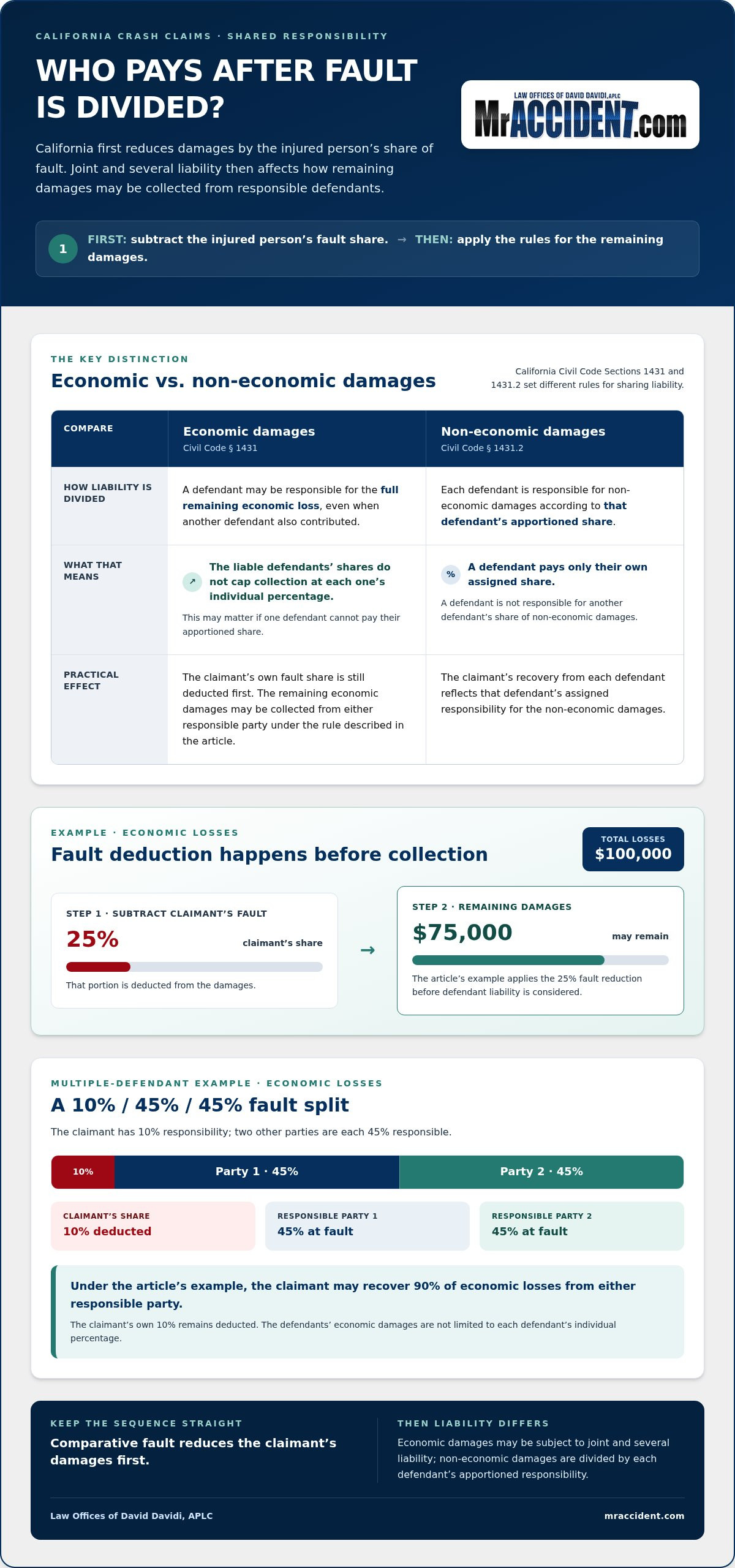
Joint and several liability for economic damages
Comparative fault first reduces a plaintiff’s damages by their percentage of fault. California’s joint and several liability rules then affect how the remaining economic damages may be collected when multiple defendants are responsible.
For example, a person with $100,000 in losses who is 25% at fault may recover $75,000. That reduction applies before liability among the responsible defendants is considered. California Civil Code Section 1431 addresses joint and several liability for economic damages. Under this rule, a defendant may be responsible for the full remaining economic loss, even if another defendant also contributed to the injury.
That interaction matters when one defendant cannot pay their apportioned share. If a claimant is 10% at fault and two other parties are each 45% responsible, the claimant may recover 90% of economic losses from either party. The claimant’s own 10% share remains deducted, but the economic damages owed by defendants aren’t limited to each defendant’s individual percentage. This can affect a settlement’s allocation and the amount recoverable from each liable party.
Non-economic damages follow a different rule. California Civil Code Section 1431.2 provides that each defendant pays non-economic damages according to that defendant’s apportioned responsibility. So, if two defendants share fault, each is responsible for their own assigned share of non-economic damages, rather than the full amount. In a car accident personal injury claim involving several parties, distinguishing economic losses from non-economic damages helps explain why the same fault percentages can affect collection differently.
In short, the plaintiff’s share of fault first reduces the damages. Joint and several liability may then allow the remaining economic damages to be collected from a responsible defendant, while each defendant’s liability for non-economic damages generally follows that defendant’s assigned percentage.
How comparative fault works in California
California compares each party’s conduct and assigns responsibility based on how it contributed to the injury. The percentages assigned among all plaintiffs and defendants must total 100%. A plaintiff’s damages are then reduced by their own percentage of fault, so the share assigned to each person directly affects compensation.
For a plaintiff’s negligence to reduce their recovery, the defendant generally must prove that the plaintiff acted negligently and that the negligence substantially contributed to the harm. Careless conduct alone is not enough if it did not substantially contribute to the injury. This distinction can matter when an insurer argues that a person’s actions contributed to a collision.
California Civil Jury Instructions No. 406 guides jurors in dividing responsibility among parties who contributed to the harm. The jury considers the evidence and assigns percentages across the responsible parties. For example, evidence may support assigning 25% fault to the injured person and 75% to another party. The calculation connects the parties’ conduct to the damages, rather than treating fault as an all-or-nothing finding.
Insurance adjusters also use comparative negligence rules when evaluating personal injury claims, although their assessments guide negotiations rather than determine a court’s decision. A failure to wear a seatbelt generally can’t be used to reduce a plaintiff’s recovery, subject to limited exceptions. Comparative negligence also applies to defective-product injury claims, where a claimant’s share of responsibility can reduce recovery. The practical takeaway: identify which actions contributed to the harm, then examine the evidence supporting each proposed percentage. If an insurer disputes your share of responsibility, get help with a California car accident claim.
Law Offices of David Davidi, APLC: Car Accident Legal Representation
Law Offices of David Davidi, APLC represents people injured in car accidents, including those facing disputed fault or questions about damages. If an insurer argues that your actions contributed to the crash, an attorney can explain how the evidence relates to California’s comparative fault rules and your claim. An attorney oversees each case from start to finish.
The firm also represents people injured in truck, motorcycle, and pedestrian accidents. Its no-win, no-fee policy means clients pay no attorney fees unless compensation is recovered. An attorney oversees your case from start to finish, rather than leaving it solely to support staff.
If you’re weighing a fault assessment or need help understanding your options after a collision, contact Law Offices of David Davidi, APLC or visit mraccident.com.
Take the Next Step With Confidence
With California comparative fault law explained in practical terms, you can approach the next stage of your claim with clearer questions. Consider how the evidence supports each person’s role, how the fault assessment affects your damages, and whether a proposed resolution accounts for your losses. If an insurer’s position does not match the evidence, legal guidance can help you understand your options and respond thoughtfully.
Law Offices of David Davidi, APLC represents people in car, truck, and motorcycle accident claims. You can discuss the circumstances of your collision, the fault concerns you’re facing, and the available path forward without pressure or a promise about the outcome. A conversation can help you decide what to do next. Contact Law Offices of David Davidi, APLC to talk about your situation and move forward with greater clarity.
Frequently Asked Questions
Who determines the percentage of fault in California injury cases?
At a California injury trial, a jury typically assigns fault percentages, although a judge may do so in some cases. Before trial, insurers and attorneys may assess each person’s contribution to the incident as they evaluate a claim. They may review witness accounts, photographs, medical records, and other evidence. A police report can inform that assessment, but it does not by itself determine legal responsibility.
How does comparative fault affect settlement negotiations?
Comparative fault can shape settlement negotiations because each side may value a claim differently based on the evidence of responsibility. An insurer might argue that the injured person contributed to the crash; the claimant may challenge that view with witness accounts, video, or other evidence. Assessments can change as new evidence emerges, so parties may revise their positions while evaluating the claim.
Can I recover compensation if I was mostly at fault?
Yes. California’s pure comparative negligence rule allows recovery even when the injured person bears most of the fault. For example, a person assigned 90% responsibility may still recover 10% of proven damages. The percentage matters because it reduces the recoverable amount, but being mostly at fault doesn’t automatically eliminate an injury claim in California.
How are damages divided among multiple defendants in California?
The answer depends on whether the damages are economic or non-economic. For economic losses, such as medical expenses or lost income, joint and several liability may allow a plaintiff to recover the remaining amount from one responsible defendant. Non-economic damages are treated differently: each defendant is liable for that defendant’s apportioned share. A case involving several drivers may therefore have different collection rules for each category of damages.
How does a plaintiff’s percentage of fault affect compensation in California?
The plaintiff’s share of fault reduces the damages they can recover. For example, if a plaintiff is found 60% responsible, the recoverable portion is 40% of proven damages. The percentage isn’t a separate penalty; it determines how much of the established loss remains attributable to other responsible parties. Accurate evidence about each person’s conduct can therefore affect the calculation.
Is fault always final?
No. An insurer’s initial fault assessment is not binding, and additional evidence may change its position. The parties may continue to dispute fault allocation during settlement discussions. If the case goes to court, a jury typically determines responsibility, although a judge may decide in some cases. An insurer’s early estimate and a court’s determination are separate stages and may produce different outcomes.

Law Offices of David Davidi, APLC is a California – based Personal Injury Law Firm, our Attorney’s provide the representation for your personal injury, accident, product liability, premises liability, and other
negligence resulting in injuries. We treat all clients and cases, large or small, with hands-on care.
Practice Area
© Copyright 2026 Law Offices of David Davidi, APLC. All rights reserved.
Digital Marketing By 