
888-529-0707 call 24-7 we service throughout california
What Is My Personal Injury Case Worth in Tulare? Key Factors Explained

What if the online average you found has little to do with what your injury claim is actually worth? If you’re asking, “what is my personal injury case worth in tulare,” it’s understandable to want a clear number, especially when medical care or time away from work may continue. But averages can’t account for your injuries, the evidence, who may be at fault, or the available insurance coverage.
A claim’s potential value depends on its specific facts and the documented effect on your life. This article explains the factors that may influence a Tulare injury claim, the records that can help show your financial and personal losses, and why a case-specific review is more useful than a generic estimate.
The Law Offices of David Davidi, APLC represents injured clients throughout California, including Tulare. With 25 years of experience, the firm handles a limited number of cases, and an attorney, not an assistant, oversees each case from start to finish. A free consultation is available. No Win No Fee. We work for free, until we win! The firm returns any calls/messages within 24 hours. SE HABLA ESPAÑOL.
Key Takeaways
- “What is my personal injury case worth in tulare” depends on the claim’s facts, not a generic average or fixed payout schedule.
- Medical expenses, missed work, and documented future needs can help show the financial impact of an injury.
- Evidence about what happened, responsibility, and available insurance coverage can strengthen or complicate a claim.
- Organize accident, treatment, work, and insurance records before a case evaluation. Missing documents don’t automatically mean your claim has no value.
- For a case-specific review, an attorney, not an assistant, oversees each case from start to finish. The firm returns calls/messages within 24 hours. SE HABLA ESPAÑOL.
What Determines What a Personal Injury Case Is Worth in Tulare?
If you’re asking, “what is my personal injury case worth in tulare,” the answer depends on the facts of your specific claim. There’s no fixed schedule that assigns a payment to a particular injury. Potential recovery may depend on whether another party can be held responsible, how the injury affected you, what losses can be supported, what insurance coverage is available, and how clearly the evidence connects those facts.
No single figure can value every Tulare injury case because responsibility, documented harm, available coverage, and evidence differ from one claim to the next. Another person’s settlement, even after a similar type of accident, can’t reliably predict your outcome. Their injuries, recovery, work impact, liability dispute, and insurance circumstances may be different. Online averages have the same limitation: they describe broad groups, not the details that shape an individual case.
As a starting point, personal injury can arise from different events and lead to different kinds of harm. For a Tulare claim, focus on how the particular event, injuries, and supporting records fit together, rather than which general category seems closest.
Why no online calculator can give a reliable Tulare case value
A calculator can’t review a disputed account of an accident, assess whether a witness is credible, or determine whether medical records support a connection between an incident and an injury. It also can’t account for incomplete records or facts that may emerge through further investigation. The result may look precise while leaving out details that matter.
An early estimate can help frame questions, but it isn’t the same as an assessment informed by records and investigation. For example, if drivers give different accounts of a collision, photographs, reports, and witness information may help clarify what happened. No formula can guarantee a settlement amount or predict what a court would decide.
How a claim’s value differs from the amount an insurer offers
An insurer’s offer is a proposal, not an automatic measure of all losses or proof that a claim has been fully evaluated. A careful review considers the documented effects of the injury alongside the facts that support responsibility. An early offer made before the extent of an injury is clear may not reflect later information. Disputed liability or gaps in documentation can also raise questions that need to be addressed.
That doesn’t mean every offer is inadequate or that every claim follows the same process. Before deciding how to respond, understand what the proposal accounts for and what remains uncertain.
A practical way to frame your Tulare case
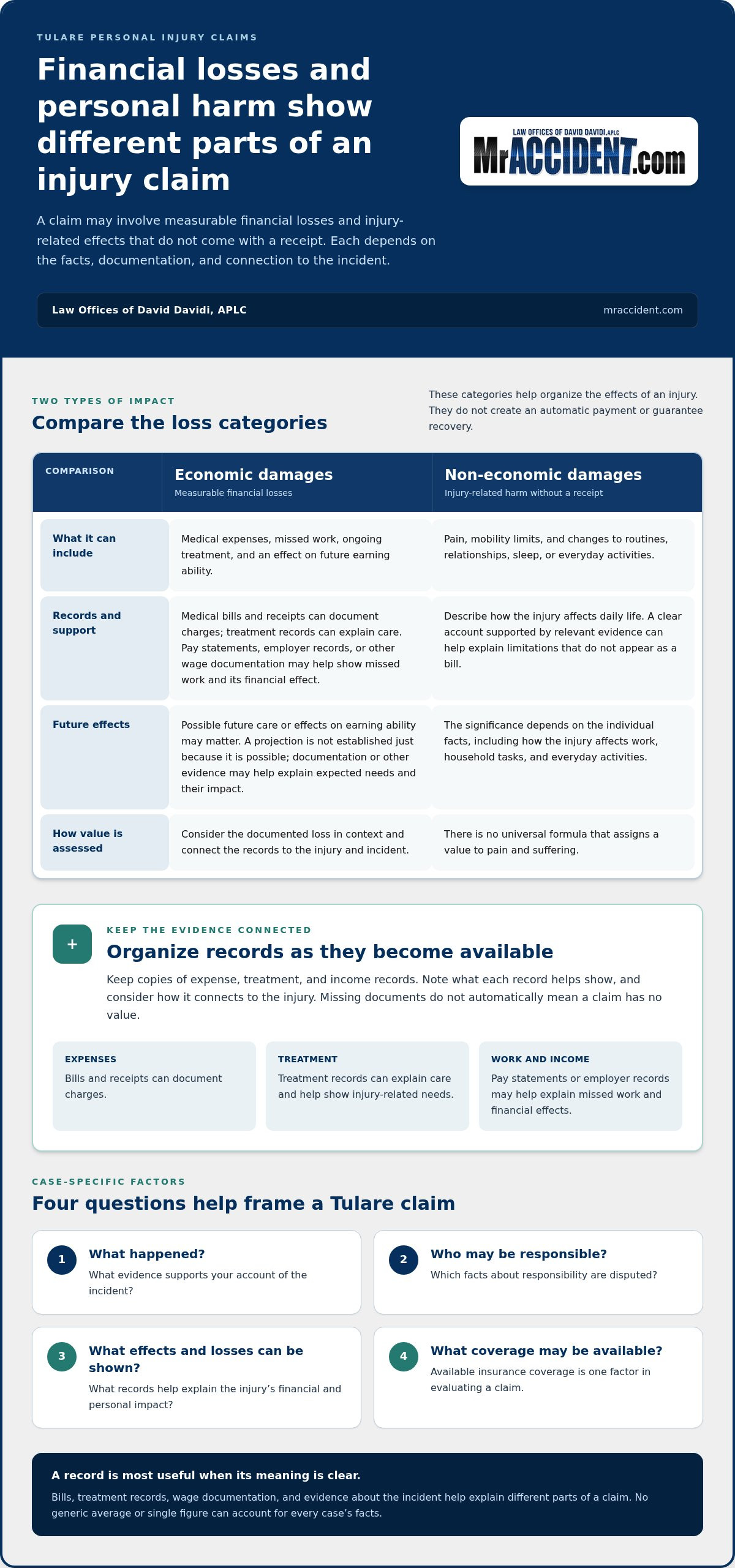
Rather than starting with a target number, organize the facts around four questions:
- What happened, and what evidence supports your account?
- Who may be legally responsible, and what facts are disputed?
- What effects and losses can records help explain?
- What insurance coverage may be available?
The Law Offices of David Davidi, APLC represents injured clients throughout California, including Tulare. With 25 years of experience, the firm handles a limited number of cases, and an attorney, not an assistant, oversees each case from start to finish. The firm returns any calls/messages within 24 hours. SE HABLA ESPAÑOL.
Which Losses and Injury Effects Can Shape a California Claim?
To understand what is my personal injury case worth in tulare, look beyond a single bill or missed shift. A claim may involve financial losses and personal effects. Each should be considered in light of the injury, the available documentation, and the facts connecting it to the incident. These categories help organize the impact; they don’t create an automatic payment or guarantee that every claimed loss will be recovered.
Economic damages are measurable financial losses, while non-economic damages describe injury-related harm that doesn’t come with a receipt. Both can matter, but they’re evaluated differently. Bills and employment records may help establish financial losses. Pain, limitations, and changes to daily life call for a clear account supported by relevant evidence.
Financial losses: treatment, missed work, and future needs
Keep records of expenses and income changes that may relate to the injury. Medical bills and receipts can document charges, while treatment records can explain the care provided. Pay statements, employer records, or other wage documentation may help show time missed from work and its financial effect. Each record should be connected to the injury and evaluated in context.
Separate costs already incurred from possible future needs. Ongoing treatment or an effect on future earning ability may be relevant, but a projection isn’t established just because it’s possible. Medical documentation or other evidence may help explain why care or work limitations are expected to continue and how they may affect you. Keep copies of records as they become available, and note what each one helps show.
Non-economic harm: pain, limitations, and daily life
Pain and suffering has no receipt, and there’s no universal formula that can assign it a value. Its significance depends on the individual facts, including how the injury affects mobility, routines, relationships, sleep, or everyday activities. A limitation that changes your workday or ability to manage household tasks may be important to describe, even though it doesn’t appear as a line item on a bill.
Consistent notes can help preserve details that are easy to forget: symptoms, activities that have become difficult, and changes in daily routines. Treatment records may provide further context. Be accurate and specific rather than overstating or minimizing the impact. Your account and supporting records work together to explain effects that financial documents alone can’t capture.
These records can help an attorney assess both the losses claimed and the evidence behind them. The firm handles a limited number of cases, and an attorney, not an assistant, oversees each case from start to finish. A case-specific injury review can help put documented financial and personal effects in context. The firm has 25 years of experience, returns any calls/messages within 24 hours, and provides support in Spanish. SE HABLA ESPAÑOL.
How Do Fault, Evidence, and Insurance Affect a Tulare Injury Claim?
For someone asking, “what is my personal injury case worth in tulare,” three questions can shape the evaluation: what evidence shows happened, who may be responsible, and what insurance coverage may be available. The location helps identify circumstances to investigate. A crash near Highway 99, for example, may have different witnesses or records than an injury in a parking lot or at a business. The location itself doesn’t establish fault or determine a claim’s value.
Evidence connects the event to the injury and helps clarify competing accounts. No single record necessarily answers every question. A report may document an incident, photographs may show conditions or damage, witnesses may describe what they observed, and medical records may help explain the injury and its timing. Each piece is more useful when considered alongside the others.
Evidence that can clarify what happened in Tulare
Preserve relevant information as soon as you can, while details are fresh and records remain accessible. Depending on the incident, useful material may include an incident or collision report, photos or videos, witness names and contact details, and medical records related to your injuries. Keep originals when possible and note when and where you obtained each item. This creates a clearer timeline without assuming any one document proves the entire claim.
Documentation can be strong, incomplete, or disputed. Consistent photos, witness accounts, and records that fit the timeline may help support an explanation. If some details are missing, that doesn’t automatically defeat a claim; other evidence may help fill gaps. If accounts conflict, assess the disagreement carefully rather than assuming one side is correct.
How disputed responsibility or limited coverage can change the analysis
Responsibility may be contested. In a California crash, for instance, the parties may disagree about what each person did before impact. California follows a pure comparative negligence rule: an injured person’s recovery may be reduced in proportion to their share of fault, rather than automatically barred because they were partly responsible. How that rule applies depends on the facts, so an attorney should assess responsibility and verify the law for the specific claim.
Insurance is another part of the analysis. Available coverage may affect potential recovery, but coverage shouldn’t be assumed based on the accident type or location. The relevant policies, applicable terms, and parties involved need to be identified. A claim’s documented impact and the evidence supporting responsibility still matter, even when coverage questions arise.
A practical review brings these threads together: compare each account with the records, identify what supports or contradicts responsibility, and determine what coverage information is available. The firm has 25 years of experience and handles a limited number of cases. An attorney, not an assistant, oversees each case from start to finish. SE HABLA ESPAÑOL.
What Should You Gather Before Seeking a Tulare Case Evaluation?
Preparing for a case evaluation doesn’t require a perfect file. A clear timeline and the records you already have can help an attorney understand what happened, how treatment has progressed, and what effects you’re experiencing. If you’re wondering “what is my personal injury case worth in tulare,” gathering information is a useful first step, but it isn’t the same as determining legal value. An attorney must assess the facts, responsibility, losses, and available coverage.
A practical record checklist for an injury claim
Keep copies in one folder, digital or paper. Organize them in this order so the events and their effects are easier to follow:
- Accident information: Write down the date, location, what you remember, and the names and contact details of witnesses. Include any incident or collision report, available photographs, and correspondence about the event. Separate what you personally observed from what someone else told you.
- Treatment records: Collect visit summaries, bills, prescriptions, referrals, and other available medical documents related to the injury. Add brief, dated notes about continuing symptoms or limitations. Keep the notes factual, including days when a symptom improves or changes.
- Work impact: Save relevant pay or employment records that show time away from work or a change in duties. Note when work was affected and how, without estimating a future income loss you can’t yet support.
- Insurance correspondence: Preserve letters, emails, claim information, and other messages from insurers. Record the date of each communication and keep copies of anything you send in response.
If a record is missing, don’t assume that means the claim has no value. Make a note of what’s unavailable and why, if you know. Don’t alter documents, fill gaps by guessing, or overstate what happened. An incomplete file can still provide a starting point for review.
Questions that help clarify the case’s impact
Alongside the documents, write down a short, factual account of how the injury has affected you over time. Consider which daily activities have become harder, whether your work routine has changed, and when those effects began or improved. Note what treatment you’ve received and whether a medical professional has discussed additional care. If you don’t know what your future needs may be, say so rather than making a prediction.
Gather records to show the timeline and impact; leave legal valuation to a case-specific review. Your notes don’t need to sound formal. Their purpose is to help preserve details and point an attorney toward questions that need a closer look.
The firm handles a limited number of cases, and an attorney, not an assistant, oversees each case from start to finish. It has 25 years of experience and returns any calls/messages within 24 hours. To discuss your records and request a case-specific injury review, contact the firm. SE HABLA ESPAÑOL.
How to Get a Personal Injury Case Reviewed in Tulare
A case-specific review can help replace guesswork with a clearer understanding of the facts that may affect your claim. If you’re asking “what is my personal injury case worth in tulare,” a review can consider your injuries, documented losses, available evidence, questions about responsibility, and insurance coverage. You don’t need to have every record in hand before starting a conversation. Sharing what you know and identifying what’s still unclear can help an attorney determine what needs closer attention.
What a case-specific review can clarify
The Law Offices of David Davidi, APLC can review the information available and discuss how the circumstances may shape a claim. That may include questions about how the injury happened, what treatment you’ve received, how your daily life or work has been affected, and what evidence or coverage information is available. The review addresses your circumstances rather than applying a generic average to your case.
A review is not a promise of a particular settlement or result. Important details may still need investigation, and the value of a claim depends on its specific facts. The firm handles only a limited number of cases, and an attorney, not an assistant, oversees each case from start to finish. That direct attorney oversight keeps your case under an attorney’s supervision throughout the process.
A straightforward next step for Tulare residents
You can begin by explaining what happened, where the incident occurred, what injuries you’ve experienced, and what records you currently have. If details remain uncertain, say so. An honest account helps the attorney focus on the right questions rather than relying on assumptions. The firm represents injured clients throughout California, including Tulare.
The Law Offices of David Davidi, APLC has 25 years of experience and offers a free consultation. Its fee policy is: No Win No Fee. We work for free, until we win! SE HABLA ESPAÑOL.
Online estimates can’t determine what your claim is worth, but a careful review can help you understand which facts may matter and what information could help explain your situation. You can request a case-specific review of your injury claim to discuss the circumstances, evidence, and questions that are most relevant to you.
Take the Next Step Toward Clarity
Not knowing what comes next can make an injury claim feel harder to manage. Instead of relying on a number drawn from someone else’s experience, focus on advice that reflects your own circumstances. If you’re still asking “what is my personal injury case worth in tulare,” a conversation with an attorney can help you identify which questions deserve attention and what information may help clarify them.
You don’t need a polished account or a complete file to begin. Explain what you know, share what concerns you, and be open about what remains uncertain. A careful discussion can help you approach the next decision with greater confidence, without promising a particular outcome.
The Law Offices of David Davidi, APLC serves injured clients throughout California, including Los Angeles, Fresno, Modesto, Bakersfield, Stockton, Tulare, Visalia, Merced, and Riverside. An attorney, not an assistant, oversees each case from start to finish, and the firm returns calls/messages within 24 hours. SE HABLA ESPAÑOL. Call 888‑529‑0707 or 888‑LAW‑0707 to request a free consultation about your Tulare injury case and take a clear, supported next step.
Frequently Asked Questions
Is there an average value for a personal injury case in Tulare?
No single average can reliably predict what an individual Tulare claim may be worth. If you’re searching “what is my personal injury case worth in tulare,” remember that settlement examples don’t account for your specific injuries, proof, responsibility, or available coverage. Even claims involving similar incidents can differ in important ways. Use averages as general background only, not as a target, promise, or substitute for a review of your own circumstances.
Can I still recover compensation if I was partly at fault in California?
Potentially, yes. California follows pure comparative negligence, so a finding of shared fault can reduce a person’s recovery in proportion to their assigned share of responsibility rather than automatically bar it. How fault is assessed depends on the evidence and circumstances of the incident. Preserve available records and avoid treating another person’s accusation as a final legal finding. An attorney can review how California’s rule may apply to your facts.
How much can medical bills and lost wages add to my case value?
There’s no fixed amount that bills or missed work automatically add to a claim. A useful first step is to compare dates on bills, treatment records, and wage documents, then note any gaps or discrepancies. For example, a pay record showing missed hours may need context about the dates and reason for the absence. Future care or earning effects require support, so don’t rely on a formula to predict an outcome.
What happens if I am still receiving medical treatment?
Your claim can still be discussed while treatment is ongoing, but some information about your recovery may remain unresolved. Keep appointment summaries and instructions together, and note when a provider discusses a change in care or activity. Follow your treating medical professionals’ guidance, and don’t delay or change treatment to influence a claim. An attorney can explain which parts of the evaluation are possible now and what may depend on later medical information.
Do I need receipts to show how an injury affected my daily life?
No. Receipts can help show purchases or expenses, but they won’t capture every change to your routine. A dated note describing a task you can no longer do comfortably, or an activity you’ve had to modify, may preserve details for later discussion. Keep these notes factual and consistent with your experience. Don’t recreate or alter records to make them seem more complete, and save relevant messages or appointment notes that add context.
Does the insurance policy limit affect what my injury case is worth?
Available coverage may affect what recovery is possible, but a policy limit alone doesn’t resolve responsibility or establish the full extent of losses. For instance, the identity of the insured party and the terms that apply may need to be clarified before coverage can be evaluated. Keep insurance letters and claim communications, including documents that describe a decision or request. Don’t assume a particular limit applies until the relevant policy information is reviewed.
How long does it take to find out what my Tulare injury case is worth?
There’s no single timetable for evaluating every claim. A preliminary discussion can identify open questions, while a more developed assessment may depend on medical information, disputed facts, or documents that are still being gathered. Ask which unresolved issue matters most and what information could help address it. Injured people in Tulare, Los Angeles, Fresno, Modesto, Bakersfield, Stockton, Visalia, Merced, and Riverside can seek representation from a firm serving clients throughout California.

Law Offices of David Davidi, APLC is a California – based Personal Injury Law Firm, our Attorney’s provide the representation for your personal injury, accident, product liability, premises liability, and other
negligence resulting in injuries. We treat all clients and cases, large or small, with hands-on care.
Practice Area
© Copyright 2026 Law Offices of David Davidi, APLC. All rights reserved.
Digital Marketing By 