
888-529-0707 call 24-7 we service throughout california
Survival Action vs Wrongful Death in California: Who Can File
The key difference in a survival action versus wrongful death in California is whose losses the claim addresses. Under California Code of Civil Procedure section 377.30, a personal representative or successor in interest may bring a survival action for claims the deceased person could have pursued. Eligible surviving family members may bring a wrongful death claim for their own losses, and both claims may be filed in some cases.
After a fatal accident, it may seem that one lawsuit should cover everything. But a survival action and a wrongful death claim serve different purposes: one addresses the injured person’s losses before death, while the other addresses eligible family members’ losses caused by the death.
This guide explains what each claim may cover, who may file, and how California families can pursue both. It compares damages, deadlines, and filing roles to help you understand which legal path may fit your family’s situation.
Key Takeaways
- Identify whether a claim seeks recovery for the deceased person’s losses before death or for surviving family members’ losses afterward.
- Learn which pre-death expenses and economic losses may be included in a survival action, and how California’s rules treat pain and suffering.
- Understand which relatives and dependents may qualify to bring a wrongful death claim.
- See how both claims may be pursued together while remaining distinct in who files and what losses they address.
- Compare the filing deadlines and claimant requirements so you can recognize the steps that may need attention first.
What are survival actions?
California Code of Civil Procedure section 377.30 lets a personal representative or successor in interest continue a claim the victim could have brought. If the injured person dies before filing suit, the claim may survive their death; it doesn’t automatically become a wrongful death claim.
The survival action vs wrongful death in California distinction is about whose losses each claim addresses. A survival action covers the victim’s losses before death, while a wrongful death claim addresses eligible family members’ losses.
Survival action damages
A survival action may seek the victim’s medical expenses, lost wages, property damage, and other economic losses incurred before death. Any recovery becomes part of the estate and is distributed under the will or California inheritance laws. Wrongful death damages, by contrast, compensate eligible family members for their own losses.
Punitive damages may also be sought if the defendant’s conduct meets the applicable legal standard. Wrongful death claims generally do not allow punitive damages, except when the death resulted from a felony homicide. This is another important distinction in the survival action vs wrongful death in California comparison.
| Claim or damages | What it addresses | Who benefits |
|---|---|---|
| Survival action | Victim’s pre-death economic losses | The decedent’s estate |
| Wrongful death claim | Family losses, such as companionship and financial support | Eligible surviving claimants |
| Punitive damages | Qualifying defendant conduct in a survival action | Included in the estate’s recovery |
To identify the relevant claim, ask whose losses the damages would compensate: the victim’s estate, surviving family members, or both.
Death before filing suit
If the injured person dies before filing suit, California Code of Civil Procedure section 377.30 allows the personal representative to bring a surviving claim. If no personal representative exists, the decedent’s successor in interest may commence it.
For example, if a crash victim incurs medical bills and lost wages before dying, a survival action can seek those losses for the estate. A separate wrongful death claim may address the family’s resulting losses, such as lost support or companionship.
Pain, suffering, and disfigurement follow a separate rule. California’s temporary provision covered qualifying actions filed on or after January 1, 2022 and before January 1, 2026. For actions filed on or after January 1, 2026, those damages are generally not recoverable in a survival action. The injury date alone doesn’t preserve recovery under the expired temporary provision.
To preserve damages under that temporary rule, the action had to be filed within its window and the applicable limitation period. A survival action generally must be filed within two years of the injury or six months after death, whichever is later. An exception may apply to qualifying cases with a trial preference under Code of Civil Procedure section 36 before January 1, 2022.
What Is a Wrongful Death Claim?
A California wrongful death claim seeks compensation for eligible survivors’ losses after someone dies because of another party’s negligence. California Code of Civil Procedure section 377.60 identifies who may bring this claim.
Survival action and wrongful death settlements follow different paths. A survival recovery becomes part of the estate and is distributed under the will or California inheritance laws. A wrongful death recovery addresses eligible family members’ losses, rather than the deceased person’s estate claim.
Useful evidence may include the death certificate, medical records, accident reports, funeral bills, and records showing financial support or family relationships. These documents help establish what happened, which losses are involved, and how surviving relatives were connected to the deceased.
California wrongful death claims
A wrongful death claim addresses losses surviving family members experience because of the death. Eligible claimants may seek compensation for lost financial support, household services, future benefits or gifts, funeral and burial expenses, and loss of companionship, love, affection, guidance, or emotional support.
Unlike a survival action, a wrongful death claim does not seek the victim’s pre-death medical bills or lost wages for the estate. Wrongful death claims generally do not allow punitive damages, except when the death resulted from a felony homicide.
Wrongful death claim eligibility
Under California Code of Civil Procedure section 377.60, eligible claimants include a surviving spouse or domestic partner and the deceased’s children. Certain dependent stepchildren and minors who lived in the decedent’s household for at least 180 days and relied on the decedent for at least half of their support may also qualify.
Parents or other heirs may qualify in some cases when closer relatives are unavailable. Eligibility depends on the claimant’s relationship to the deceased and, for some claimants, dependency or household circumstances.
Claim purpose and beneficiaries
The two claims protect different interests. A survival action continues the deceased person’s own legal claim, while wrongful death compensates eligible survivors for harms they personally suffered after the death.
For example, the estate may pursue pre-death medical expenses through a survival action. A spouse or child may seek compensation for lost support or companionship through a wrongful death claim. Funeral expenses may be recoverable through either claim, depending on who paid them.
When preparing to file, gather records connecting the accident, death, and claimed losses. Medical bills and treatment records can document care before death; funeral receipts show expenses paid. Financial records may help demonstrate support or household contributions, while family and dependency records can help establish a claimant’s relationship and eligibility.
A lawyer can help assess how negligence evidence and family-loss records fit together; legal guidance after a fatal accident can help clarify the claims and potential beneficiaries.
Filing survival and wrongful death claims together
California families may pursue survival and wrongful death claims together in some cases. The claims remain distinct, with different claimants, losses, and filing deadlines.
Survival action deadlines
A survival action generally must be filed within two years of the injury or six months after the decedent’s death, whichever is later. This differs from wrongful death’s usual focus on the date of death. If death occurs after the injury, compare both periods rather than assuming the death date controls the survival claim.
The personal representative, or successor in interest if there is no representative, brings the decedent’s surviving claim. Track the injury date, death date, and estate appointment documents separately. These details help identify the applicable period and who can act for the estate.
Wrongful death deadlines
A wrongful death action typically must be filed within two years of the person’s death, according to the California Legislature. Its deadline differs from the survival action’s injury-based period. The family’s wrongful death claim and the estate’s claim therefore need separate deadline calculations, even when both arise from one accident.
Filing one claim does not necessarily preserve the other. In Quiroz v. Seventh Ave. Center, 140 Cal.App.4th 1256, a survival claim added by amended complaint did not relate back to the family’s timely wrongful death complaint. That ruling makes it important to identify both claims before filing.
In some cases, both claims can proceed in one lawsuit. Eligible surviving claimants bring the wrongful death claim, while the personal representative or successor in interest pursues the decedent’s surviving claim. The claims may share facts about the accident and alleged negligence, but each seeks compensation for different losses.
A practical filing review should separate the claims before deadlines approach:
- Record the injury date and date of death to calculate the survival-action period.
- Calculate the wrongful death deadline from the date of death.
- Identify the eligible family claimants and the estate’s personal representative or successor in interest.
- List each claim’s losses separately, such as pre-death expenses for the estate and family losses for wrongful death.
These steps matter because a timely wrongful death complaint may not preserve a survival action. Keep the estate’s personal injury records, family-loss documentation, and filing dates organized as distinct parts of the case.
California filing deadlines may also depend on the circumstances and applicable exceptions. A personal representative should preserve records showing when the injury occurred, when the decedent died, and when the estate representative was appointed. Those dates help clarify which deadline applies to each claim and who has authority to pursue it.
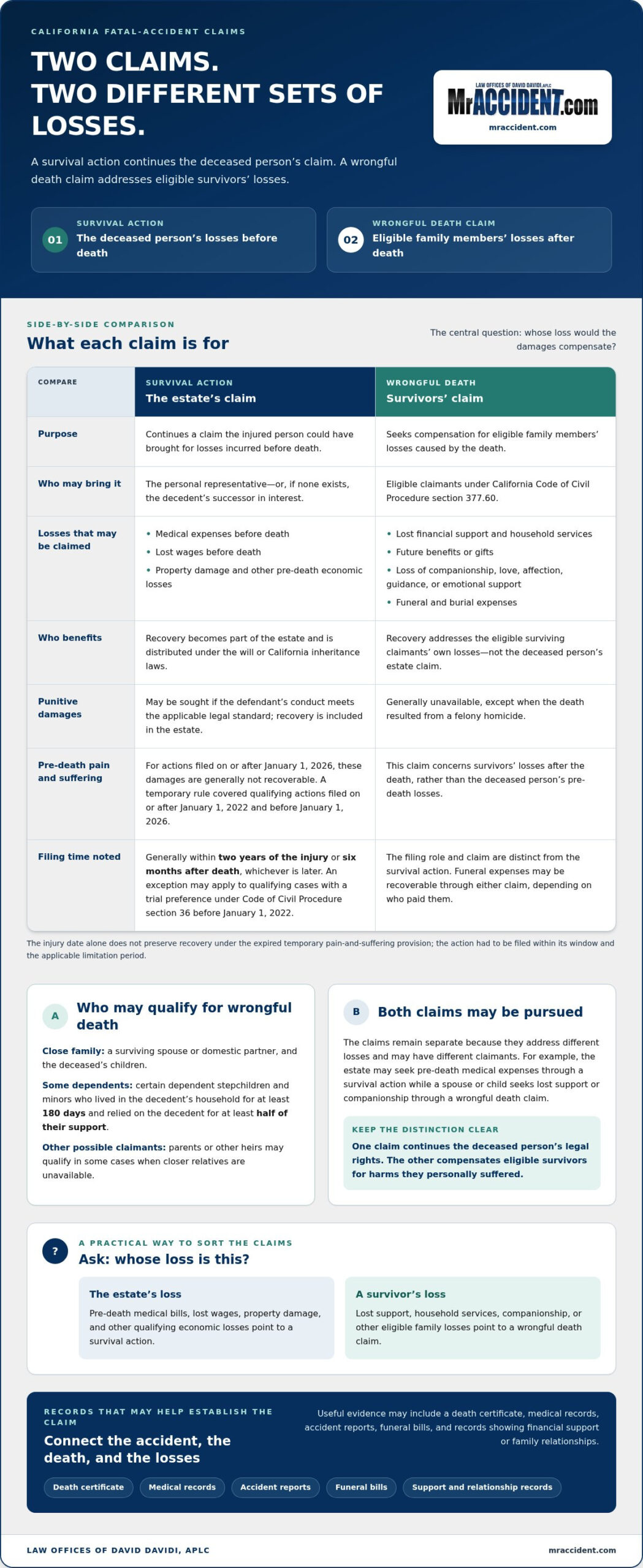
Who may bring wrongful death and survival actions
California law assigns survival actions and wrongful death claims to different people. Code of Civil Procedure sections 377.30 and 377.60 distinguish who may pursue each claim and whose interests it protects.
Under section 377.30, the decedent’s personal representative may file a survival action. If no personal representative exists, the decedent’s successor in interest may commence it.
A successor in interest steps forward to pursue a claim the deceased person could have brought. California Code of Civil Procedure section 377.32 addresses the affidavit requirements for successors in interest. The claim remains the decedent’s, even though someone else brings it after death. Any compensation sought through that action concerns the decedent’s surviving legal claim, not a relative’s separate wrongful death claim.
The personal representative’s role differs from a family member’s role in wrongful death litigation. Section 377.30 also makes survival actions subject to Chapter 1, commencing with section 7000, of Part 1 of Division 7 of the Probate Code. These rules connect the surviving claim to estate administration. A relative’s personal relationship to the decedent alone doesn’t make that person the representative or successor in interest.
For a wrongful death claim, Code of Civil Procedure section 377.60 identifies eligible claimants. They include the surviving spouse or domestic partner and the deceased’s children. Certain dependent stepchildren and other heirs may qualify under the statute, including parents when no closer relatives are available. Their claim is distinct from the estate’s survival action because it addresses survivors’ losses.
A minor may qualify under section 377.60 if the child lived in the decedent’s household for at least 180 days and relied on the decedent for at least half of their support. Both facts matter: household residence and financial dependence. For instance, a minor who lived elsewhere or received less than half their support from the decedent may not meet this specific eligibility test, though another statutory basis could apply.
Before preparing either claim, identify who may file and keep the roles distinct:
- Identify the estate’s personal representative, if one exists.
- If none exists, determine who may act as successor in interest and address section 377.32’s affidavit requirements.
- List relatives who may qualify under section 377.60, then assess any dependency or household requirements.
An attorney can help distinguish these roles and organize the information supporting each claimant’s interest. The personal representative or successor pursues the decedent’s claim; eligible relatives bring the wrongful death claim for their own losses.
Differences between survival actions and wrongful death lawsuits
In California, a survival action and wrongful death lawsuit can arise from the same fatal injury, but they protect different interests. The key distinction is whether the claim belongs to the deceased person’s estate or addresses losses suffered by surviving family members.
A survival action continues the decedent’s personal injury claim under Code of Civil Procedure sections 377.30 and 377.34. A wrongful death claim under section 377.60 belongs to eligible survivors. The claims can proceed together, but one lawsuit does not merge their legal purpose, beneficiaries, or damages.
| Comparison point | Survival action | Wrongful death claim |
|---|---|---|
| Whose claim | The decedent’s claim continues through an authorized representative. | Eligible family members pursue their own claim. |
| Purpose | Address losses the deceased incurred before death. | Address harm survivors experience because of the death. |
| Typical damages | Pre-death medical expenses, lost wages, and property damage. | Loss of support, household services, companionship, and funeral expenses. |
| Recipient | Recovery becomes part of the estate. | Recovery compensates eligible claimants for their losses. |
| Punitive damages | May be sought when the defendant’s conduct meets the legal standard. | Generally unavailable, except in felony homicide cases. |
| Filing role | Personal representative or successor in interest. | Eligible survivors identified by California law. |
| Time focus | Injury date and death date can affect the deadline. | The general filing period is measured from death. |
These differences shape how evidence and expenses are organized. A medical bill for treatment before death may support the estate’s claim. Evidence of lost financial support or companionship relates to survivors’ separate losses. Funeral expenses may be recovered through either action, depending on who paid them.
The damages also differ for pain and suffering. For survival actions filed on or after January 1, 2026, the deceased person’s pain, suffering, and disfigurement are generally not recoverable. That rule does not transform the family’s grief into estate damages; wrongful death focuses on legally recognized losses to eligible survivors.
Consider a fatal crash involving hospital treatment before death. The estate may pursue documented medical expenses and lost wages from that period. A spouse or child may separately seek compensation for lost support or companionship. Keeping invoices, wage records, and family-loss evidence tied to the correct claim helps show which losses belong to whom.
To compare the claims in a specific fatal accident, identify the claimant, the loss, and the record supporting it. If you need help evaluating a family’s wrongful death claim, discuss your wrongful death claim.
Law Offices of David Davidi, APLC: Car Accident Legal Representation
Law Offices of David Davidi, APLC represents California families in wrongful death claims after fatal car accidents. The firm also represents people affected by fatal truck, motorcycle, and pedestrian accidents.
If you’re unsure how the family’s claim differs from the deceased person’s estate claim, an attorney can assess the circumstances, identify the relevant losses, and explain the legal process. The firm provides direct access to experienced attorneys and works on a no-win, no-fee basis.
For guidance about a fatal accident claim, contact Law Offices of David Davidi, APLC or visit mraccident.com.
Take the Next Step With Clear Records
If you’re weighing a survival action versus a wrongful death claim in California, prepare a focused summary of the case. Create a timeline of the accident, medical treatment, and death. Gather the records already available, then note which documents still need to be located. This can help keep important details organized for a conversation with an attorney.
Also write down who is handling the estate and which relatives may have potential claims. These roles can raise separate questions, so recording names and relationships can make the next discussion more productive. You don’t need to resolve every legal issue before seeking guidance.
Law Offices of David Davidi, APLC represents people and families in cases involving fatal car, truck, and motorcycle accidents. To discuss your situation and possible next steps, contact Law Offices of David Davidi, APLC.
A careful conversation can help you move forward with greater clarity and support.
Frequently Asked Questions
Can Both Claims Be Filed Together?
Yes, both claims may be pursued in the same case when the facts support each one. For example, after a fatal collision, the estate’s claim might address losses the victim incurred, while eligible relatives pursue losses they experienced. Keep evidence organized by claim: records about the victim’s treatment support the estate’s case, while family and financial records help explain survivors’ losses.
What Damages Can Families Recover?
Eligible family members may seek compensation for losses caused by the death, including lost financial support, household services, companionship, and funeral or burial expenses. Consider how the deceased contributed to daily life, not only income. For example, household spending records may help show financial contributions, while relatives can describe the guidance or support they relied on. The claim addresses survivors’ harm, not the deceased person’s pre-death expenses.
What Happens When Negligence Leads to Loss?
A fatal-accident claim must connect the responsible party’s failure to use reasonable care with the death and resulting losses. In a crash, for example, evidence may show how the collision happened and whether a driver’s conduct caused it. The estate’s claim and surviving relatives’ claims address different losses, even if they rely on evidence about the same event. A clear timeline can help connect the accident to its later consequences.
Who Files Each Claim?
The estate’s personal representative, or successor in interest when there is no representative, files the survival action. Eligible survivors bring the wrongful death claim for their own losses. These roles do not automatically belong to the same person. A relative may qualify to bring a wrongful death claim but still need separate authority to act for the estate. Identify each claimant’s role before preparing documents or discussing a settlement.
Who Brings Them?
Who brings each claim depends on the legal interest involved. A personal representative or successor in interest acts for the deceased person’s surviving claim; qualifying relatives pursue wrongful death losses. If one family member handles estate matters, that alone does not establish their eligibility for every claim. Write down who represents the estate and which relatives may have individual claims, then keep their supporting records distinct.
Who Is Eligible to Bring a Wrongful Death Lawsuit in California?
California law identifies eligible claimants, including a surviving spouse or domestic partner and the deceased’s children. Certain dependent stepchildren, minors who meet household and support requirements, parents, or other heirs may also qualify depending on the circumstances. A family tree can help identify potential claimants, but relationship alone may not resolve every relative’s eligibility. Dependency and household facts can matter for some claimants.
What Damages Can Be Recovered in a California Survival Action?
A survival action may seek losses the deceased incurred before death, such as medical bills, lost wages, and property damage. Gather itemized bills, wage documentation, and repair or replacement records to connect each amount to the injury. The claim is brought for the estate, not as compensation for relatives’ grief. For actions filed on or after January 1, 2026, the deceased’s pain, suffering, and disfigurement are generally not recoverable.
What Damages Can Family Members Recover in a California Wrongful Death Case?
Family members may seek compensation for the support, services, and personal connection they lost because of the death. The relevant proof depends on the loss: household and financial records may show contributions, while family members can describe the deceased’s guidance and companionship. Funeral and burial expenses may also be claimed, depending on who paid them. These damages belong to eligible survivors rather than becoming part of the deceased person’s estate.

Law Offices of David Davidi, APLC is a California – based Personal Injury Law Firm, our Attorney’s provide the representation for your personal injury, accident, product liability, premises liability, and other
negligence resulting in injuries. We treat all clients and cases, large or small, with hands-on care.
Practice Area
© Copyright 2026 Law Offices of David Davidi, APLC. All rights reserved.
Digital Marketing By 