
888-529-0707 call 24-7 we service throughout california
California Helmet Law: Bicycle Fines and Penalties
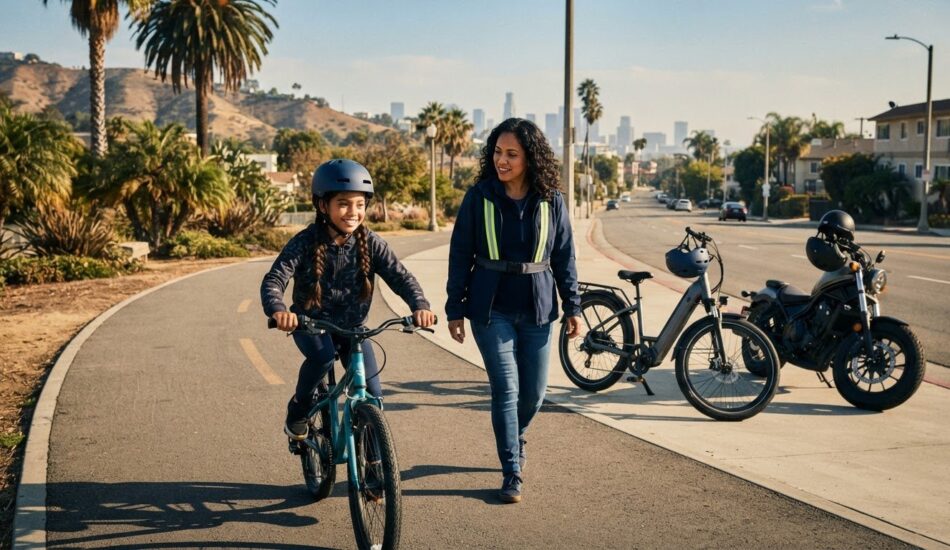
For young cyclists, California’s helmet rule can carry a fine for a parent or guardian. Under the california helmet law, people under 18 must wear helmets while bicycling in specified areas; the maximum fine for violating this youth rule is $25, payable by a parent or guardian. Motorcycle, motor-driven cycle, and motorized-bicycle drivers and passengers must also wear helmets under Vehicle Code Section 27803, according to the California State Legislature. Adults riding ordinary bicycles aren’t covered by the statewide youth rule, though local helmet rules may apply.
Those distinctions matter. A citation involving a young bicycle rider raises different questions from a motorcycle helmet violation, and both are separate from the legal issues that may follow a crash. It’s reasonable to ask what counts as wearing a helmet, why these laws exist, and who is responsible when a minor rides without one. This guide explains California helmet law, including bicycle rules, parental responsibility, and penalties that may apply to motorcycle and e-bike riders, so you can understand how the requirements relate to your situation.
Key Takeaways
- Learn what California law means by wearing a helmet and which riders must follow the statewide requirements.
- Understand why helmet rules focus on preventing serious head injuries and how safety benefits shape them.
- See when a parent or guardian may be responsible for a minor’s bicycle helmet fine.
- Compare the potential consequences of motorcycle helmet violations with the rules for different e-bike classes.
- Find out when an injury claim after a bicycle or motorcycle crash may call for legal guidance.
Why Are Helmet Laws Necessary?
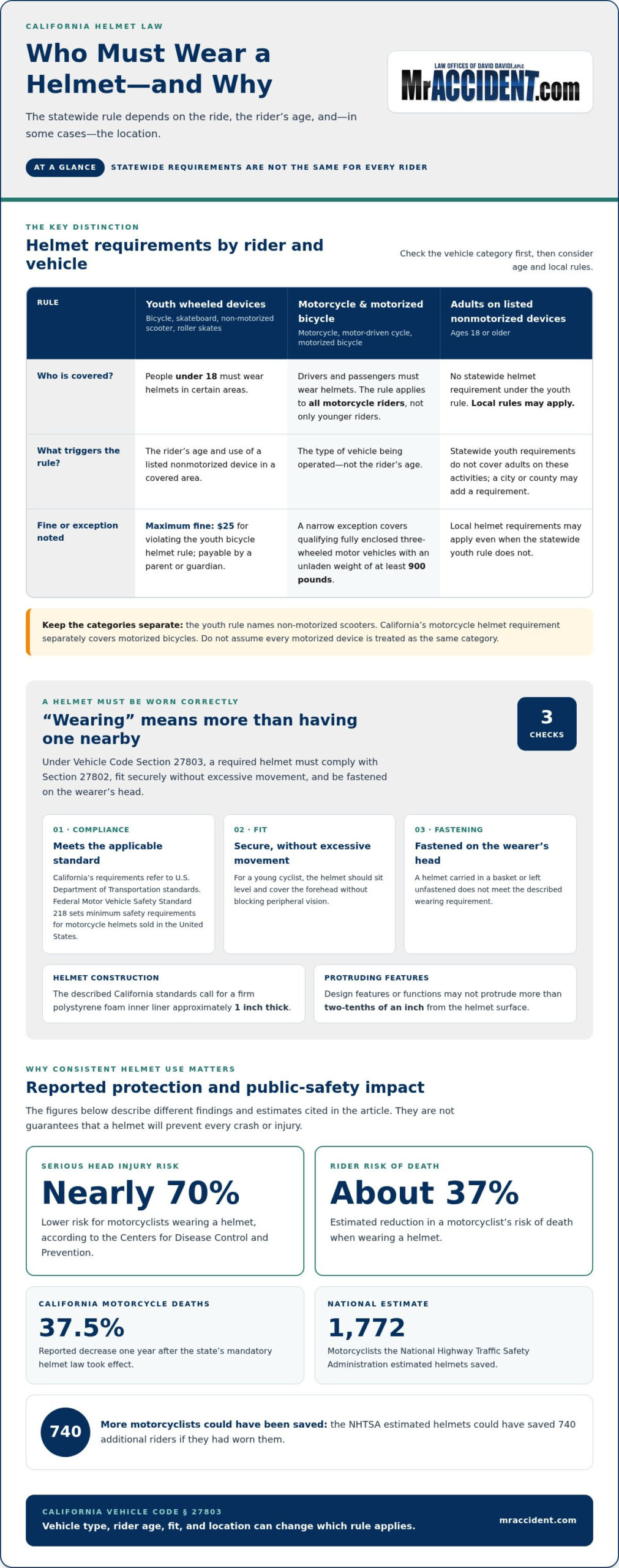
Helmet rules distinguish motorcycles from bicycles, and California sets different requirements for each. According to the California State Legislature, California Vehicle Code Section 27803 requires motorcycle, motor-driven cycle, and motorized bicycle drivers and passengers to wear safety helmets. This statewide rule applies to all motorcycle riders, not only younger riders. For a motorcycle passenger, the requirement applies too. The law focuses on the vehicle being operated, so identifying the type of ride matters before considering the rider’s age.
California also protects young people using several nonmotorized wheeled devices. According to the California State Legislature, people under 18 must wear helmets when riding bicycles, skateboards, non-motorized scooters, or roller skates in certain areas. A child riding a bicycle and a teenager using a skateboard both fall within this youth rule. For adults aged 18 or older, California has no statewide helmet requirement for those listed activities, although municipal rules may apply. The difference is important: the statewide youth requirement doesn’t make every adult cyclist subject to the same rule.
What counts as wearing a helmet? Under section 27803, a required helmet must comply with section 27802, be fastened on the wearer’s head, and fit securely without excessive movement. A helmet carried in a basket or left unfastened doesn’t meet that description. Fit matters because a loose helmet can shift during a fall. For a young cyclist, a helmet should sit level and cover the forehead without blocking peripheral vision. Those practical checks help distinguish wearing a helmet from simply having one nearby.
The motorcycle rule also has a narrow vehicle-based exception. According to the California State Legislature, section 27803 exempts qualifying fully enclosed three-wheeled motor vehicles with an unladen weight of at least 900 pounds. The exception concerns the vehicle’s enclosure, wheel configuration, and unladen weight. It isn’t a general exemption for a rider who prefers not to wear a helmet. Religious belief is not identified as an exception in the requirements described here; the specified exception turns on vehicle design.
What about scooters, skateboards, and other wheeled devices? People under 18 must wear helmets on bicycles, skateboards, non-motorized scooters, and roller skates in certain areas. The rule described here names non-motorized scooters, so don’t assume it treats every motorized device as the same category. California’s motorcycle helmet requirement separately covers motorized bicycles under section 27803.
Do requirements vary by city or county? Statewide rules apply across California, but local rules can add helmet requirements, including for adult bicycle riders. An adult cyclist may therefore face a local requirement even when the statewide rule for young riders does not apply. Identify the device and location involved: a minor on a bicycle, an adult on a skateboard, and a motorcycle passenger may be subject to different parts of the law.
Purpose and safety effects of helmet laws
Helmet laws address a specific risk in a motorcycle accident: severe head injury. The Centers for Disease Control and Prevention reports that wearing a motorcycle helmet reduces the risk of serious head injury by nearly 70 percent. A separate estimate puts the reduction in a rider’s risk of death at approximately 37 percent. These figures explain why helmet rules focus on consistent use, not simply carrying protective equipment. A helmet can help limit harm, but it can’t prevent every injury or crash.
California’s experience also illustrates the public-safety purpose. Motorcycle deaths reported in the state dropped by 37.5 percent one year after its mandatory helmet law took effect. Nationwide, the National Highway Traffic Safety Administration estimated that helmets saved approximately 1,772 motorcyclists. It estimated that helmets could have saved 740 more motorcyclists if those riders had worn them. These estimates show why helmet laws address both individual protection and preventable deaths across the riding public.
How do California helmet laws compare with federal helmet safety standards? California law determines which riders must wear helmets, while federal standards set minimum safety requirements for motorcycle helmets sold in the United States. Federal Motor Vehicle Safety Standard 218 covers helmet safety specifications; California’s requirements use standards adopted by the state and identified as U.S. Department of Transportation standards. The law’s wearing rule and the helmet’s safety standard work together, but they answer different questions.
Riders can focus on three practical checks before a trip: the helmet’s compliance, fit, and fastening. Look for a helmet that meets the applicable U.S. Department of Transportation standard. Under California Vehicle Code section 27803, a required helmet must comply with section 27802, fit securely without excessive movement, and be fastened on the wearer’s head. A loose helmet or one left unfastened doesn’t satisfy that wearing requirement. These checks matter even on a short ride through familiar streets.
Helmet construction also affects protection. California’s helmet standards call for a firm polystyrene foam inner liner approximately 1 inch thick and prohibit design features or functions that protrude more than two-tenths of an inch from the helmet surface. The standards address how the helmet is built, while secure fit addresses how it sits on the rider. A helmet that meets a product specification still needs to be worn correctly to provide its intended protection.
Bicycle helmets are designed for a different vehicle category than motorcycle helmets, so riders should choose one suited to their vehicle. Motorcycle and bicycle helmets are designed for different vehicle categories, so their certification standards are not interchangeable. Riders can reduce avoidable risk by choosing a helmet for the vehicle and fastening it properly before riding. Safety figures describe reduced risk, not immunity from injury; a compliant helmet is one protective measure among several.
Bicycle helmet fines and parental responsibility
California’s youth bicycle helmet rule applies to people under 18 riding in certain areas. If a young cyclist violates that requirement, the maximum fine is $25, and a parent or guardian is responsible for paying it. The amount is a ceiling, not a statement that every case automatically results in the maximum. The key distinction is that the rule places payment responsibility on the adult, even when the rider is a minor.
Age, activity, and location help identify whether the rule applies. For example, a 16-year-old riding a bicycle in an area covered by the requirement must wear a helmet. An adult riding an ordinary bicycle isn’t covered by this statewide youth rule, though local helmet rules may apply. A skateboard, non-motorized scooter, or roller skates can also fall under the youth requirement in specified areas. The device and the place of riding both matter.
Parental responsibility goes beyond reminding a child to wear a helmet. California’s rule makes a parent or guardian responsible for paying the fine under the youth law, and parents may be held liable if minors ride without appropriate headgear. Checking a child’s helmet before a ride is a practical precaution. Make sure it sits level, covers the forehead, and does not obstruct peripheral vision.
Keep the legal issue precise. The stated maximum applies to the specified youth helmet law; it shouldn’t be treated as a universal fine for every cyclist or every wheeled device. A 17-year-old riding a bicycle and an adult riding one are not in the same age category under the statewide youth rule. Likewise, the relevant requirement concerns wearing a helmet, not merely having one in a backpack or attached to the bicycle.
If a citation concerns a minor, focus on the facts that determine which rule applies: the rider’s age, the device, the location, and whether a helmet was worn. These details help distinguish a youth bicycle violation from a local rule that may apply to an adult. A parent or guardian can keep the citation and note where the ride occurred to clarify the requirement and responsibility for the fine.
The rule is intended to prevent injury, but a fine and an injury are separate concerns. A helmet can reduce the risk of head injury, while a bicycle collision may raise separate questions about how the crash happened and who was responsible. If a minor is injured in a bicycle accident, the circumstances of the collision matter beyond the helmet citation. Keeping these issues distinct helps families understand what the fine addresses and what an injury claim may involve.
Penalties for riding without a helmet
For motorcycle riders, California’s stated penalty for riding without an acceptable safety helmet is a fine of up to $250 and/or one year of probation. The phrase “and/or” allows the stated penalty to involve a fine, probation, or both. The rule concerns an acceptable helmet, so simply carrying one does not satisfy the requirement to wear it while riding. Riders and passengers should treat helmet use as part of preparing the motorcycle for traffic.
The motorcycle penalty differs from the rule for a young bicycle rider. These laws cover different vehicles and situations, so a motorcycle penalty does not automatically apply to everyone riding without a helmet. First identify the vehicle: a motorcycle, motor-driven cycle, motorized bicycle, and non-motorized bicycle may each be subject to different requirements. The rider’s age and location can also matter, particularly under bicycle helmet rules.
Helmet compliance involves more than choosing any head covering. Under California’s motorcycle requirements, the helmet must meet applicable standards, fit securely, and be fastened on the wearer’s head. A helmet that shifts excessively or is left unfastened may not meet the legal wearing requirement. Before riding a motorcycle, confirm the helmet is appropriate for that vehicle and secured as intended.
Electric bicycles have separate helmet rules, and violating California e-bike helmet laws can lead to fines. The rule varies by class and rider age, so identifying the e-bike class is an important first step. For example, a Class 3 e-bike rider must wear a helmet regardless of age. Don’t treat every e-bike as a standard bicycle when considering helmet requirements or potential penalties.
A traffic stop or citation can raise questions about the vehicle involved and whether the helmet met the requirement. Keep the citation and note the vehicle type, helmet worn, and circumstances of the ride. These details help distinguish a motorcycle matter from an e-bike or bicycle issue, rather than relying on the general phrase “riding without a helmet.”
A helmet penalty and an injury claim address different concerns. The penalty concerns compliance with a helmet rule; a claim after a crash concerns what caused the collision and the resulting harm. If a rider is injured in a motorcycle or bicycle accident, preserve records about the crash and the helmet involved. These facts can help clarify what happened without treating a citation as a complete account of the accident.
For people riding motorcycles, motor-driven cycles, or motorized bicycles, the practical takeaway is straightforward: wear an acceptable, properly fastened helmet before entering traffic. E-bike riders should identify the class and applicable age requirement before riding. These steps can help avoid preventable helmet violations and support safer travel on California roads.
Are helmets required for electric bicycle riders in California, and does the rule vary by class?
Yes, California’s e-bike helmet rules depend on the bicycle class and the rider’s age. Class 3 riders must wear helmets regardless of age. For Class 1 and Class 2 riders, the statewide youth helmet rule applies to people under 18 in certain areas. Adults aged 18 or older aren’t covered by that statewide youth requirement for those classes, although local rules may apply.
The class describes how the motor assists, not just how fast a rider chooses to travel. A Class 1 e-bike assists only while the rider pedals, and assistance stops at 20 mph. A Class 2 e-bike can move under motor power without pedaling up to 20 mph. A Class 3 e-bike assists only while pedaling and stops assisting at 28 mph. Knowing the class helps identify the helmet rule that applies.
For example, an adult on a Class 1 e-bike isn’t subject to the statewide youth helmet requirement, while a Class 3 rider must wear a helmet regardless of age. A person under 18 riding a Class 2 e-bike must follow the youth rule in areas where it applies. These distinctions make age, class, and location useful facts to establish before deciding whether a helmet is legally required.
Check the class information supplied with the e-bike or displayed on its labeling. Then consider the rider’s age and where the ride will take place. Don’t assume that a throttle or pedal assist alone determines the helmet obligation. Class 1 and Class 3 both use pedal assistance, but their assistance limits differ, and Class 3 has its own helmet requirement for riders of every age.
The distinction also matters after a crash. If a rider is injured, the e-bike’s class, the rider’s age, the location, and helmet use can help describe the circumstances. A helmet citation and the cause of a collision are separate issues: the helmet rule concerns required protective equipment, while an injury claim concerns how the accident happened and the harm that followed.
If an e-bike collision caused an injury, preserve the bicycle’s class information and any records describing the crash. Photos, the location, and details about helmet use can help keep the facts clear. To discuss an injury after an e-bike collision, get help with a bicycle accident claim.
Before riding, match the e-bike’s class to the rider’s age and route. For Class 3, every rider needs a helmet under California’s rule. For Class 1 or Class 2, the statewide youth requirement applies to riders under 18 in specified areas, and local rules may add requirements. That quick distinction helps riders make a more informed choice before heading out.
Law Offices of David Davidi, APLC: Car Accident Legal Representation
Law Offices of David Davidi, APLC represents people injured in car, truck, motorcycle, and pedestrian accidents throughout California, including Los Angeles, Fresno, Modesto, Bakersfield, Stockton, Tulare, Visalia, Merced, and Riverside. If a bicycle or motorcycle crash left you with medical concerns, lost income, or questions about responsibility, legal guidance can help clarify the issues surrounding an injury claim.
A helmet citation and a personal injury claim are separate matters. The citation concerns compliance with a safety rule; an accident claim examines how the collision happened, who may be legally responsible, and what injuries followed. The firm represents people injured in accidents and can help you understand your legal options after a crash.
If you’d like to discuss an accident injury, contact Law Offices of David Davidi, APLC.
Take the Next Step With Confidence
Understanding how California helmet law applies can help you make sense of a citation, but an injury after a crash raises separate concerns. Focus on how the collision has affected your health, ability to work, and recovery. Clear legal guidance can help you consider those issues while keeping your well-being in focus.
Law Offices of David Davidi, APLC represents people injured in car, truck, and motorcycle accidents. If you’re weighing what to do after a collision, you can discuss the circumstances and your options with the firm. You don’t have to sort through every legal question alone.
Connect with Law Offices of David Davidi, APLC to discuss an accident injury and take a considered next step. Whatever the circumstances, give yourself room to focus on recovery and move forward with support.
Frequently Asked Questions
What Does It Mean to Wear a Helmet?
Wearing a helmet means putting on one suited to the vehicle, fastening it, and securing it so it fits properly while you ride. A helmet sitting loosely on your head or resting on a bicycle is not being worn. For a practical check, fasten the strap and make sure the helmet does not shift excessively. The required fit and compliance depend on the vehicle and the applicable rule.
Who is required to wear a helmet under California law?
Motorcycle, motor-driven cycle, and motorized bicycle drivers and passengers must wear helmets under California Vehicle Code Section 27803, according to the California State Legislature. People under 18 must wear helmets while using bicycles, skateboards, non-motorized scooters, or roller skates in certain areas, also according to the California State Legislature. Class 3 e-bike riders must wear helmets regardless of age. For other bicycles, age and local rules matter.
What are California’s motorcycle helmet requirements and approved helmet standards?
California requires motorcycle riders and passengers to wear acceptable safety helmets. Federal Motor Vehicle Safety Standard 218 sets minimum safety requirements for motorcycle helmets sold in the United States. California’s requirements rely on standards adopted by the state and identified as U.S. Department of Transportation standards. When choosing a helmet, distinguish motorcycle standards from bicycle helmet certification, which is identified with the Consumer Product Safety Commission.
What is California’s bicycle helmet law by age and riding situation?
People under 18 must wear helmets while bicycling in certain areas; the statewide youth rule also covers skateboards, non-motorized scooters, and roller skates. Adults aren’t subject to a statewide helmet requirement for ordinary bicycles, but municipal rules can apply. E-bike riders should identify their class: Class 3 requires helmets at every age, while the youth requirement applies to under-18 riders on other classes in specified areas.
What are the fines or penalties for violating California helmet laws?
For violating the specified youth helmet law, the maximum bicycle-related fine is $25, and a parent or guardian is responsible for paying it. The stated penalty for riding a motorcycle without an acceptable safety helmet is a fine of up to $250 and/or one year of probation. Violations of California e-bike helmet laws can also lead to fines. The applicable consequence depends on the vehicle and rule involved.

Law Offices of David Davidi, APLC is a California – based Personal Injury Law Firm, our Attorney’s provide the representation for your personal injury, accident, product liability, premises liability, and other
negligence resulting in injuries. We treat all clients and cases, large or small, with hands-on care.
Practice Area
© Copyright 2026 Law Offices of David Davidi, APLC. All rights reserved.
Digital Marketing By 