
888-529-0707 call 24-7 we service throughout california
Car Accident Deposition Prep: A California Guide

Your strongest deposition answer may be the one you haven’t rehearsed. The key to how to prepare for a deposition in a car accident case isn’t memorizing a script. It’s understanding the process and giving truthful, careful answers, even when you don’t remember every detail.
If you’re worried about being caught off guard, that’s understandable. A deposition is sworn testimony, usually given in response to questions from the other side’s attorney while a court reporter records what you say. You may be asked about the crash, your injuries, treatment, and how the accident has affected your daily life. You don’t need to guess or exaggerate. Clear, honest answers matter more than perfect recall.
This guide explains what to expect, which records and details to review, and how to respond thoughtfully during questioning. The Law Offices of David Davidi, APLC represents car accident clients throughout California, including Los Angeles, Fresno, Modesto, Bakersfield, Stockton, Tulare, Visalia, Merced, and Riverside. The firm has 25 years of experience and limits its caseload so an attorney, not an assistant, oversees each case from start to finish. Calls and messages are returned within 24 hours. SE HABLA ESPAÑOL.
Key Takeaways
- A deposition is sworn testimony during a lawsuit, but the format and recording method may vary.
- Learn how to prepare for a deposition in a car accident case by reviewing relevant records with your attorney, identifying what you don’t recall, and planning logistics instead of memorizing a script.
- Listen carefully, pause before answering, and respond truthfully in your own words. If you don’t know or remember something, say so rather than guessing.
- On deposition day, take your time and follow your attorney’s guidance. Ask counsel about breaks or concerns during the proceeding.
- The Law Offices of David Davidi, APLC represents car accident clients throughout California and has 25 years of experience. An attorney, not an assistant, oversees each case from start to finish; calls and messages are returned within 24 hours. SE HABLA ESPAÑOL.
What Is a Car Accident Deposition, and Why Does Your Testimony Matter?
A car accident deposition is sworn testimony taken during the information-gathering stage of a lawsuit, known as discovery. An attorney asks a witness questions, and a court reporter usually records the answers to create a written transcript. Depending on the circumstances and applicable rules, the deposition may also be recorded by video or conducted remotely. The general legal deposition process involves questioning outside the courtroom, but the specific arrangements can vary.
A deposition isn’t a trial. There’s no judge or jury deciding the case while you answer. The attorneys are gathering information rather than presenting a complete argument to the court. Still, what you say matters: your testimony may help the parties understand the facts and may be referred to later in the case. It’s normal to feel pressure, but you don’t need to sound polished or predict what might help your claim.
Accuracy comes first. If you clearly remember a detail, describe it in your own words. If you’re unsure or don’t recall, don’t fill the gap with a guess. A careful, honest answer is more useful than one shaped to sound convincing or match what you think an attorney wants to hear. Understanding this principle is a key part of how to prepare for a deposition in a car accident case.
Who attends a car accident deposition?
The witness being questioned is called the deponent. The examining attorney asks questions, while the deponent’s attorney is there to provide legal guidance. A court reporter commonly records the testimony. A videographer, interpreter, or remote meeting participants may also be involved, depending on the arrangements. Before the deposition, ask your attorney who will attend, how the testimony will be recorded, and whether it will take place in person or remotely.
What topics might the questions cover?
Questions may address your background, how the collision happened, and the injuries you say resulted from it. You may also be asked about medical treatment, symptoms over time, changes to everyday activities, or records relevant to your account. These are broad areas, not a guaranteed list of questions. The details depend on the case, so prepare by understanding the subjects and reviewing relevant materials with your attorney, not by rehearsing a script.
Your testimony matters because it gives the parties a direct account of what you experienced and remember. People can recall the same event differently or imperfectly, especially under stress. You’re not expected to have an answer for every detail or to present yourself as flawless. Listen to each question, answer only what you know, and be precise about the limits of your memory. Your attorney can explain how the deposition fits your case and help you understand what to expect without asking you to memorize responses.
How to Prepare Before a Car Accident Deposition
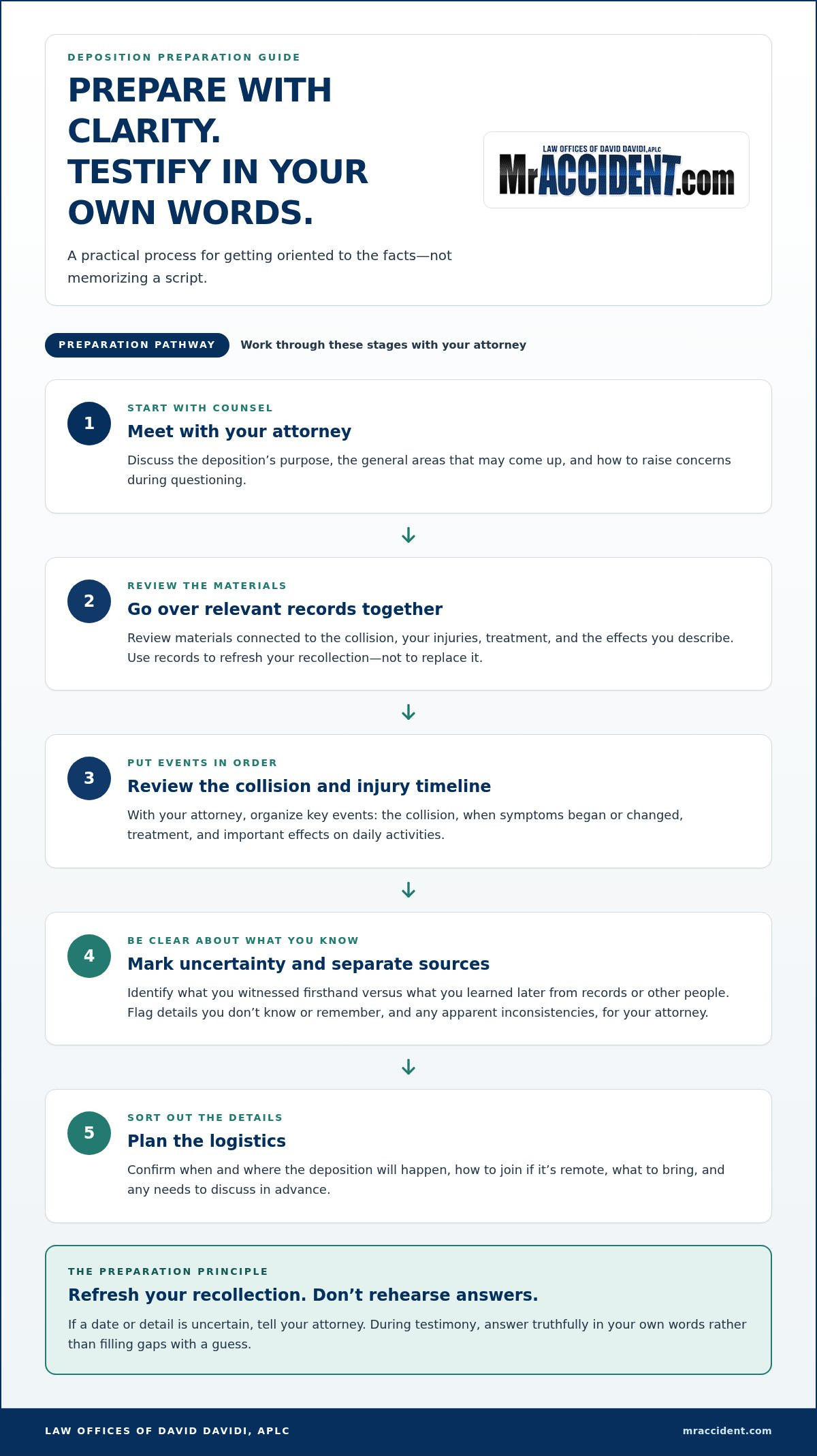
Preparation isn’t about building a perfect story. It’s about getting oriented to the facts, identifying what you genuinely remember, and knowing how to handle uncertainty. Work through these steps with your attorney. The goal is to testify in your own words, not to rehearse someone else’s version of events.
- Meet with your attorney. Discuss the purpose of the deposition, the general areas that may come up, and how to raise concerns during questioning.
- Review relevant materials together. Look over records connected to the collision, your injuries, treatment, and claimed effects. Use them to refresh your recollection, not to replace it.
- Identify what you don’t know or remember. Separate what you witnessed firsthand from details you learned later through records or other people. Flag uncertainty or apparent inconsistencies for your attorney.
- Plan the logistics. Confirm when and where the deposition will happen, how to join if it’s remote, what to bring, and any needs to discuss in advance.
Preparation improves clarity when you review relevant facts without memorizing answers. A script can make it harder to respond naturally when a question is phrased differently or raises an unexpected detail. Instead, make a short list of questions for counsel, including any point in the records that seems different from your own memory.
Review the collision and injury timeline with your attorney
Organize the key events in order: the collision, when symptoms began or changed, treatment, and important effects on daily activities. Review relevant records with your attorney so you can distinguish what they document from what you personally remember. If a date or detail is uncertain, tell your attorney and flag it for counsel rather than trying to fill the gap with a guess.
Records may help bring details to mind, but they don’t turn something you didn’t witness into firsthand knowledge. For example, you might remember where you were going but not the exact time, or recognize a treatment date in a record without recalling it independently. Discuss those distinctions openly. If an accident report or related filing is part of the case materials, your attorney can help you understand it. The California DMV explains its California DMV accident reporting requirements, including information about the SR-1 form.
Plan practical details before deposition day
Before the date arrives, confirm the location or remote connection instructions, arrival time, expected duration, and any directions from counsel. Discuss accessibility, interpretation, breaks, or other needs ahead of time so they aren’t left until the last moment. Ask which documents you’ve been instructed to bring. Don’t assume you should bring every record you have; follow your attorney’s guidance about materials for the proceeding.
If you’re unsure what to review, direct your questions to the attorney handling your matter. At the Law Offices of David Davidi, APLC, an attorney, not an assistant, oversees each case from start to finish, and calls and messages are returned within 24 hours. For California car accident case guidance, focused preparation can help you approach testimony with greater clarity.
How to Answer Car Accident Deposition Questions Clearly and Truthfully
Questions may come quickly, and it’s natural to feel pressure to respond right away. You’re allowed to take a moment. Your task isn’t to persuade the questioner or make your account sound polished. It’s to provide truthful testimony based on what you actually know and remember.
- Listen to the full question. Wait until the attorney finishes, then pause briefly to collect your thoughts.
- Answer only what was asked. Keep your response focused. Don’t add unrelated details in an effort to explain or strengthen your answer.
- Use your own words. Don’t adopt another person’s suggested version if it doesn’t match your recollection.
- Be honest about uncertainty. Don’t guess, estimate, or exaggerate to make an answer seem complete.
Careful testimony isn’t the same as rehearsed or evasive testimony. You can prepare to listen closely and answer clearly without memorizing lines. For example, if you remember that traffic was moving slowly but can’t recall the exact speed, don’t invent a number. Explain what you genuinely remember, and be clear about what you don’t.
These principles are central to how to prepare for a deposition in a car accident case, but they apply in the moment, too. A short, accurate response is usually clearer than a long explanation that introduces details the question didn’t ask for. If you realize you misunderstood a question, say so and ask for clarification rather than trying to defend an answer that doesn’t reflect what you meant.
What if you do not remember or understand a question?
If you genuinely don’t recall a detail, say that you don’t remember. Don’t fill in a date, distance, or sequence because it seems likely. If a question is unclear, ask the attorney to repeat or rephrase it. When you’re uncertain whether a detail comes from your own memory or something you learned later, explain that distinction. Discuss that kind of uncertainty with your attorney during preparation.
How to handle compound, leading, or difficult questions
A compound question can ask about several things at once. If you’re unsure what’s being asked, request clarification or ask for each part to be addressed separately. A question may also suggest an answer or use a description you don’t agree with. Don’t argue or accept a premise that isn’t accurate. Respond truthfully to the question as you understand it, and let your attorney address objections or procedural concerns.
Stay composed if a question feels repetitive or challenging. You don’t need to match the questioner’s tone or explain more than you know. Pause, listen, and answer carefully. If you’re concerned about how to respond, raise that concern with your attorney rather than trying to handle a legal objection on your own.
What to Do on Deposition Day and After Your Testimony
Deposition day can feel like a major milestone, but you don’t need to treat it like a performance. Follow the instructions your attorney gave you, take each question one at a time, and tell counsel promptly if something affects your ability to continue. The practical steps are straightforward:
- Arrive or connect as instructed. Allow time for travel or setup, and follow the directions your attorney provided for the location or remote session.
- Listen before answering. Let the question finish, pause to understand it, and speak clearly in your own words.
- Take the time you need. If you’re unsure what a question means, ask for clarification. If you need a break or have a concern, raise it with your attorney.
- Follow counsel’s guidance. Your attorney can advise you about procedure, breaks, objections, and concerns that arise during the deposition.
These habits put your preparation into practice. You don’t have to sound forceful or polished. Clear, truthful answers matter more than trying to appear confident or anticipating how the testimony might affect the case.
Staying composed during questioning
Take a breath and give yourself a moment to understand each question. If pain, fatigue, or confusion is interfering with your ability to answer carefully, tell your attorney promptly. Don’t push through silently or try to hide the problem. Your counsel can help address the concern and explain what options may be appropriate in the circumstances.
What may happen once the deposition ends?
After the questioning, your attorney can explain whether a transcript will be available for review and what process applies to your case. Any review opportunity depends on applicable rules and case-specific instructions, so don’t assume you can make changes or that every deposition follows the same procedure. Ask your counsel how to handle any possible corrections or concerns about the record.
Attorneys may use deposition testimony alongside other evidence as they continue evaluating the case and planning strategy. That doesn’t mean the deposition alone determines whether the case settles, proceeds to trial, or what it may be worth. Next steps depend on the facts, the stage of litigation, and the procedures that apply. Your attorney can explain what comes next after considering the testimony in context.
The Law Offices of David Davidi, APLC represents car accident clients throughout California. The firm has 25 years of experience and limits its caseload, with an attorney, not an assistant, overseeing each case from start to finish. If you want case-specific support after your testimony, speak with a California car accident attorney. SE HABLA ESPAÑOL.
Get California Car Accident Deposition Guidance from an Attorney
General preparation tips can help you understand the process, but your own attorney is best placed to prepare you for the facts, records, and concerns specific to your case. If you’re unsure how to prepare for a deposition in a car accident case, discuss your questions directly with the attorney overseeing your matter. They can help you understand what topics may come up, review relevant information with you, and address points you’re worried could be misunderstood.
Preparation should be grounded in your actual case, not a memorized script or assumptions about what testimony should sound like. Share uncertainties and concerns with counsel before the deposition. That gives your attorney the context to offer guidance tailored to your circumstances and explain how to handle questions that feel difficult or unclear.
What direct attorney oversight means for deposition preparation
At the Law Offices of David Davidi, APLC, an attorney, not an assistant, oversees each case from start to finish. Your case guidance and deposition preparation receive direct attorney oversight. The firm accepts a limited number of cases to provide focused attention to each client, rather than treating preparation as a one-size-fits-all step.
The firm has 25 years of experience representing car accident clients throughout California. That experience informs its approach to case guidance, but no attorney can promise a particular deposition outcome, settlement, or recovery. Your testimony is one part of a larger legal matter, and case-specific guidance should account for the evidence, your circumstances, and the stage of the case.
How to take the next step with California counsel
If you have questions about an upcoming deposition or need legal guidance after a car accident, a consultation can help you discuss your circumstances and understand possible next steps. The Law Offices of David Davidi, APLC offers a free consultation for car accident matters. You can request a free consultation to talk about your case and deposition concerns.
The firm represents clients throughout California and provides Spanish-language support. SE HABLA ESPAÑOL. The firm’s fee commitment is: No Win No Fee – we work for free, until we win!
Before your deposition, consider writing down questions to discuss with counsel, such as how the proceeding will be arranged, which materials to review, or how to raise a concern during questioning. An attorney familiar with your case can respond in context and help you understand what to expect. You deserve guidance that takes your account seriously and keeps the focus on accurate, truthful testimony.
Take the Next Step with Confidence
A deposition is one stage in a larger legal process, and your preparation should reflect the facts and needs of your own case. If a question remains after reading this guide, write it down and raise it with the attorney handling your matter. Addressing concerns early can help you feel more settled about what comes next, without trying to predict how the case will turn out.
Understanding how to prepare for a deposition in a car accident case is a useful starting point, but personal legal guidance can connect general information to your circumstances. The Law Offices of David Davidi, APLC represents car accident clients throughout California, with an attorney overseeing each case from start to finish. When you’re ready to discuss your situation, request a free consultation.
You don’t have to figure out the next step alone. With clear guidance, you can move forward with greater confidence.
Frequently Asked Questions
How long does a car accident deposition usually take?
In California, a deposition is generally limited to seven hours of testimony, with exceptions that may apply, including in certain complex or employment cases. That limit refers to testimony time, so the full appointment may take longer if there are breaks or other pauses. Ask your attorney what schedule to expect. The actual length can depend on the case, the questions, and whether an exception applies.
Can I bring notes to a car accident deposition?
Ask your attorney before bringing or referring to notes during your deposition. Notes might help you organize questions or review case details beforehand, but reading prepared answers can make your testimony sound rehearsed and may not be appropriate during questioning. If you’re concerned about forgetting an important topic, tell counsel in advance. Your attorney can explain what materials to bring and how to handle them during the proceeding.
Can a car accident deposition take place remotely in California?
Yes. California permits depositions by telephone, videoconference, or other remote electronic means, though the specific arrangements depend on the case and applicable rules. If you’ll participate remotely, confirm the platform, connection instructions, and how exhibits will be shared with your attorney beforehand. Choose a quiet, private place and test your equipment in advance so technical issues don’t distract you from understanding the questions.
What should I wear to a car accident deposition?
Choose clean, neat clothing that’s comfortable enough to wear throughout the proceeding. A deposition isn’t a trial, so you don’t need special courtroom attire, but avoid clothing that distracts from your testimony. If you’re appearing by video, wear something suitable for an in-person meeting and check how it looks on camera. If an injury or medical device affects what you can wear, discuss any concerns with your attorney.
Can I take a break during my deposition?
You can raise the need for a break with your attorney during the proceeding. Ask counsel beforehand how to handle breaks, especially if you have pain, fatigue, medication needs, or another concern that could affect your ability to focus. If you need a pause, communicate that clearly rather than struggling through questions. Your attorney can guide you on the appropriate timing and procedure for the circumstances.
What happens if I need to correct something I said in my deposition?
Tell your attorney promptly if you believe an answer was inaccurate or incomplete. A transcript review or correction process may apply, but the rules and instructions can depend on the case. Don’t try to change testimony informally or rely on memory about the exact wording. Explain what concerns you and why, then let your attorney advise you about the proper way to address the record.
Do I have to answer every question during a deposition?
Usually, you should answer questions truthfully, but ask your attorney for guidance if a question is unclear, seeks information you believe is privileged, or raises another concern. Your attorney can make objections and, in appropriate circumstances, may instruct you not to answer. Don’t refuse simply because a question feels uncomfortable. If you’re learning how to prepare for a deposition in a car accident case, discuss these concerns with counsel beforehand, whether your case is in Los Angeles, Fresno, Modesto, Bakersfield, Stockton, Tulare, Visalia, Merced, or Riverside.

Law Offices of David Davidi, APLC is a California – based Personal Injury Law Firm, our Attorney’s provide the representation for your personal injury, accident, product liability, premises liability, and other
negligence resulting in injuries. We treat all clients and cases, large or small, with hands-on care.
Practice Area
© Copyright 2026 Law Offices of David Davidi, APLC. All rights reserved.
Digital Marketing By 