
888-529-0707 call 24-7 we service throughout california
Lost Wages Claim After a Car Accident in California: How to Prove Your Income Loss

What if the hardest part of a lost wages claim after car accident california isn’t showing that you missed work, but proving how the crash affected your income? A missed paycheck can add pressure while you recover. If your hours vary, you’re self-employed, or you returned to work with restrictions, calculating the loss may take more than counting missed shifts.
You may be able to recover income losses, but a strong claim needs to connect the amount to accident-related medical restrictions and reliable records. This guide explains the difference between past lost wages and reduced future earning capacity, and which documents may help support each, from pay stubs and employer records to invoices, tax documents, and medical work restrictions.
You’ll also learn how partial work restrictions and changing income can affect your claim, and how to respond if an insurer questions your evidence or time away from work. When the records are complicated or your ability to work in the future may be affected, legal guidance can help you assess and present your California car accident claim.
Key Takeaways
- A lost wages claim after car accident california may cover past income you missed, while lasting work limits raise a separate question about future earning capacity.
- Build a clear timeline by matching missed work to medical restrictions and the income records that support your calculation.
- Variable hours or self-employment call for records that reflect how you actually earn income.
- Insurers may question whether the crash caused missed work. Conflicting dates or unsupported estimates can make your claim harder to assess.
- When income evidence or work restrictions are disputed, an attorney can review the records and address insurer questions.
What Can a Lost Wages Claim After a California Car Accident Include?
A lost wages claim after car accident california may include income you missed because crash-related injuries kept you from working. Whether a particular loss is recoverable depends on the evidence, liability, and facts of your case. A missed paycheck alone doesn’t establish the full claim. Your records should connect your injuries and work restrictions to the income you say you lost.
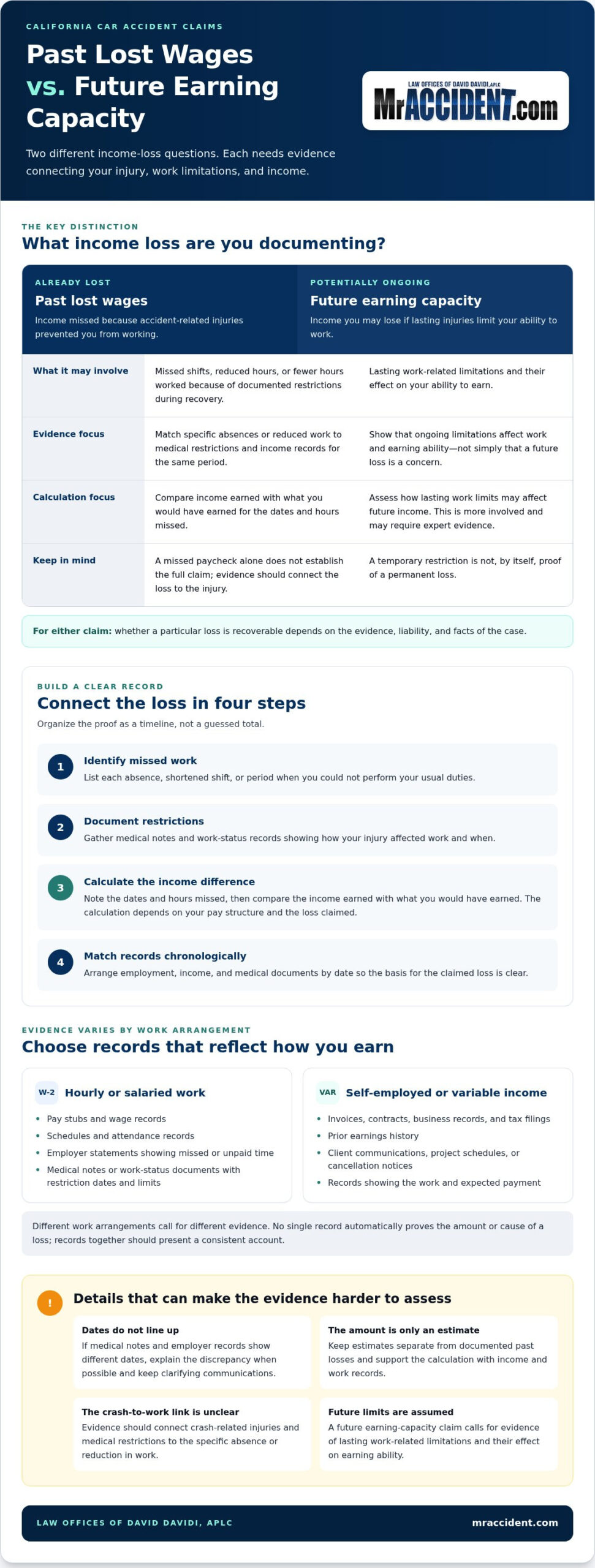
Past lost wages are income missed because accident-related injuries prevented you from working; reduced future earning capacity concerns income you may lose if lasting injuries limit your ability to work. The distinction matters. Missed shifts during recovery relate to income already lost. A claim for future loss needs evidence that ongoing limitations affect your work, not just concern that they might.
Both issues fall within personal injury law, but whether a particular loss is recoverable depends on California law and the facts. Your job title or pay arrangement doesn’t decide the issue by itself. The key is whether reliable evidence supports the loss and links it to your crash-related injury.
Which income losses may be part of a claim?
Depending on the evidence, past losses may include missed shifts or reduced hours during recovery. If you returned to work but could perform fewer hours because of documented restrictions, the resulting reduction in income may also be relevant. Future earning capacity is different: it generally requires evidence of lasting work-related limitations and their effect on your ability to earn. Don’t assume every lost benefit or potential bonus is recoverable. Those items need to be evaluated based on the facts of your case.
Does the claim depend on being a salaried employee?
No. You don’t need a conventional paycheck to document an income loss, but different work arrangements call for different evidence. Hourly workers may use schedules and wage records; salaried workers may need employer records showing missed or unpaid time. Contractors and self-employed workers may rely on contracts, invoices, or business records to show how work and income were affected. Document unpaid time off and reduced work separately where possible. Eligibility and proof depend on the facts and applicable California law.
The right calculation depends on how you earn. A steady salary, variable shifts, and project-based income each create a different picture of what was lost. Keep past income losses separate from any claim about future earning ability, then compare each with medical restrictions and supporting records. This helps distinguish a temporary interruption from evidence of a lasting reduction in earning capacity.
How Do You Calculate and Prove Lost Income After a California Crash?
A credible calculation starts with a clear timeline, not a guessed total. For a lost wages claim after car accident california, organize the evidence in this order:
- Identify missed work: List each absence, shortened shift, or period when you couldn’t perform your usual duties.
- Document restrictions: Gather medical notes and work-status records showing how your injury affected your work and when.
- Calculate the income difference: Note the dates and hours missed, then compare the income you earned with what you would have earned. The calculation depends on your pay structure and the loss claimed.
- Match the records: Arrange employment, income, and medical documents chronologically so the basis for the claimed loss is clear.
Records that connect the injury, work restrictions, and income loss make a wage-loss claim clearer and easier to evaluate. Medical records should support the connection between crash-related injuries and the specific absence or reduction in work. If a doctor’s note and employer records show different dates, explain the discrepancy when you can and keep any communications that help clarify it.
What records can support a lost wages claim?
Depending on your work arrangement, useful records may include pay stubs, tax documents, employer statements, schedules, and attendance records. Add medical notes or work-status documents showing restriction dates and limits. Sort the documents by date and keep copies of the originals. No single record automatically proves the amount or cause of a loss. Taken together, the records should present a consistent account.
How can self-employed or variable-income workers document losses?
If your income changes from week to week or project to project, gather invoices, contracts, business records, tax filings, and prior earnings history. For canceled work or reduced business activity, preserve client communications, project schedules, cancellation notices, and records showing the work and expected payment. These documents can help explain the impact, but their significance depends on the full evidence and circumstances.
Past lost income can often be assessed against a specific period and earnings records. A future earning-capacity claim is more involved because it concerns how lasting work limitations may affect future income, and it may require expert evidence. Don’t treat a temporary restriction as proof of permanent loss. Keep estimates separate from documented past losses, and seek legal guidance if the records or future impact are disputed. An attorney can review how California car accident representation may help address those questions.
What Can Insurers Dispute in a California Lost Wages Claim?
An insurer may question whether crash-related injuries caused you to miss work, whether your time away was medically supported, or whether the amount claimed matches your earnings. That review doesn’t automatically mean your claim will be denied. Clear, consistent evidence and the legal arguments applied to your case matter. In a lost wages claim after car accident california, gaps in records, conflicting dates, and estimates without supporting documents can make a loss harder to assess.
| Common dispute point | Records that may help clarify it |
|---|---|
| Whether the injury caused the absence | Medical records, work-status notes, and employer communications showing the dates and restrictions |
| How much income was missed | Pay records, schedules, attendance history, and documentation of reduced hours or unpaid time |
| Conflicting dates or changing work capacity | A dated timeline comparing medical restrictions with hours worked and earnings |
| Variable or self-employed income | Relevant invoices, contracts, business records, and prior earnings history |
California follows a pure comparative negligence rule. If you’re found partly responsible for the crash, your compensation may be reduced by your share of fault. How fault affects a wage-loss claim depends on the evidence and circumstances. An insurer’s position doesn’t determine the final outcome on liability or claim value.
Can you claim lost wages if you returned to work part-time?
Possibly. Returning part-time or performing modified duties doesn’t necessarily erase an income loss. Keep records of your actual hours, restrictions, earnings, and changes as your work capacity develops. For example, schedules can show reduced hours, while medical work-status records may explain why your schedule changed. Whether the loss is recoverable depends on the evidence and applicable law.
What if the insurer questions your records or recovery timeline?
Keep your records accurate and consistent. If you find an error, correct it promptly and preserve the corrected version and a relevant explanation. Medical restrictions and employer records may help reconcile different dates, such as a gradual return to work after an initial absence. Don’t exaggerate, conceal information, or alter documents. If the insurer disputes causation, your timeline, or variable earnings, legal guidance can help you assess the evidence and respond to the specific concern.
What Should You Do to Document a California Wage-Loss Claim?
Good records can reduce uncertainty while you focus on recovery. Follow your medical advice, document what changed at work, and keep evidence that connects your injury, work restrictions, and income. A simple dated log can help you track absences, reduced hours, and changes in job duties as they happen.
A step-by-step evidence checklist after the collision
Record each missed day or reduced shift, the duties you couldn’t perform, and any change in earnings. Notify your employer as appropriate and save messages about absences, modified duties, or work restrictions. Keep original records, not just estimates or summaries.
- Save pay statements, schedules, attendance records, and relevant tax materials.
- Keep medical notes and work-status communications showing dates and restrictions.
- For contract or self-employed work, retain relevant invoices, contracts, client messages, and business records.
- Organize pay and medical evidence by date so you can compare restrictions with hours worked and income changes.
For broader context on an injury claim, read this car accident legal representation guide. The records you gather may also help explain how a particular work absence relates to your recovery.
When should you seek legal guidance?
Consider seeking legal guidance if liability is disputed, recovery takes longer than expected, your income is complex, or medical restrictions may affect future work. An attorney can review the evidence and explain how California law may apply to your circumstances. If you’re considering representation, these questions to ask a personal injury lawyer may help you prepare.
Timing matters. California personal-injury claims generally have a two-year filing deadline from the injury date, but exceptions may apply. Claims involving a government entity can have a much shorter deadline, generally requiring a claim within six months. Deadlines depend on the parties and circumstances, so don’t assume the general period applies to your case. Confirm the current rules promptly.
If your lost wages claim after car accident california involves disputed records, future work restrictions, or questions about deadlines, get guidance on your California car accident claim. Early legal review can help you understand what evidence may matter and what steps to take next.
How Can a California Car Accident Attorney Help With Lost Wages?
A wage-loss claim can involve more than adding up missed shifts. An attorney may review who was responsible for the crash, how the injuries affected your ability to work, and whether employment and income records support the amount claimed. For a lost wages claim after car accident california, that review can help identify gaps, organize evidence, and address questions raised by an insurer. The value of legal guidance depends on the facts of the case, and no particular outcome is guaranteed.
What an attorney may review in a wage-loss claim
An attorney can compare your absence dates with medical restrictions, employer records, and income documentation. If the records don’t align, the difference may need an explanation or additional support. For example, medical notes may show when you were restricted from working, while schedules and pay records can clarify how those limits affected your hours and earnings.
If an injury may affect your ability to work in the future, counsel can assess whether the evidence supports a claim for reduced earning capacity. That may require additional documentation or expert analysis. An attorney can also address insurer questions about the connection between the crash, your work limits, and your income loss without treating a disputed claim as automatically invalid.
What to expect when discussing your case with the firm
The Law Offices of David Davidi, APLC represents California car accident injury victims, including people in Los Angeles, Fresno, Modesto, Bakersfield, Stockton, Tulare, Visalia, Merced, and Riverside. When discussing a claim, an attorney may consider liability, injury records, employment details, and how the income loss was calculated. The guidance should reflect your circumstances, since general information cannot determine what applies to an individual claim.
The firm works on a contingency-fee basis, with no upfront legal fees and fees collected only if compensation is recovered. This arrangement lets you discuss representation without paying legal fees at the outset, though it doesn’t guarantee recovery. If disputed wage records, complicated income, or lasting work restrictions make your next steps unclear, speak with the Law Offices of David Davidi, APLC about your accident claim.
Take the Next Step Toward a Clearer Wage-Loss Claim
A strong lost wages claim after car accident california connects the income you say you lost to crash-related work restrictions and reliable records. Keep past missed earnings separate from possible future earning-capacity losses, and organize medical notes alongside pay, schedule, and employer records. If you work variable hours or for yourself, use records that reflect how you actually earn.
If an insurer disputes your timeline, the cause of missed work, or the amount claimed, an attorney can review the evidence and explain how California law may apply to your circumstances. The Law Offices of David Davidi, APLC represents car accident injury victims throughout California. The firm works on a contingency-fee basis, with no upfront legal fees and fees collected only if compensation is recovered. Clients have direct access to experienced attorneys, not only support staff.
Discuss your California car accident claim with an attorney. You don’t have to sort through complicated records alone. With legal guidance, you can better understand your next steps.
Frequently Asked Questions
Can I claim lost wages after a car accident in California?
Generally, yes. An injured person may seek income losses connected to crash-related injuries, but recovery depends on the evidence, liability, and the facts. Keep records of missed work, changes in earnings, and medical restrictions that explain why you couldn’t work. The Law Offices of David Davidi, APLC represents car accident injury victims throughout California, including Los Angeles, Fresno, Modesto, Bakersfield, Stockton, Tulare, Visalia, Merced, and Riverside.
What documents do I need to prove lost wages after a car accident?
Useful evidence may include pay stubs, work schedules, employer statements, attendance records, tax materials, and medical notes describing work restrictions. For a lost wages claim after car accident california, the most useful records depend on how you earn income. Hourly employees may need shift records, while a salaried worker may need employer confirmation of unpaid time. Organize documents by date and check that they support both the missed work and the amount claimed.
Can I claim lost wages if I am self-employed in California?
Possibly. Self-employed workers can use records to show prior earnings and how an injury disrupted actual work. Relevant evidence may include tax filings, invoices, contracts, business records, and client communications about canceled projects. A dated record connecting the injury to the work affected can help explain the loss. No single document guarantees recovery. The result depends on the evidence, liability, and circumstances of the case.
Can I recover lost income if I used sick leave or vacation time?
Possibly, but how paid leave is treated depends on the circumstances, evidence, and applicable law. Save records showing which leave you used, the dates, and why you were unable to work. Don’t assume using paid time off automatically defeats an income-loss claim, or that it guarantees compensation. Because the effect can be case-specific, a California attorney can review how your leave records fit with the rest of your claim.
Can I claim lost wages if I returned to work part-time?
Yes, returning part-time doesn’t necessarily mean your income loss has ended. Reduced hours, modified duties, or lower earnings may be relevant if records connect the changes to crash-related injuries. Track your hours and pay, follow medical work restrictions, and save employer communications about accommodations or schedule changes. Whether the reduced earnings are recoverable depends on the evidence, the connection to the crash, and applicable California law.
How are future lost earnings calculated after a California car accident?
Future earning-capacity losses are evaluated differently from pay already missed. Evidence may need to show lasting work restrictions and how they affect your ability to earn, considering factors such as employment history and expected work. The calculation depends on the case, and expert analysis may be relevant. A rough estimate alone may not explain the effect of an injury, so discuss the evidence and calculation with an attorney before relying on a figure.
How long do I have to file a California car accident injury claim?
California personal injury claims generally have a two-year filing deadline from the injury date, but exceptions can apply. A claim involving a government entity may have a much shorter deadline, generally requiring a claim within six months. The relevant deadline depends on the parties and circumstances, so don’t rely on a general summary to calculate your exact date. Have a California attorney review the facts and current law promptly to protect your rights.

Law Offices of David Davidi, APLC is a California – based Personal Injury Law Firm, our Attorney’s provide the representation for your personal injury, accident, product liability, premises liability, and other
negligence resulting in injuries. We treat all clients and cases, large or small, with hands-on care.
Practice Area
© Copyright 2026 Law Offices of David Davidi, APLC. All rights reserved.
Digital Marketing By 