
888-529-0707 call 24-7 we service throughout california
Signs You Have a Good Personal Injury Lawyer for Your Claim

A lawyer’s value often becomes clearest when an insurer delays, denies a claim, or makes an offer that doesn’t reflect your injuries and losses. The signs you have a good personal injury lawyer include clear explanations, attentive communication, a careful assessment of your losses, and a practical plan for dealing with the insurer. You should understand what happens next and why, without pressure to accept a quick settlement.
It’s reasonable to want answers while coping with pain, treatment, missed work, or financial stress. A capable lawyer can assess the evidence and your claim, explain the insurer’s response, and pursue compensation for your documented losses.
This article explains how to recognize those qualities, what effective representation can look like when an insurer delays or disputes a claim, and how a lawyer can evaluate and negotiate a personal injury claim. You’ll also learn why prompt, clear communication and a thorough understanding of your injuries matter before you make decisions about settlement.
Key Takeaways
- Look for a lawyer who explains insurer delays, denials, and settlement offers clearly and outlines a practical response.
- A thorough claim evaluation considers evidence, liability, current losses, and how injuries may affect future care and earnings.
- Review a lawyer’s relevant experience and client feedback for useful details about communication, case handling, and outcomes.
- Ask who will manage your case, how updates work, and how settlement decisions are made before choosing representation.
- Use the answers to decide whether the lawyer’s approach fits your needs and gives you a clear path forward.
1. Insurance delays, denials, and low settlement offers
A capable attorney treats an insurer’s delay as a problem to document and address, not a reason to accept silence. Keep claim numbers, adjuster names, emails, and call dates in one file. If an insurer repeatedly requests paperwork, ask which specific records it needs and keep copies of what you send. A clear timeline shows what remains unresolved and helps focus follow-up.
Medical records and treatment history can answer disputes about injury severity. Gaps or delays in care may give an insurer grounds to argue that an injury was minor or had another cause. Follow prescribed treatment, attend appointments, and tell medical professionals how the accident happened. According to the Centers for Disease Control and Prevention, proper medical documentation strengthens injury claims and supports damage calculations.
Assess a low offer against documented losses before deciding whether to accept or reject it. Gather medical bills, proof of lost wages, repair records, and information about ongoing care. An attorney can evaluate whether the offer accounts for current expenses and the injury’s effects on your recovery and work. A focused response connects the evidence to your claimed losses and identifies what the offer leaves out.
An insurer may press you to settle before the full impact of an accident is clear. If you still have pain, specialist visits, or missed work, you may not yet know your likely treatment needs or total lost wages. Don’t accept a settlement just to end repeated calls. Once you accept an insurance settlement for a car accident, you generally can’t seek additional compensation later if symptoms worsen or new ones appear.
Accidents involving several drivers, commercial vehicles, or multiple insurers can complicate responsibility and communication. Each insurer may investigate a different driver or dispute who caused the crash. Preserve the police report, photographs, witness details, and messages from every adjuster. A personal injury attorney can organize this evidence, identify unanswered liability questions, and coordinate claim discussions instead of letting separate insurers shift responsibility onto someone else.
If an insurer denies your claim, request the denial and its reasons in writing. Compare them with the policy correspondence, accident evidence, and medical records. A good attorney can explain which facts matter, identify missing evidence, and negotiate when the denial or offer doesn’t reflect the documented claim. Be cautious about recorded statements, admissions of fault, or social media posts that could be used to challenge your account.
Consider hiring a personal injury lawyer when an adjuster refuses your claim, liability is unclear, injuries are serious, or an offer fails to address documented damages. In California, the deadline to bring a personal injury claim is generally two years from the injury, but exceptions may apply. Ask promptly how the deadline applies to your accident, then preserve evidence and keep records while your claim is evaluated.
2. How legal representation can help evaluate and negotiate a claim
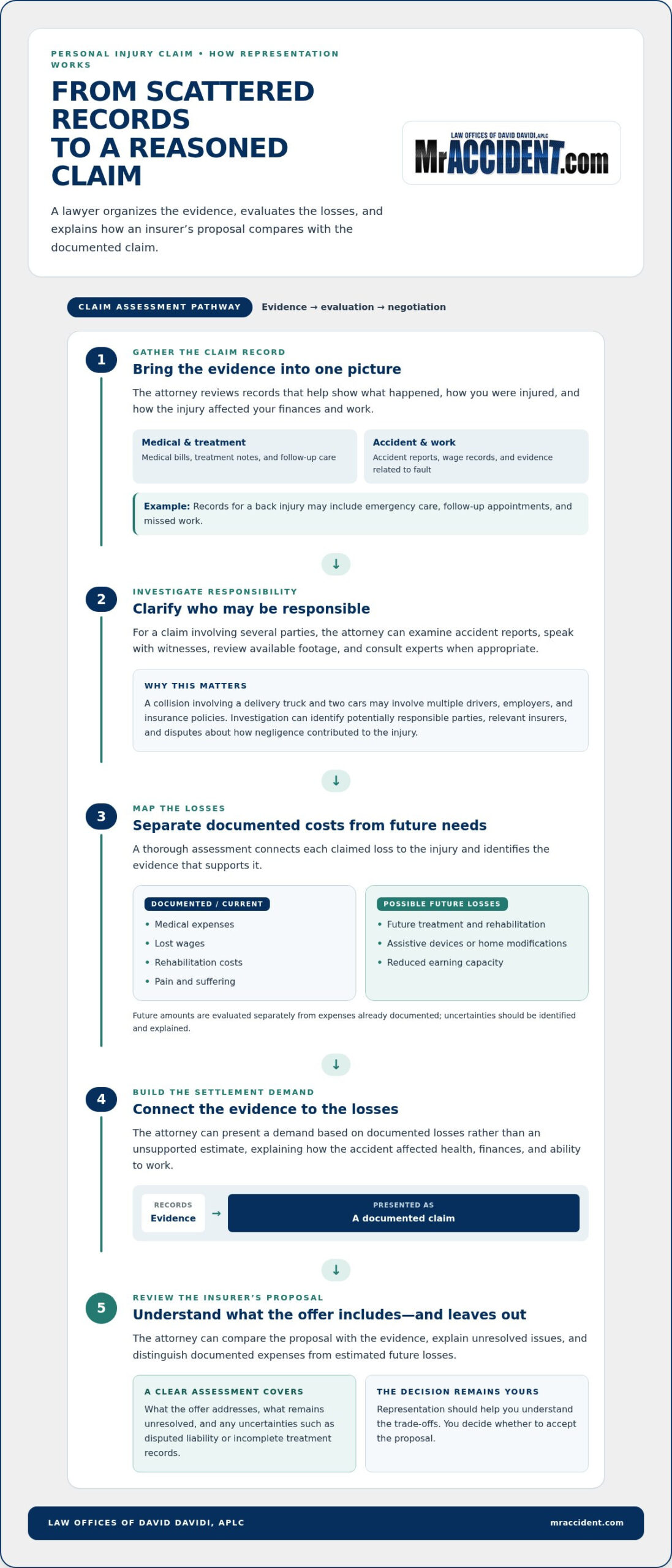
A personal injury attorney can turn scattered records into a structured claim assessment. They review medical bills, treatment notes, accident reports, wage records, and evidence related to fault. For example, a back injury may involve emergency care, follow-up appointments, and missed work. Those records help explain how the accident affected your health, finances, and ability to work. The attorney can present a settlement demand based on documented losses rather than an unsupported estimate.
Claims involving several parties need careful analysis of who may be responsible. A collision involving a delivery truck and two cars, for instance, may involve multiple drivers, employers, and insurance policies. An attorney can examine accident reports, speak with witnesses, review available footage, and consult experts when appropriate. This investigation can identify potentially responsible parties, relevant insurers, and disputes about how negligence contributed to the injury.
A thorough assessment also considers losses that haven’t yet appeared as bills. A personal injury claim may include medical expenses, lost wages, rehabilitation costs, and pain and suffering. If the injury requires continuing care, the evaluation may also consider future treatment, rehabilitation, assistive devices, home modifications, and reduced earning capacity. A useful consultation explains how each claimed loss relates to the injury and what evidence supports it.
Ask how the attorney will evaluate your claim before negotiations begin. A clear explanation distinguishes documented expenses from estimated future losses and identifies uncertainties, such as disputed liability or incomplete treatment records. The attorney can compare an insurer’s proposal with the evidence and explain what the offer includes or leaves unresolved. You decide whether to accept; representation should help you understand the trade-offs.
Contingency fee arrangements generally tie an attorney’s fee to a recovery rather than requiring hourly payments as the case proceeds. Review the written agreement carefully. It should explain how the fee is calculated and how case expenses are handled. Ask for a plain-language explanation of any terms you don’t understand before signing, so you know what the agreement says.
Lawyer licensing and professional rules vary by state. Before hiring an attorney, confirm they’re authorized to practice where your claim will be handled, and ask about experience with similar injuries and insurance disputes. For example, regional injury litigation firms such as leeson-law.com focus specifically on their state’s civil courts and legal procedures. An attorney should be able to explain how relevant local requirements may affect your case.
Good communication has practical markers: you know who handles questions, how updates arrive, and what developments will prompt a call. Ask for a clear update plan, such as a discussion after records arrive or the insurer responds. You can also review publicly available information about an attorney’s licensing status and disciplinary history through the relevant state authority.
Watch for guarantees of a particular outcome, pressure to sign before understanding the agreement, or vague answers about who will manage your claim. If a car accident caused your injuries, you can explore car accident legal representation as one way to discuss claim evaluation and negotiation.
3. What qualifications and experience should a good personal injury lawyer have?
Start by confirming that the attorney is authorized to practice where your claim will be handled. Rules for admission and professional conduct vary by state, so check the relevant state authority’s public directory. If your accident happened in one state and you live in another, ask which jurisdiction’s rules and courts may affect your claim. Among the signs you have a good personal injury lawyer are current authorization and a clear understanding of local practice.
Relevant experience should match the legal and factual issues in your case. A lawyer who handles vehicle collisions may be familiar with crash reports, driver statements, and disputed fault. A product liability claim may require examining the product, purchase records, warnings, and evidence of a defect. Dedicated practices like Roach Law illustrate how focused representation can help navigate complex negligence claims. Ask for examples of similar case types and a clear explanation of the issues involved.
Look for the ability to investigate, not just negotiate. In a multi-vehicle crash, for example, an attorney may need to examine photographs, speak with witnesses, review available camera footage, and assess each party’s actions. Ask who will gather and organize that material. A lawyer should explain how the evidence could support liability and what gaps still need attention.
Understanding how injury evidence supports claimed losses matters. For a fracture requiring rehabilitation, the attorney should be able to explain how medical records, treatment plans, missed work, and recovery limitations inform the claim’s evaluation. They shouldn’t make medical diagnoses. Instead, they should organize the records and present documented effects without overstating what the evidence shows.
Trial experience can matter even if you hope to resolve your claim through negotiation. Ask whether the attorney has handled litigation and what steps they would take if settlement discussions stall. A useful answer describes preparation, such as reviewing evidence, identifying witnesses, and assessing legal arguments. Be cautious of anyone who guarantees a result or says every case is certain to settle.
Ask who will supervise your case and who will handle routine tasks. If an assistant gathers records, find out how the attorney oversees that work. Ask who will explain a disputed liability finding or review a settlement offer with you. A clear update plan also helps you understand how important information will reach you.
Professional judgment includes explaining weaknesses honestly. If witnesses give conflicting accounts, a capable lawyer should identify the conflict and describe how it may affect liability. Ask how the attorney would address that evidence rather than relying on broad claims about past success. A specific answer shows whether they can assess your facts instead of applying a generic strategy.
Before signing, review the representation agreement and ask about unclear terms. Confirm who represents you, how decisions will be communicated, and how the attorney-client relationship may end. Other signs you have a good personal injury lawyer include consistent answers about licensing, relevant experience, evidence, and supervision. Compare those answers with the explanations you receive during your consultation.
Requirements for admission and professional conduct depend on the state, so check an attorney’s authorization with the regulator for the state handling your claim. If the accident and your residence involve different states, ask which jurisdiction’s rules and courts may apply.
4. How can you verify a personal injury lawyer’s track record and client reviews?
Start with specific case examples, not a headline result. Ask whether the lawyer handled claims involving injuries and liability issues like yours. For a rear-end collision, for example, ask how the attorney addressed disputed fault, treatment records, and lost income. A useful explanation identifies the lawyer’s role, the challenge, and how the case resolved without promising your claim will follow the same path.
Look for context behind verdicts and settlements. A recovery amount alone doesn’t show the injury’s severity, available insurance, disputed evidence, or time required to resolve a case. Ask whether the result came from a settlement or trial, what issues shaped the outcome, and whether the lawyer personally handled negotiations. Clear answers help you understand the attorney’s experience without treating someone else’s case as a prediction.
You can review court records through the relevant court system when an attorney describes trial experience. Search the attorney’s name and compare listed cases with examples discussed during your consultation. Case records can show filings and procedural steps, but not every negotiation or client experience. Ask the lawyer to explain unfamiliar terms, such as a dismissal or judgment, in the context of that case.
Read client reviews for detailed patterns, not just star ratings. Look for comments about communication, explanations of next steps, and whether clients felt heard during difficult decisions. Several reviews might mention prompt updates, while another describes confusion about who answered questions. Consider each review’s substance and date, then ask how the firm will communicate about your case.
Treat reviews as one source of information, not proof of legal skill. A positive account describes one client’s experience, but can’t establish that the same approach fits your injury claim. Compare reviews with what the lawyer tells you directly. If comments mention delays or unclear updates, ask what caused them and how the attorney keeps clients informed.
During your meeting, ask for an example of a challenging case and listen for specifics. A lawyer should explain the evidence, legal issue, and their role without revealing confidential client details. Ask about similar cases only when the answer will help you assess relevant experience. Then compare the explanation with the lawyer’s public case history and themes in client feedback.
Keep a brief comparison record after each consultation. Note the lawyer’s role in past cases, how clearly they discussed outcomes, and whether their answers matched available records. Also record how they responded to questions about communication and case strategy. Comparing these details can help you distinguish relevant experience from impressive-sounding claims.
5. What questions should you ask when choosing a personal injury attorney?
Use your consultation to learn how the attorney would approach your claim. Ask, “What facts do you need to evaluate liability and damages?” A useful answer may identify an accident report, witness accounts, medical records, and proof of missed work. If your case involves several parties, ask how the attorney would investigate each person’s role and assess the available evidence.
Clarify who will handle the work. Ask, “Who will be my main contact, and who makes important case decisions?” If an assistant gathers records, find out how the attorney supervises that work. Ask who will explain a disputed liability finding or review a settlement offer with you. You should leave knowing how to raise questions and receive meaningful updates.
Ask about experience that matches your claim, not just general case totals. “Have you handled cases involving injuries like mine or similar liability disputes?” invites a focused answer. For a pedestrian accident, the lawyer might discuss driver statements, photographs, or witness accounts. Ask what challenges arose and how the attorney addressed them, without expecting someone else’s outcome to predict yours.
Discuss strategy by asking, “What information is still needed before you can assess the claim?” and “What could complicate negotiations?” A lawyer should explain how medical documentation, liability evidence, and future losses may affect the evaluation. If treatment is ongoing, ask how claim timing and settlement decisions will be discussed. Clear reasoning is more useful than a guaranteed result.
Review the written fee agreement before signing. Ask how the attorney’s fee is calculated, how case expenses are handled, and what happens to expenses if there’s no recovery. Request plain-language explanations of unfamiliar terms. Don’t rely on a verbal summary alone; compare the answers with the agreement so you understand its terms and your responsibilities.
Ask how communication works in practice: “How will I receive updates, and what events will prompt you to contact me?” A specific answer might include updates after important records arrive or the insurer responds. Also ask how to reach the attorney with urgent questions. If the answers are vague during the consultation, clarify expectations before agreeing to representation.
Before choosing, ask, “What are the strengths and weaknesses you see so far?” An honest response should distinguish known facts from unanswered questions. Note whether the attorney listens, explains legal terms clearly, and addresses your concerns directly. If you’re ready to discuss a car accident claim, request a case discussion to learn what information may help evaluate it.
Law Offices of David Davidi, APLC: Car Accident Legal Representation
Law Offices of David Davidi, APLC represents people injured in car accidents throughout California. The firm can help assess evidence, liability, and potential damages when an insurer delays, denies a claim, or makes an offer that doesn’t account for documented losses. The firm also represents people injured in truck, motorcycle, and pedestrian accidents.
During a discussion, you can explain what happened, describe your injuries, and ask how the firm would approach your claim. Its no-win, no-fee policy means clients don’t pay attorney fees unless there’s a recovery. The firm also provides direct access to experienced attorneys, so you can discuss your concerns with legal counsel rather than only support staff.
If you’re ready to discuss a car accident claim, contact Law Offices of David Davidi, APLC.
Take the Next Step With Confidence
Your next move can be a focused conversation, not a commitment made under pressure. Before you decide, write down what you need from legal representation, such as a clear explanation of the process, direct attorney involvement, or help responding to an insurer. The signs you have a good personal injury lawyer become clearer when the lawyer’s answers address your priorities and the facts of your situation.
Bring your questions and any relevant claim correspondence to a discussion. For collision claims, Law Offices of David Davidi, APLC handles car, truck, and motorcycle accident legal representation. A conversation can help you understand how those services may relate to your circumstances and what steps could come next.
Contact Law Offices of David Davidi, APLC to discuss your claim and take a considered next step. You deserve clear answers as you decide how to move forward.
Frequently Asked Questions
What case strategy and settlement approach indicate a competent personal injury lawyer?
A competent lawyer builds a strategy around the evidence, liability issues, and documented losses, then explains how each affects settlement discussions. For example, if a witness account conflicts with the police report, the attorney should identify that issue and explain how it may shape negotiations. They should discuss an offer’s strengths and risks, prepare the claim carefully, and leave the decision to accept or reject a settlement to you.

Law Offices of David Davidi, APLC is a California – based Personal Injury Law Firm, our Attorney’s provide the representation for your personal injury, accident, product liability, premises liability, and other
negligence resulting in injuries. We treat all clients and cases, large or small, with hands-on care.
Practice Area
© Copyright 2026 Law Offices of David Davidi, APLC. All rights reserved.
Digital Marketing By 