
888-529-0707 call 24-7 we service throughout california
Wrongful Death Lawsuits for Loss of Companionship in Stockton
An adult child can generally file a wrongful death lawsuit for loss of companionship in Stockton when a parent’s death was caused by another party’s wrongful act; a parent’s age or retirement alone doesn’t remove a child’s eligibility. The claim may seek compensation for the lost love, companionship, and guidance. According to California Legislative Information, wrongful death claims generally must be filed within two years of the death.
Losing a parent can leave adult children grieving while facing difficult questions about their legal rights. You may wonder whether the law recognizes your relationship, especially if your parent was retired or no longer earned an income.
This article explains when adult children can bring a claim and how loss-of-companionship damages differ from financial losses. It also covers wrongful death claims versus survival actions, when punitive damages may be available, and how comparative fault can reduce recovery. The central questions are who may bring a claim and how evidence establishes responsibility and loss.
Key Takeaways
- Adult children may generally bring a claim after a parent’s death; retirement alone doesn’t determine eligibility. California Legislative Information says wrongful death claims generally must be filed within two years of the death.
- Separate a wrongful death claim, which addresses losses suffered by surviving family, from a survival action, which pursues certain claims belonging to the deceased person.
- Companionship damages focus on the relationship and losses such as love, society, and guidance, not only financial support.
- Punitive damages are generally unavailable in wrongful death claims, but may be pursued through a related survival action in some circumstances.
- California’s comparative fault rule can reduce damages according to the deceased person’s share of fault, rather than automatically eliminating recovery.
Can adult children file a wrongful death claim for a parent who was elderly and retired?
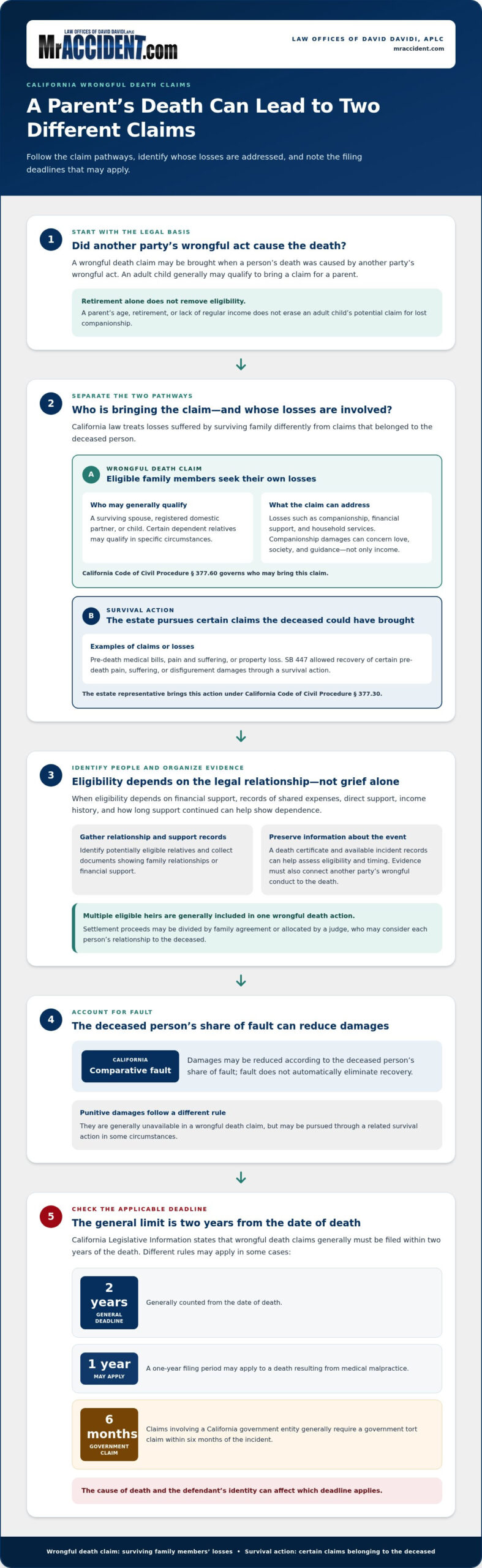
Yes. In California, adult children generally may bring a wrongful death claim for a parent. Retirement alone does not remove their standing: a parent’s age or employment status does not erase the family’s potential claim for lost companionship.
California Claimant Eligibility
California Code of Civil Procedure Section 377.60 governs who may bring a wrongful death claim. A surviving spouse or registered domestic partner and the deceased person’s children generally have standing. An adult child may therefore qualify even when the parent was elderly, retired, or no longer providing regular income.
Other relatives may qualify under specific circumstances. Parents or siblings may be eligible if the deceased had no surviving spouse, domestic partner, or children. A dependent minor may qualify if they relied on the deceased for at least 50% of financial support. Certain dependent stepchildren and putative spouses may also qualify under the stated financial-dependence criteria.
For example, an adult daughter does not lose eligibility solely because her retired father had no wages. The claim concerns legal eligibility and losses caused by the death, which may include the loss of their companionship and his guidance.
Standing to File
Standing means that California law permits someone to bring a claim; it is not based simply on who feels grief. A surviving spouse, registered domestic partner, or child generally has standing. Certain dependent relatives may also qualify, including qualifying stepchildren and a deceased person’s putative spouse.
Emotional closeness alone does not establish standing for an unmarried partner. Financial dependence may support eligibility in some cases, even without marriage or registered domestic-partner status. Records of shared expenses, direct support, income history, and how long support continued can help show that dependence.
When several eligible heirs exist, California generally requires them to be included in one wrongful death action. A child considering a claim should identify other potentially eligible relatives early. This helps coordinate the family’s claims rather than treating each person’s eligibility as a separate lawsuit.
Filing Time Limit
Deadlines matter even while a family is grieving. California Legislative Information states that the general deadline is two years from the date of death. Record that date and raise the deadline promptly when considering next steps.
A different deadline may apply to some cases. For a death resulting from medical malpractice, a one-year filing period may apply. Claims involving a California government entity generally require a government tort claim within six months of the incident. Those rules make the cause of death and the defendant’s identity important early questions.
Begin by gathering the death certificate, available incident records, and names of potentially eligible relatives. Organize documents showing family relationships or financial support, too. These materials help an attorney assess eligibility and timing while preserving information about the event that caused the death. A timely claim still needs evidence connecting another party’s wrongful conduct to the death.
Wrongful death claims versus survival actions
California law distinguishes compensation for surviving family members from claims belonging to the deceased person. Understanding which losses fit each action helps families see what a death case may address.
Claim and Survival Action Differences
A wrongful death claim addresses losses suffered by surviving family members after a death. California Code of Civil Procedure Section 377.60 governs who may bring it. The claim can seek compensation for losses such as companionship, financial support, and household services. Those damages belong to eligible family claimants, not to the deceased person’s estate.
A survival action follows a different path. Under California Code of Civil Procedure Section 377.30, the estate may pursue claims the deceased could have brought if they had lived. These may include pre-death medical bills, pain and suffering, or property loss. SB 447 allowed recovery of certain pre-death pain, suffering, or disfigurement damages through a survival action.
Eligible Claimants and Settlement Allocation
California permits multiple eligible heirs to join a single wrongful death lawsuit, and they are typically included in one action. This allows the case to address eligible family members’ losses together. A surviving spouse and children, for example, may each have distinct relationships and losses while participating in the same lawsuit.
Family members may agree on how to divide settlement proceeds, or a judge may allocate them. The judge may consider each person’s relationship to the deceased. Before resolving distribution, claimants can identify their connection and the losses they claim. This discussion concerns how proceeds are shared, not whether the death caused harm.
Family Members Bringing Claims
Eligible family members bring a wrongful death claim for their own losses. By contrast, the estate representative brings a survival action on the deceased person’s behalf. Both claims can arise in one case, but they seek different damages. Keeping them distinct clarifies who may seek compensation for companionship and who may pursue the deceased person’s pre-death losses.
Identify potential claimants and the estate representative early. For example, a child can document their relationship with the deceased while the representative gathers bills related to the final injury. This organization helps an attorney distinguish family members’ claims from estate claims and present each category clearly.
A civil wrongful death claim is separate from criminal charges. In a civil case, the preponderance-of-the-evidence standard means the evidence must show that the defendant’s negligence more likely than not caused the death. A criminal case requires proof beyond a reasonable doubt. A family may pursue a civil claim even if no criminal charges are filed.
A construction death may also support a wrongful death claim if a third party played a role. Evidence might point to a contractor, equipment maker, or another outside party. The facts determine who may be responsible. An investigation of the construction site can help distinguish a third party’s conduct from the circumstances surrounding the fatal incident.
When a fatal crash caused the loss, families can explore wrongful death legal representation to assess related claims. The key first step is sorting each loss into the correct action, then identifying who can bring it.
Loss of companionship and other non-economic damages
In California, loss of companionship covers the love, society, and guidance a person provided. A wrongful death lawsuit for loss of companionship in Stockton may seek recognition of these relationship losses alongside financial harms. Family testimony, messages, photographs, and records of shared routines or support can help document the relationship.
Companionship, Guidance, and Support
Companionship damages address the personal connection between eligible survivors and the deceased. An adult child might describe regular calls, shared holidays, or a parent’s guidance on major life decisions. These details show what the relationship meant beyond financial contributions or practical help.
California wrongful death damages may include loss of love, society, and companionship. A surviving spouse or domestic partner may also bring a loss-of-consortium claim involving lost intimacy and companionship. In a wrongful death lawsuit for loss of companionship in Stockton, evidence should describe the actual relationship, not rely only on a family member’s legal status.
Calculating Wrongful Death Damages
California does not use one fixed formula to calculate companionship damages. The relationship, the deceased person’s financial support, and household services can help establish the losses claimed. An attorney can organize these categories separately, distinguishing non-economic harm from expenses and other measurable financial losses.
Economic damages may include expected financial support, household services, funeral and burial expenses, and medical bills related to the final injury or illness. Records of regular contributions can show lost support, while household schedules or family testimony can describe tasks the deceased performed. Connect each item to a specific loss experienced by a claimant.
Evidence of Companionship Loss
Evidence can show what the relationship looked like day to day. Family members may describe shared routines, frequent communication, caregiving, or advice. Photographs, letters, messages, and calendars can help establish these patterns. People who knew the family may also provide context about the deceased’s role.
Organize evidence by person and type of loss. One child might collect messages and note shared activities, while another claimant documents financial contributions or household responsibilities. These examples connect personal testimony to concrete experiences before the death and help distinguish each survivor’s individual losses.
California sets specific caps on non-economic damages in medical malpractice cases. The cause of death therefore matters when evaluating a claim. A fatal collision and a death connected to medical care arise in different legal contexts, and different damages rules may apply.
Keep evidence of companionship separate from financial records. Personal accounts can describe relationship losses, while contribution records and bills support economic claims. This organization helps explain how the death changed family relationships and daily life, with supporting evidence for each claimed loss.
Can I sue for “punitive damages” in a wrongful death case?
Punitive damages are generally unavailable in a California wrongful death claim itself. They may be pursued through a related survival action brought on the deceased person’s behalf by the estate. Malice, oppression, or fraud may support punitive damages. A death involving drunk driving, for example, may require closer examination of the driver’s conduct.
Ordinary negligence and serious misconduct are not the same. A driver whose carelessness causes a fatal accident may expose responsible parties to wrongful death liability, but negligence alone does not establish the stated criteria for punitive damages. Evidence that a driver was intoxicated, for example, may raise a different question about the conduct involved. The evidence must connect the defendant’s actions to the death.
Fatal accidents may involve cars, trucks, motorcycles, or pedestrians. An investigation can examine how the collision happened, who was involved, and whether another party’s conduct caused the death. A family’s losses may include funeral expenses, medical bills related to the final injury, and loss of companionship. These compensatory losses are distinct from punitive damages.
A third party may also share responsibility. For example, a fatal construction accident may support a family claim if a third party played a role. In a vehicle collision, evidence may point to a driver or another responsible party. Identifying each party’s conduct helps clarify which claims may apply and whether the estate has a related survival action.
To prove negligence in a civil case, the evidence must show it is more likely than not that the defendant’s negligence caused the death. Useful steps include obtaining the police report, collecting medical records, and preserving witness statements. Accident reconstruction or forensic experts may help explain disputed events. A wrongful death attorney can assess how the records support causation and identify evidence of alleged misconduct.
Organize the available information before discussing the case. Keep incident records together, note witness names, and preserve photographs or messages related to the accident. After a fatal vehicle crash, the police report and witness accounts may help establish how the collision happened; medical records can document the final injury and treatment. Together, these materials can distinguish evidence of ordinary negligence from facts that may raise questions of malice, oppression, or fraud.
A criminal case and a civil claim follow different processes. A criminal charge alone does not decide a family’s civil claim, which uses the preponderance-of-the-evidence standard. The evidence must show it is more likely than not that negligence caused the death. Families can assess the civil evidence separately, including whether a survival action may address the deceased person’s claims.
Comparative fault in wrongful death cases
Under California’s comparative fault rule, the deceased person’s share of responsibility can reduce the damages surviving family members recover. It does not automatically eliminate a claim. If evidence shows that both a driver and the deceased contributed to a fatal collision, each person’s conduct may affect the family’s recovery.
The practical question is what the evidence shows about the events leading to the death. A police report may describe the scene, while witness statements may clarify what happened before impact. Medical records can document the fatal injury, and accident reconstruction evidence may explain disputed details. Consider each source alongside the others rather than relying on a single account.
Consider a hypothetical Stockton crash in which a driver and deceased cyclist each allegedly failed to take reasonable care. The driver’s insurer might argue that the cyclist contributed to the collision. The family can compare that position with witness accounts, scene evidence, and the collision report to identify facts that support or challenge the proposed allocation of fault.
California follows pure comparative negligence. Compensation is reduced according to the applicable share of fault rather than eliminated. If the deceased bears some responsibility, surviving family members may still pursue damages, although the recoverable amount may be lower. The key distinction is between a reduction based on the evidence and a complete bar to recovery.
Fault arguments can affect more than companionship damages. A family’s claimed losses may also include financial support, household services, and funeral and burial expenses. Records of household contributions can help establish economic losses, while evidence about the collision addresses responsibility. Keeping loss documentation separate from fault evidence helps explain both parts of the claim.
Surviving family members can take practical steps to preserve relevant evidence. Keep photographs, messages, and incident documents together. Record witness names and contact details, and note where each document came from. If a report conflicts with a witness’s account, preserve both. These steps can help a wrongful death attorney assess disputed fault without overlooking evidence that supports the family’s position.
A defendant’s claim that the deceased caused the accident is an argument, not a final finding. The evidence must be assessed as a whole, including conduct before the collision and facts that may contradict the allegation. A case review can help identify the strongest evidence and explain how comparative fault may affect recovery. Request a case review to discuss the evidence and your family’s claim.
Law Offices of David Davidi, APLC: Car Accident Legal Representation
Law Offices of David Davidi, APLC represents families pursuing wrongful death claims after fatal accidents. If a loved one died in a vehicle collision, the firm can help assess responsibility, available evidence, and the family’s losses. Its related legal representation covers car, truck, motorcycle, and pedestrian accidents.
This support may be useful when insurers dispute fault, several parties may share responsibility, or a family needs to distinguish a wrongful death claim from a survival action. The firm handles a limited number of cases, and an attorney, not an assistant, oversees each case from start to finish. No Win No Fee: the firm works for free until it wins.
If you’re ready to discuss your family’s situation, contact Law Offices of David Davidi, APLC.
Choose a Clear Next Step for Your Family
Turn what you have learned into a plan that reflects your family’s priorities. Before discussions with insurers move forward, gather relevant documents and questions, including concerns about responsibility and comparative fault. A focused conversation with an attorney can clarify which issues need attention and what information may support your family’s position.
If you are considering a wrongful death lawsuit for loss of companionship in Stockton, Law Offices of David Davidi, APLC represents families in car, truck, and motorcycle accident cases. The firm can discuss how those claims relate to your family’s circumstances and the next steps in pursuing a claim.
Contact Law Offices of David Davidi, APLC to discuss your situation. Taking one informed step at a time can help your family move forward with greater clarity.
Frequently Asked Questions
How long do wrongful death cases typically take to resolve in San Joaquin County?
Cases can resolve within a year when liability is clear and insurance carriers cooperate. Disputed fault, multiple parties, or catastrophic damages can extend resolution to two to three years or longer. For example, a contested crash involving several defendants generally requires more investigation than a clear-liability claim. The evidence, number of parties, and insurer cooperation shape the timeline; these periods describe case patterns, not a fixed schedule.
What Damages Can the Surviving Family Members Claim?
Eligible family members can seek compensation for relationship losses and financial harms connected to the death. Damages may include lost love, society, companionship, and guidance, as well as lost financial support and household services. Funeral and burial expenses and medical bills related to the final injury or illness may also be claimed. Organize invoices, support records, and details of household contributions to document these separate losses.
What is the deadline to file a wrongful death lawsuit in California?
The general deadline is two years from the date of death, according to California Legislative Information. A shorter period may apply in some cases: deaths resulting from medical malpractice may have a one-year filing period. Claims against a California government entity generally require a government tort claim within six months of the incident, according to California Legislative Information. Identify the incident type and responsible party promptly because they can affect deadlines.
Why Hire a Wrongful Death Attorney in Stockton?
A wrongful death attorney can help organize evidence, identify potentially responsible parties, assess disputed fault, and distinguish family losses from estate claims. Law Offices of David Davidi, APLC represents families in wrongful death cases throughout California, including Stockton, Los Angeles, Fresno, Modesto, Bakersfield, Tulare, Visalia, Merced, and Riverside. For a fatal collision, focused legal guidance can help a family understand the claim and prepare relevant records.
Can the Estate Also Seek Damages?
Yes. California Code of Civil Procedure Section 377.30 allows a survival action on behalf of the deceased person’s estate. It can pursue claims the deceased could have brought if they had lived, such as pre-death medical expenses, property loss, and qualifying pain and suffering. The estate’s claim is distinct from relatives’ wrongful death claims. For example, the estate can address the deceased person’s bills, while heirs pursue their own losses.
How is a wrongful death settlement divided among family members?
Family members can agree on how to divide settlement proceeds. If they cannot agree, a judge may allocate them based on each person’s relationship to the deceased. Claimants can document their individual relationships and losses before discussing distribution. Allocation is separate from deciding who qualifies to participate in the claim, so identifying all eligible relatives early can help avoid overlooking someone with a potential interest.
Who can file a wrongful death lawsuit in California?
A surviving spouse or registered domestic partner and the deceased person’s children generally have standing to file. Other relatives, including parents or siblings, may qualify in specific circumstances, such as when there is no surviving spouse, partner, or child. Certain financially dependent relatives may also qualify. For example, a dependent minor may be eligible if they relied on the deceased for at least 50% of their financial support.
What is the statute of limitations for a wrongful death lawsuit in California?
California’s general deadline for filing a wrongful death claim is two years from the date of death, according to California Legislative Information. Eligibility and timing are separate questions: being an eligible family member does not extend the filing period. A death connected to medical malpractice may involve a one-year period, while a claim against a government entity generally requires a tort claim within six months of the incident. The cause of death and the defendant’s identity matter.

Law Offices of David Davidi, APLC is a California – based Personal Injury Law Firm, our Attorney’s provide the representation for your personal injury, accident, product liability, premises liability, and other
negligence resulting in injuries. We treat all clients and cases, large or small, with hands-on care.
Practice Area
© Copyright 2026 Law Offices of David Davidi, APLC. All rights reserved.
Digital Marketing By 