
888-529-0707 call 24-7 we service throughout california
California Personal Injury Damages Caps: Which Limits Apply
California generally does not impose a ceiling on compensatory damages in most personal injury cases. Some California personal injury claims may be subject to limits on noneconomic damages. Punitive damages have no statutory cap, though legal standards govern when they may be awarded and how much.
It’s understandable to wonder whether a damages limit could reduce compensation after an injury. The key distinction is the type of claim and damages involved: most injury cases aren’t subject to a general cap, though specific exceptions may affect what a person can recover.
This article explains how California’s rules apply to compensatory and punitive damages, including medical malpractice limits and circumstances that can restrict noneconomic damages. You’ll learn which limits may matter to a claim and why identifying the type of loss is an important first step.
Key Takeaways
- Most California personal injury claims don’t face a general cap on compensatory damages, but identify the type of claim before estimating what may be recoverable.
- Medical malpractice is a key exception: AB 35 sets changing limits on noneconomic damages, so the claim’s category and timing matter.
- Punitive damages have no statutory cap, but they’re governed by separate legal standards and aren’t available in every case.
- Some circumstances can restrict noneconomic damages even when a general cap doesn’t apply. Learn which facts may affect your claim.
Are There Damage Caps in California Personal Injury Cases?
California generally has no cap on damages in most personal injury cases, though medical malpractice and certain conduct involve exceptions. Whether a California personal injury damages cap applies depends on the claim type, the loss, and any specific restriction.
Economic and Non-Economic Damages
Economic damages cover measurable financial losses, such as medical bills and lost wages. Noneconomic damages address personal harm, including pain and suffering. The distinction matters because a limit may affect one category without limiting the other. The severity of the injury and evidence of expenses help support the damages sought in a lawsuit.
California generally does not cap economic damages in medical malpractice claims. For claims against California government entities, the ordinary personal injury rule does not establish one general damages ceiling. The analysis depends on the claim’s legal basis and the damages sought, so a California personal injury damages cap cannot be assumed to govern every public-entity claim.
Restrictions on Non-Economic Damage Recovery
Some rules restrict noneconomic recovery based on a claimant’s conduct. A person injured while committing a felony cannot recover noneconomic damages for that injury. A driver convicted of DUI is also prohibited from recovering noneconomic damages. These restrictions can affect pain-and-suffering claims even when financial losses, such as medical expenses, remain a separate category.
These are specific eligibility restrictions, not a general cap on every injury claim. The circumstances of the injury and the claimant’s conduct determine whether a restriction applies.
Damage Caps by Case Type
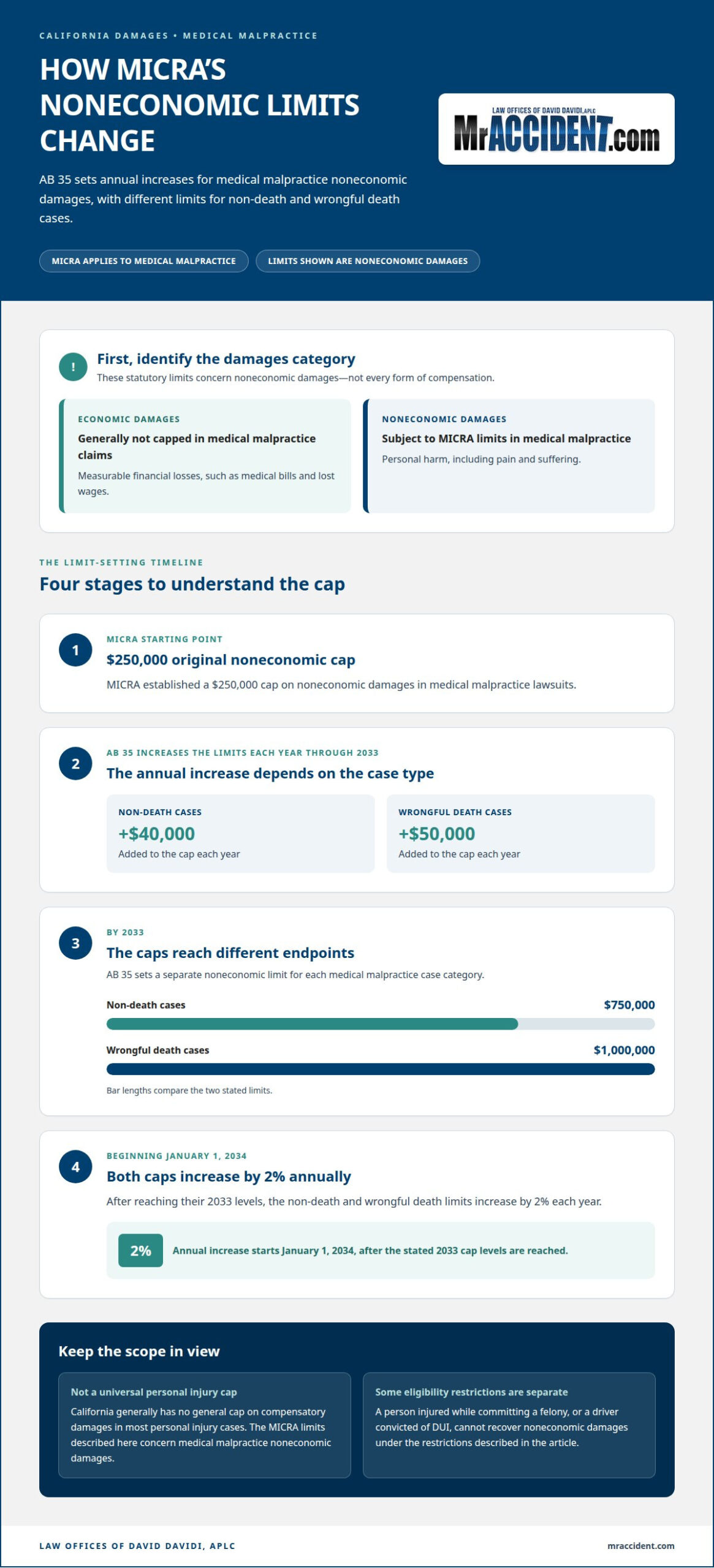
Medical malpractice claims have statutory noneconomic limits under MICRA. According to California Legislature (Legislative Information), MICRA established a $250,000 cap on non-economic damages in medical malpractice lawsuits. AB 35 increases the cap for non-death medical malpractice cases by $40,000 each year through 2033, until it reaches $750,000, according to California Legislature (Legislative Information). For wrongful death medical malpractice cases, AB 35 increases the cap by $50,000 each year through 2033, until it reaches $1,000,000, according to California Legislature (Legislative Information).
According to California Legislature (Legislative Information), after the MICRA caps reach $750,000 for non-death cases and $1,000,000 for wrongful death cases in 2033, they increase by 2% annually beginning January 1, 2034. A wrongful death claim has a noneconomic cap when it involves medical malpractice; that limit does not apply to every wrongful death claim.
California general tort and personal injury damages caps
California doesn’t set one maximum award for every ordinary personal injury lawsuit. The claim type and damages sought matter, especially when a specific statutory limit applies.
Caps in General Personal Injury Lawsuits
For a general tort claim, a damages cap is a legal ceiling on the compensation a plaintiff may recover. California has no general cap on compensatory damages in most personal injury cases, so a defendant’s liability isn’t automatically limited to a preset maximum. A cap that applies to one particular claim doesn’t necessarily apply to another.
For example, a claim for pain and suffering after an ordinary accident is not subject to a general state damages ceiling. That doesn’t establish the claim’s value: the plaintiff must still prove the harm and its connection to the defendant. The California compensation reform act, MICRA, concerns medical malpractice limits, not a universal cap for every tort lawsuit.
Constitutional Restrictions on Damage Caps
A constitutional challenge asks whether a particular damages cap can stand under constitutional protections. It doesn’t, by itself, remove a limit or set a different maximum for the plaintiff. The legal analysis must focus on the specific statute, the claim it covers, and the basis of the challenge.
In a California lawsuit, consider a cap’s constitutionality separately from whether it applies. For example, a plaintiff alleging pain and suffering in a product case should first identify the governing claim and any relevant limit. A constitutional argument is not a substitute for establishing liability or documenting losses.
Products liability claims have a distinct answer: California is listed among states without a cap on compensatory damages in those cases in the September 2025 update. That means there is no general statutory maximum identified for this claim category; the plaintiff still must support the damages sought.
If a defective product caused an injury, the claim’s facts and evidence shape the compensation request, rather than a general products-liability damages ceiling. Product liability claims can involve questions about the product, the injury, and the losses connected to it.
Are Punitive Damages Capped in California?
California has no statutory cap on punitive damages, but that doesn’t mean every personal injury lawsuit can recover them. Under California Civil Code Section 3294, punitive damages require clear and convincing evidence of wrongdoing. Their purpose is to punish sufficiently serious misconduct, not simply to repay a plaintiff’s medical bills or other losses.
The evidence standard is demanding. A plaintiff must present clear and convincing evidence to support punitive damages, rather than relying only on proof that the defendant caused an injury. Evidence of ordinary carelessness alone, for example, doesn’t establish the required level of wrongdoing. The court considers the conduct and evidence presented in the case.
Even when punitive damages are available, the amount must relate to the actual harm suffered. California law doesn’t set a fixed dollar maximum, and the award isn’t calculated simply by adding a standard amount to compensatory damages. The defendant’s conduct, the plaintiff’s losses, and the harm inform the assessment.
Some discussions describe punitive awards as potentially reaching four to five times compensatory damages. That range is not a statutory cap or a guaranteed formula. Constitutional limits require proportionality to the harm, so a court evaluates the circumstances rather than applying an automatic multiplier to every claim.
California Civil Code Section 3294 also separates punishment from compensation: compensatory damages address proven injury losses, while punitive damages address sufficiently serious misconduct. The distinction matters in a personal injury lawsuit because proving medical expenses or pain and suffering doesn’t, by itself, prove entitlement to punitive damages. A breach of contract alone does not support punitive damages under the rule described for California claims.
In short, California has no statutory punitive-damages ceiling, but the evidence threshold and constitutional proportionality still constrain an award. The defendant’s conduct, the quality of proof, and the harm are central to any punitive claim.
State laws limiting compensatory damages
Compensatory damages address a plaintiff’s losses, but state laws can limit recovery in different ways. A damages cap sets a maximum award; an eligibility rule can instead prevent recovery for a particular category of harm. That distinction matters in a California personal injury case because a limit may depend on the claim and the claimant’s circumstances.
Consider a general illustration, not a California rule: a person suffers $1 million in damages, and the state cap is $500,000. The cap leaves $500,000 unrecovered. California doesn’t use that example as a general ceiling for personal injury claims. A reader should distinguish a stated cap from other legal rules affecting compensation.
California’s Personal Responsibility Act restricts noneconomic damages in some motor vehicle cases, but its reach can extend beyond a vehicle accident. In Chude v. Jack in the Box Inc., 109 Cal. Reptr. 3d 773 (2010), an uninsured driver couldn’t recover noneconomic damages for a burn from spilled hot coffee, although the incident wasn’t a motor vehicle accident. The example shows why the facts behind a claim matter.
Eligibility restrictions and damages caps aren’t interchangeable. The Chude example concerns noneconomic losses, not a universal maximum on all compensatory damages. Economic losses, such as medical bills, remain a separate category when assessing the injury and compensation sought. The legal question is which rule applies to which loss.
Fault can also affect recovery without imposing a damages cap. California follows pure comparative fault under Li v. Yellow Cab Co.: a claimant found 20 percent at fault receives 80 percent of a $100,000 award. That reduction reflects the claimant’s share of responsibility, not a statutory ceiling on the award.
For an accident claim, separating the type of damages, eligibility restrictions, and any fault allocation clarifies how state rules affect recovery. Discuss an accident claim involving fault or limits on compensation.
Law Offices of David Davidi, APLC
Law Offices of David Davidi, APLC helps injured people understand how damages rules may affect an accident claim. If you’re unsure whether a limit applies, an attorney can assess the type of case, the losses involved, and the evidence supporting your compensation claim. The firm represents people in car, truck, motorcycle, and pedestrian accident cases.
That distinction matters because a general personal injury claim, a medical malpractice case, and a claim involving restricted noneconomic damages can follow different rules. Legal representation can help organize evidence, evaluate the claimed losses, and address questions about liability and damages during negotiations or litigation.
If an accident left you with injuries and questions about recoverable damages, contact Law Offices of David Davidi, APLC to discuss your situation.
Take the Next Step With a Clear Plan
Before making decisions about settlement or litigation, organize records showing how the injury affects your daily life and finances. Medical documentation, work records, and a clear account of ongoing limitations can help describe the losses being claimed. Understanding how the California personal injury damages cap applies is one part of the assessment, alongside liability and supporting evidence.
An attorney can connect those details to the legal categories at issue and identify questions to consider before responding to an insurer or evaluating an offer. The accident circumstances, available proof, and applicable rules all shape the next move. Your specific circumstances determine which issues deserve closer analysis.
Law Offices of David Davidi, APLC provides legal representation for car, truck, and motorcycle accident cases. If you’re weighing your options, a conversation can help clarify a practical next step without pressure or promises about the outcome.
Contact Law Offices of David Davidi, APLC to discuss your situation and move forward with greater clarity.
Frequently Asked Questions
Does California cap damages in personal injury lawsuits?
California has no general damages ceiling for most personal injury lawsuits, but claim-specific rules can affect recovery. Medical malpractice claims, for example, have limits on noneconomic damages, while certain restrictions may affect a claimant’s eligibility for those damages. To assess a particular case, identify the legal claim, separate economic from noneconomic losses, and consider whether a special rule applies to the claimant or defendant.
How are California MICRA noneconomic damage caps adjusted annually?
AB 35 increases the medical malpractice noneconomic cap by set annual amounts through 2033. The non-death cap rises by $40,000 annually until reaching $750,000; the wrongful death cap rises by $50,000 annually until reaching $1,000,000. After those caps reach their stated amounts in 2033, both increase by 2% annually beginning January 1, 2034. The applicable category depends on whether the malpractice claim involves a death.
Are punitive damages capped in California personal injury cases?
California has no statutory cap on punitive damages, but a plaintiff must meet a separate evidentiary standard. California Civil Code Section 3294 requires clear and convincing evidence of wrongdoing for punitive damages. An award must also be proportionate to the actual harm suffered. For instance, proof that a defendant caused an injury doesn’t alone establish entitlement to punitive damages; the evidence must support the required level of misconduct.

Law Offices of David Davidi, APLC is a California – based Personal Injury Law Firm, our Attorney’s provide the representation for your personal injury, accident, product liability, premises liability, and other
negligence resulting in injuries. We treat all clients and cases, large or small, with hands-on care.
Practice Area
© Copyright 2026 Law Offices of David Davidi, APLC. All rights reserved.
Digital Marketing By 